AFCI Breaker Keeps Tripping? How to Tell a Real Arc from a Nuisance Trip (2026)
An AFCI that keeps tripping is the most misread device in a house. It has exactly one output - the handle goes to the middle - and that single output stands for two situations that could hardly be more different: a fire that is quietly starting inside a wall, or a vacuum cleaner that sparks by design.
Everyone who owns one eventually reaches the same three ideas, in the same order: reset it, blame the breaker, replace it with a normal one. The first is fine. The second is sometimes right. The third is how people remove a safety device and call it a repair.
I have spent more than seven years maintaining critical-infrastructure power systems, where an intermittent trip is never written off as a flaky device - it is a signal with a cause, and the cost of ignoring it is measured in equipment, not annoyance. Houses run the same physics with less instrumentation. This is the drill I run on my own panel, in the order I run it, using about $60 of tools.
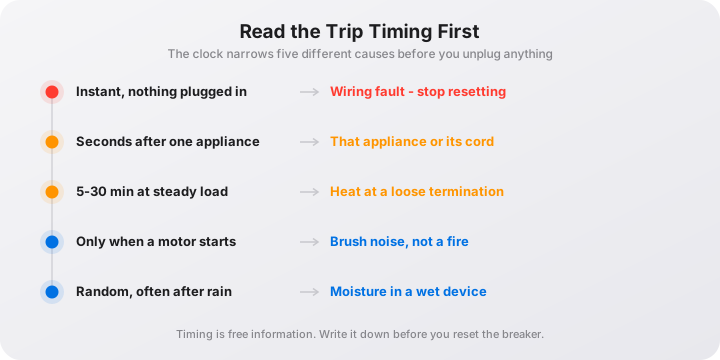
The 30-Second Answer: Read the Timing, Not the Label
Before you unplug a single thing, write down when it trips. Timing is the highest-information fact available, and it costs nothing.
| When it trips | What it usually means | Your first move |
|---|---|---|
| Instantly on reset, handle snaps hard, nothing plugged in | A wiring fault: short circuit, shared neutral, damaged cable, or a device with a dead short | Stop resetting it. This is electrician territory - repeated resets into a hard fault damage the breaker |
| Holds with everything unplugged, trips within seconds of one appliance | That appliance or its cord - the AFCI is reading real arcing or real leakage | Move the appliance to another AFCI circuit to see whether the trip follows it |
| Trips after 5 to 30 minutes at a steady load | Heat: a loose termination, a backstabbed receptacle, or an overloaded circuit | Feel the cover plates on that circuit. Warm plastic is a finding, not a feeling |
| Trips only when a motor starts or stops | Brush noise from a universal motor - a genuine arc signature that is not a fire | Test the tool on a non-AFCI circuit. If it is clean there, the wiring is not the problem |
| Trips at random, days apart, often after rain | Moisture in an outdoor box, a wet appliance, or a failing breaker | Inspect outdoor devices and anything that lives in a damp location first |
| Started right after renovation or new insulation | A nail, screw, or staple through a cable behind the drywall | Do not keep resetting. This one needs the wall opened or the cable traced |
The single most useful split is the first row versus everything below it. An AFCI that trips with nothing plugged in has already eliminated every appliance in the house. What is left is the wiring, the breaker, or a device on the circuit that is not a plug-in - a hardwired smoke detector, a disposal, a built-in microwave, a furnace blower.
What an AFCI Is Actually Listening For
A normal 60-hertz current is a clean sine wave. An arc is not clean. It is a sputtering discharge that strikes and extinguishes many times per half-cycle, and it puts a burst of high-frequency noise on the wave along with a characteristic shoulder where the current abruptly stops and restarts.
An AFCI samples the waveform thousands of times per second and looks for that shape. The listing standard is UL 1699, and the version on sale for homes today is the combination type, which has to respond to both arc geometries:
- Series arc - a break in one conductor: a loose terminal screw, a receptacle where the wire was pushed into the backstab hole and never tightened, a cord with broken strands under the jacket, a staple driven too hard. The arc carries the full load current, which is usually only a few amps - far below the 15 or 20 amps the breaker needs to trip magnetically. It can burn for months. UL 1699 requires a combination AFCI to clear a 5-amp series arc.
- Parallel arc - hot to neutral or hot to ground, typically through a nail or a chewed cable. Current is high, but the breaker’s own magnetic trip may or may not beat the arc. UL 1699 calls for clearing a 75-amp parallel arc.
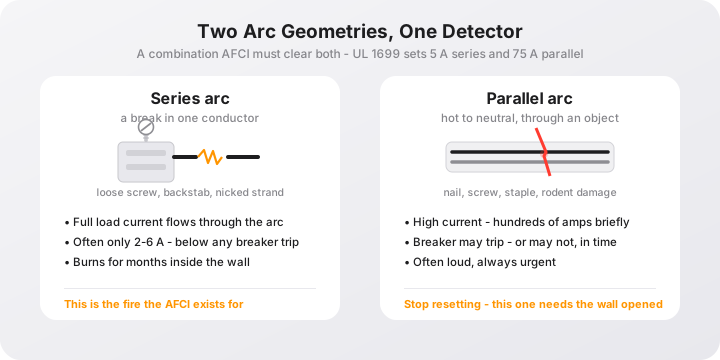
That distinction is the whole reason the device exists. A standard breaker is an overcurrent device; it is blind to a 4-amp arc at a loose screw, which is exactly the failure that burns houses down while everyone sleeps. An AFCI is a waveform device. It is the only thing in the panel looking at the shape of the current rather than its size.
Two Jobs in One Breaker, and Nobody Tells You the Second One
Here is the part that explains a large share of mysterious trips: a combination-type AFCI also contains ground-fault sensing for equipment, set somewhere around 30 to 50 milliamps depending on the listing.
Not 5 milliamps. That is the GFCI’s number, and it is chosen to protect a person. The AFCI’s ground-fault element is set higher, because its job is to catch a line-to-ground arc - a conductor leaking current into a metal box or damp wood - not to protect a hand. But 30 to 50 milliamps is still roughly a three-hundredth of what a 15-amp breaker needs.
The practical consequence: a device leaking 40 milliamps to ground will trip an AFCI and will never trip a standard breaker. A freezer with moisture in the compressor windings. A sump pump with a cracked cord jacket sitting in a wet pit. An outdoor fountain pump. A water heater element gone soft. None of these are arcs. All of them are ground faults, and the AFCI is the only device in the panel that can see them.
This matters because it changes the diagnosis. If the trip correlates with a specific appliance and the appliance is not a brushed motor, do not assume waveform noise - suspect leakage. A clamp meter that reads milliamps around the cord, or simply trying the appliance on a GFCI-protected circuit, will settle it. A GFCI that trips on an appliance is telling you the same thing the AFCI was.
Real Arc vs Nuisance Trip: The Discrimination Table
Most people want a yes-or-no answer. The honest answer is a list of observations, and the list is short enough to run in a few minutes.
| Observation | Points toward a real fault | Points toward a nuisance trip |
|---|---|---|
| Smell | Fishy, acrid, or burning-plastic odor near a device or the panel | Nothing |
| Heat | Warm cover plate, warm plug face, discolored plastic | Everything cool to the touch |
| Visual | Scorched terminal, blackened wire end, melted backstab, green corrosion | Clean terminations |
| Sound | Buzzing or sizzling at a receptacle, switch, or the panel | Only the appliance itself makes noise |
| Reproducibility | Trips with nothing plugged in, or with several different devices | Trips with exactly one appliance, every time |
| Timing | Worsening over weeks; trips after the circuit has been loaded a while | Unchanged for years; tied to one tool |
| Pattern | Correlates with rain, humidity, or a renovation | Correlates with a vacuum, saw, treadmill, or hair dryer |
If two or more cells in the left column are true, stop reading and call an electrician. That combination is what an arc fault looks like when it is winning.
Cause 1: The Shared Neutral, Which Fools More AFCIs Than Any Appliance
If I had to name the number-one reason a house full of AFCIs trips for no apparent reason, it is not a vacuum. It is a multiwire branch circuit.
Older homes - and plenty of newer ones wired by someone in a hurry - run two hot conductors, black and red, from the panel in one cable, sharing a single white neutral. Each hot is on its own single-pole breaker. Electrically this is legal and efficient: the two 120-volt legs are on opposite phases, so the neutral only carries the difference between them.
An AFCI cannot work that way. It measures the current leaving on the hot and the current returning on the neutral, both to detect arcs and to run its ground-fault sensing. On a shared neutral, the return current it sees belongs partly to a circuit it does not control. The arithmetic never balances, and the device trips - sometimes immediately, sometimes only when both circuits are loaded.
Code caught up: multiwire branch circuits have required a means to disconnect all ungrounded conductors simultaneously - a two-pole breaker or handle ties - since the 2008 cycle, and AFCI protection on one requires a two-pole AFCI. Houses wired before that, with two independent single-pole breakers on a shared neutral, are the classic source of this problem.
How to identify one at your panel: look for two single-pole breakers whose conductors leave through the same cable or conduit, with a red and a black wire and only one white. If they are joined by a handle tie or a two-pole breaker, that is a legal multiwire circuit. If they are independent, someone either wired it before the rule or ignored it.
The safety warning that goes with this: turning off one of those breakers does not make the neutral safe. The other circuit is still energized and still feeding that white wire, and it is connected to every device box on both circuits. Verify dead with a non-contact tester at the box, not at the panel label. If you are not comfortable with that sentence, this is the point to call someone.
The fixes, in order of cost: replace the two single-pole AFCI breakers with a two-pole AFCI (parts roughly $90 to $140, one slot pair), or have an electrician separate the circuits by running a dedicated neutral (a few hundred dollars depending on the run), or - the cheap and honest option - move one of the two circuits off AFCI protection onto a circuit that genuinely does not need it, if code allows. Never the option: leave one leg unprotected and pretend the problem is gone.
Cause 2: Brushed Motors Are Supposed to Arc
A vacuum cleaner, a circular saw, a miter saw, a corded drill, a blender, a sewing machine, a treadmill, an older furnace blower - all of them use universal motors with carbon brushes riding on a spinning commutator. Every brush pass is a make-and-break contact. Every make-and-break is a small arc. That is not a defect; it is how the motor works, and it is why the motor has a fan on the same shaft.
The AFCI hears real arcing. It has no way to know the arc is inside a motor housing rather than inside a wall.
The confirmation test takes two minutes and it is decisive: plug the tool into a different AFCI-protected circuit. If it trips there, the appliance is the constant and the wiring is innocent. If it is clean on the other circuit, the trip is telling you something about that specific circuit - and you are back to Causes 1, 4, or 5.
Cordless tools with brushless motors, vacuums with inverter drives, and tools with soft-start circuitry are all much friendlier to AFCIs. So is any motor plugged into a circuit that is GFCI-only, which is typical for garages, unfinished basements, and outdoor receptacles - one of the few places where older code leaves you a legitimate place to run a balky tool.
Cause 3: Power Supplies, Dimmers, and Waveform Noise
The second family of false alarms is anything that chops the sine wave into something uglier.
- Switch-mode power supplies - laptop bricks, phone chargers, LED drivers, TV power boards, network gear. They rectify and switch at tens of kilohertz, and a cheap one with a failing input capacitor produces a distinctly arc-like noise signature.
- Leading-edge dimmers - the common TRIAC dimmer chops the front of every half-cycle. A dimmer at 30 percent brightness is a waveform generator, and a marginal one on a circuit with other noise sources is a repeat offender.
- Older fluorescent ballasts and some LED retrofit tubes - magnetic ballasts especially, and any tube whose ballast is on its way out.
- Half-wave devices - some ionic hair dryers and older heating appliances rectify half the wave on purpose, which produces DC offset on the neutral that AFCI sensing is not designed to tolerate.
- UPS units - and this one is worth flagging on a backup-power site: a UPS with a modified-sine-wave inverter, or one whose input filter has failed, is a known AFCI tripper. If a home office circuit started tripping when a UPS was added, unplug the UPS and test before you suspect the house wiring. The UPS troubleshooting guide covers the device side of that conversation.
The tell for this family is that the trip appears when a device is switched on, not when it is running at steady state, and that the device works perfectly everywhere else.
Cause 4: The Faults That Deserve the Name
Before you write off every trip as nuisance, remember what field studies keep finding: a large share of AFCI trips that get called false are reporting a genuine defect. The device is cheap, impatient, and undiscriminating - but it is usually not lying.
The usual suspects, in order of how often I find them:
- Backstabbed receptacles. The wire pushed into the hole in the back of a $2 receptacle, held by a spring leaf, with maybe 30 percent of the contact area of a screw terminal. It works for fifteen years and then it does not. Pull the receptacle, look at the holes, and move the conductors to the side screws - properly torqued, which for a typical 15-amp device means roughly 12 to 14 inch-pounds, not wrist-tight.
- Worn receptacles. Even screw-terminated devices wear out. A loose contact in a 20-year-old outlet arcs every time a plug is wiggled. If a plug falls out under its own weight, replace the device - it costs $3 and takes ten minutes.
- Damaged cords. A lamp cord under a rug, a vacuum cord with a nick, an extension cord with a broken jacket at the plug. The extension cord safety guide covers how to inspect and when to cut the end off and re-terminate. This is the cheapest fix in the entire article.
- Aluminum branch wiring. The 1965-to-1973 era. Aluminum expands and contracts differently from brass, terminals loosen, and loose aluminum oxidizes into a poor conductor that heats and arcs. If your house is in that window and you have not identified the wiring, start with how to tell whether you have aluminum wiring - an AFCI on an aluminum circuit tripping repeatedly is a warning worth taking seriously.
- Rodent damage and old cloth insulation. Attic and crawlspace runs, especially in older homes, where the sheath has been chewed or the cloth has crumbled off.
- A device with a failing heating element or winding - a toaster, a space heater, a dryer. This is where the AFCI’s ground-fault element earns its keep: the leakage is tens of milliamps, invisible to everything else in the panel.
The inspection that finds most of this is unglamorous: kill the breaker, verify dead at the box, pull each receptacle on the circuit, and look for discoloration, backstabs, and loose screws. Fifteen minutes per box. A $25 non-contact tester and a $10 screwdriver do the work.
Cause 5: A Breaker That Has Simply Worn Out
AFCI breakers are electronics in a plastic shell, bolted to a busbar, in a box that heats and cools every day. They fail. When they fail they usually fail by tripping early rather than by not tripping at all - which is the safe direction, but it makes a dying breaker look exactly like a wiring problem.
Signs that point at the device rather than the circuit:
- The trips started gradually and got more frequent with no change in what is plugged in.
- The breaker is old enough to predate the current generation - early AFCIs from the late 1990s and 2000s had a genuinely poor reputation for nuisance trips, and the detection algorithms have improved substantially since.
- The breaker is not the brand listed for your panel. Breakers are listed for specific panel lines. A physically fitting breaker from another brand, or a rebuilt one of unknown origin, can sit on the busbar with poor contact and generate its own heat and noise.
- The breaker body is warm when the circuit is lightly loaded, or there is discoloration on the busbar fingers.
- A TEST button that does not trip the breaker, or a breaker that will not reset at all.
The test is substitution: buy one AFCI of the correct brand and type for your panel - $45 to $75 at retail - and swap it in. If the trips stop, the breaker was the answer. If they continue unchanged, you have eliminated the device for the price of a part you can keep as a spare, and you know the circuit is the problem.
One caution: turn the main off before pulling a breaker if you are not comfortable working near a live bus. The busbar stabs stay energized with the branch breaker off. Panel work is the one part of this article where the honest advice for most homeowners is to watch rather than do.
Cause 6: Moisture, Rodents, and the Renovation That Came Later
Three causes that do not fit the appliance-versus-wiring split:
Moisture. Covered in the ground-fault section above, but it deserves its own line because the correlation is so reliable. Trips that cluster with rain, with the first cold snap, or with a humid week are wet-device trips. Outdoor receptacles with a missing gasket, a lamp post whose splice is sitting in water, an irrigation valve box, a garage circuit that takes on water at the slab. Fix the water, not the breaker.
Rodents. Squirrels in the attic, mice in a crawlspace. They chew the sheath and sometimes the conductor, leaving a notch that arcs under load. If the trips are seasonal or started after you heard scratching, that is the lead.
The renovation that came later. A drywall screw through a cable, a staple driven through the sheath, a cable pinched behind a baseboard, insulation packed around a hot conductor. Trips that begin within weeks of construction work are almost never coincidence. This is also the case where continuing to reset the breaker is genuinely dangerous - a nail through a cable is a parallel arc waiting for the right load.
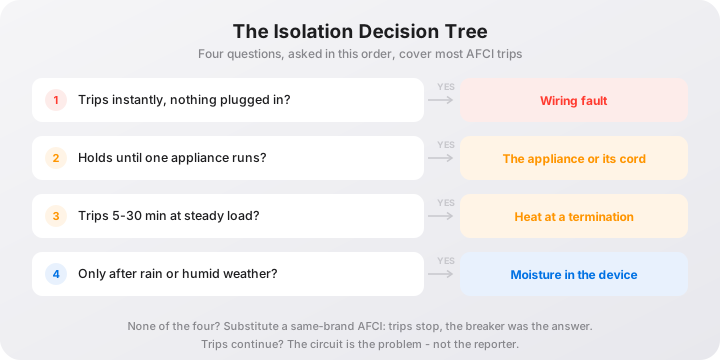
The 20-Minute Isolation Drill
This is the sequence, in order. Stop as soon as the trip reproduces, because that is your answer.
- Write down the trip pattern before you touch anything. Instant, delayed, or random; what was running; whether it rained.
- Unplug everything on the circuit - actually unplugged, not switched off. Devices on standby still draw current, and a switch-mode supply in standby is a candidate. Check the whole circuit, including the far bedroom and the garage, because half the time the tripping appliance is not the one in the room you are standing in.
- Reset once. If it trips instantly with nothing connected, stop: this is a wiring fault, and no amount of further testing by a homeowner improves it. Call an electrician and tell them exactly that sentence.
- If it holds, add devices back one at a time, starting with the ones that were running when it tripped. Bring each up to real load - a vacuum to full suction, a saw actually cutting, a heater on high.
- When one reproduces the trip, test that appliance on another AFCI circuit. Trips on both circuits: the appliance. Trips on one only: the wiring on that circuit.
- Inspect the boxes on the tripping circuit with the breaker off and dead verified: backstabs, discolored terminals, loose screws, scorched plastic, warm-to-the-touch cover plates that were warm before you killed power.
- Look at the panel. Is this a shared neutral? Is the breaker the right brand? Is the busbar finger discolored? Is the breaker body hot with a light load?
- Substitute a known-good AFCI of the same brand if the trip survived steps 1 through 7 and nothing else explains it.
If the drill produces nothing after 20 minutes and the trips are more than occasional, the next honest step is an electrician with a circuit tracer and a thermal camera - not a different breaker, and not a bigger one. A circuit breaker finder and a non-contact voltage tester are the two tools that make the drill fast instead of guesswork, and a receptacle tester is worth having for step 6. If you are going to swap the breaker yourself, buy an AFCI breaker in the brand your panel is listed for - the panel brand, not the cheapest listing.
Four Findings That Mean Stop
Some combinations are not a puzzle to solve at leisure:
- A burning or fishy smell at a device, a cord, or the panel. Kill the circuit at the panel and leave it off.
- A warm or discolored cover plate, plug face, or breaker body. Heat at a termination is the failure that precedes the fire, not a symptom that follows it.
- An AFCI that trips instantly with nothing plugged in, especially after new construction. Parallel fault, live and waiting.
- Any arcing sound - buzzing, sizzling, ticking - at a receptacle, switch, or the panel. Arc faults are audible before they are visible.
In all four cases, the correct sequence is: stop using the circuit, do not reset it again, call an electrician today. If the panel itself is hot, smells, or is buzzing, call the utility or an emergency electrician and do not touch the panel cover.
What It Costs to Fix
Prices below are illustrative 2026 US figures - parts from retail, labor as a service-call range that varies a lot by region and access. The point of the table is not the exact dollar but the shape: the cheap fixes are the ones that solve most trips.
| Fix | Parts | Installed | When it is the right answer |
|---|---|---|---|
| Replace a worn receptacle | $3-8 | $150-300 (service minimum, typical) | Loose contacts, backstabs, discolored device |
| Re-terminate on screw terminals | $0 | DIY, 15 min per box | Backstabbed connections found during inspection |
| New AFCI breaker, same brand | $45-75 | $150-350 | Trips follow the breaker; TEST button fails |
| Two-pole AFCI for a shared neutral | $90-140 | $200-400 | Legal but unprotected multiwire circuit |
| Separate a shared neutral (new run) | $20-60 in wire | $300-700 | Two circuits that must both stay AFCI protected |
| Dual-function (AFCI + GFCI) breaker | $60-95 | $150-350 | Circuit needs both protections in one slot |
| Trace and repair a damaged cable | varies | $250-800 | Nail, staple, rodent, or renovation damage |
| Replace an outdoor device and seal it | $15-40 | $150-300 | Trips correlate with rain or humidity |
For context on what a panel-level job costs when several of these arrive at once, the panel upgrade cost breakdown covers the difference between swapping a breaker and replacing a panel - and why the second is quoted far more often than it is needed.
The Two Fixes That Are Never Fixes
Replacing the AFCI with a standard breaker. This is the most common and most dangerous answer. It removes the only device in the panel that can see a series arc, and it leaves the actual fault in the wall, where it continues to heat. It also creates a disclosure problem at resale and a coverage question with an insurer after a fire. If a licensed electrician proposes this, ask them to put the reasoning in writing.
Putting in a bigger breaker. A 20-amp breaker on 14-gauge wire is a fire waiting for a load. The AFCI tripping is not an indication that the breaker is too small; it is an indication that something downstream is arcing. Upsizing treats the messenger.
There is exactly one legitimate way to get a stubborn AFCI circuit to stop tripping, and it is the unglamorous one: find what the device is reporting and fix that. Sometimes the answer is a $3 receptacle. Sometimes it is a $50 breaker. Sometimes it is a 40-milliamp leak in a freezer that would otherwise have gone unnoticed until it was a shock hazard.
The Bottom Line
An AFCI is the only device in your panel that is not measuring how much current is flowing but what shape it is in - and it has a second, quieter job watching for ground faults at tens of milliamps. That is why it trips on things a standard breaker cannot see, and why its trips are so often dismissed as false.
Read the timing first. Nothing plugged in means wiring, and wiring means stop. One appliance means the appliance, and one test on another circuit proves it. Minutes of delay at load means heat, and heat means a termination that needs a screwdriver. Rain means water. And a breaker that has quietly aged out is a $50 question you can answer by substitution.
If you take one thing from this: a tripping AFCI has never once been the problem. It has only ever been the report. GFCI and AFCI protect against different hazards and neither one is optional decoration, while a plain breaker that keeps tripping without a TEST button is a different drill entirely - that one is in the circuit breaker tripping guide.
Frequently Asked Questions
Why does my AFCI breaker trip only when I vacuum?
Because a vacuum cleaner is a brushed motor, and brushes spark by design. Every time a brush passes a commutator segment it makes and breaks contact, producing broadband high-frequency noise on the current waveform - which is the same signature an arc fault detector is built to find. The AFCI is not malfunctioning. It is hearing real arcing, just not dangerous arcing. Confirm it in two minutes: plug the vacuum into a different AFCI-protected circuit. If it trips there too, the appliance is the constant and the wiring is fine. Practical fixes are to run that tool on a circuit without AFCI protection (garage or workshop circuits are usually GFCI only), use a vacuum with a soft-start or inverter drive, or accept a nuisance trip now and then. What you should not do is swap in a standard breaker.
Can I replace an AFCI breaker with a regular breaker to stop the tripping?
That is not a repair, it is disabling a safety device - and it is the single most common wrong answer to this problem. AFCI protection has been required in bedrooms since the 1999 NEC and now covers essentially every 120-volt branch circuit in a dwelling. Remove it and you have removed the only device in the house that detects a series arc: the loose terminal or nicked conductor that sits at a few amps, too low to trip a 20-amp breaker, hot enough over months to ignite the framing around it. Insurance and home inspection both care about this. If the trips are genuinely nuisance, the fix is finding the noise source or correcting the wiring - never removing the protection.
How do I know if my circuit has a shared neutral?
Look at the panel. A multiwire branch circuit has two hot conductors - usually black and red - leaving in the same cable or conduit and sharing one white neutral back to the panel. If you see two single-pole breakers feeding conductors that travel together, and only one white wire in that cable, you have one. Code has required the two breakers to be tied together with a handle tie since 2008, so a legal installation shows a two-pole breaker or two breakers joined by a bar. The safety warning matters more than the identification: turning off one of those two breakers does not de-energize the shared neutral, because the other circuit is still feeding it. Verify dead at the box with a non-contact tester before touching anything, and treat any shared-neutral circuit as electrician work when an AFCI is involved.
Why does my AFCI trip in damp or rainy weather?
Because a combination-type AFCI contains ground-fault sensing for equipment, set somewhere around 30 to 50 milliamps - roughly six to ten times the 5 milliamp threshold of a person-protecting GFCI, but far below the 15 or 20 amps a thermal-magnetic breaker needs. Water finding its way into an outdoor receptacle, a lamp post, an irrigation valve, or a garage circuit gives it exactly that: tens of milliamps leaking to ground through wet soil or a damp box. The same trip shows up from an appliance whose heating element or compressor winding has moisture in it - a freezer, a sump pump, an outdoor fountain. The pattern is the tell: trips that cluster with rain, dew, or a humid week are a moisture problem, not an arc problem, and the fix is sealing, replacing, or re-routing the wet device.
Do plug-in AFCI testers actually work?
No, and this is worth knowing before you spend the money. A plug-in device cannot create a real arc, so it cannot test an arc fault detector. What those tools test is a GFCI, by leaking a calibrated current to ground. The only listed test for an AFCI is the TEST button on the breaker or receptacle itself, which injects a simulated arc signature into the detection circuit. A tester that reports a pass or fail on an AFCI is reporting on something it cannot measure. Use the TEST button monthly, and if you want to know whether a breaker is healthy, substitute a known-good AFCI of the same brand and see whether the trips follow the breaker or stay with the circuit.