Aluminum Wiring: How to Tell If Your House Has It (and What to Do)
I have walked into a lot of houses where the buyer’s home inspector wrote one sentence that derailed the entire sale: “Aluminum branch circuit wiring observed — recommend evaluation by a licensed electrician.” Two words on a report, and suddenly the seller is staring at a repair quote, the buyer is rethinking the mortgage, and everyone is googling whether the house is a death trap.
The honest answer is more measured than the panic suggests. Aluminum wiring is a real, documented fire hazard — the U.S. Consumer Product Safety Commission has investigated it since the 1970s — but it is a specific hazard, in a specific era of construction, and it has two well-established fixes. The problem is never the metal itself. It is the connection.
Here is everything I tell a homeowner when they ask me about aluminum wiring, in the order I tell it.
The Short Version
| Your situation | What it means | What to do |
|---|---|---|
| House built before 1965 | Almost certainly copper | Nothing. Verify at one outlet if you are unsure. |
| House built 1965–1973 | Possible aluminum branch wiring | Inspect the cable and a few devices (below). |
| House built after 1973 | Small branch circuits are copper again | Nothing for branch circuits; large feeders may still be aluminum and that is fine. |
| Aluminum confirmed on 15A/20A circuits | Real, documented fire risk | Get a licensed electrician to remediate (COPALUM or AlumiConn). |
| Aluminum only on large feeders (8 AWG+) | Normal and safe (modern alloy) | Leave it alone. |
If your house falls in the 1965–1973 window, keep reading. If it does not, you can almost certainly skip the rest — but the identification steps below are worth knowing anyway, because “almost certainly” is not “certainly,” and I have been surprised by houses that were built in 1975 and still had leftover aluminum spools in the walls.
Why Aluminum Wiring Exists at All
In the mid-1960s, the price of copper spiked — sharply enough that builders went looking for a cheaper conductor. Aluminum was abundant, cheaper, and, on paper, a perfectly good electrical conductor. So between roughly 1965 and 1973, somewhere around two million American homes were wired with aluminum for the small 15- and 20-amp branch circuits — the wires that run to your outlets, switches, and light fixtures.
This was not a back-alley shortcut. It was a widespread, code-permitted practice at the time, and the manufacturers genuinely believed it would work. The problem was not discovered by conspiracy; it was discovered by firefighters and forensic investigators who kept finding the same failure mode: a connection at an outlet or switch that had loosened, heated up, and eventually arced.
The era ended as abruptly as it began. By the early-to-mid 1970s, the industry had moved back to copper for branch circuits, and the aluminum that remained was reformulated into a harder, safer alloy (the AA-8000 series) and reserved for the larger conductors where it performs well. But the two million homes were already wired.
Why It Is a Fire Hazard: The Physics of a Loosening Connection
Everything dangerous about aluminum wiring traces back to three material properties, and all three point at the same place — the screw terminal or splice where one wire meets another.
1. Aluminum expands and contracts more than copper. Aluminum’s thermal expansion is roughly 40% higher than copper’s. Every time a circuit carries load, the wire warms and grows; every time it cools, it shrinks. Over hundreds or thousands of heating and cooling cycles, that repeated movement literally works a connection loose — think of it as thermal ratcheting. A connection that was tight the day it was installed is a little less tight a decade later.
2. Aluminum oxidizes almost instantly. Bare aluminum forms a thin oxide layer the moment it meets air, and aluminum oxide is a poor conductor — it acts more like an insulator than a metal. On copper, the oxide that forms is still reasonably conductive and the problem is minor. On aluminum, the oxide layer adds resistance at the very point where you least want it: the connection.
3. Aluminum “creeps” under pressure. Under sustained pressure from a screw terminal, aluminum deforms permanently over time. The screw that felt snug when torqued down gradually loses its clamping force as the metal yields beneath it. This is why simply re-tightening an old aluminum connection is not a permanent fix — it will loosen again.
Add those three together and you get the failure sequence: a connection loosens, its resistance rises, current flowing through that resistance generates heat, the heat accelerates the oxidation and loosening, and eventually the connection runs hot enough to char the surrounding insulation or arc. The scary part is that this happens inside the outlet box, behind the wall plate, where you cannot see it until it is already a problem.
How to Tell If Your House Has Aluminum Wiring
This is the part anyone can do, and it does not require opening anything dangerous. Here is the method, in order of least to most invasive.
Step 1: Check the year the house was built. If it is 1965–1973, you are in the prime window. If it is outside that window, you are probably fine, but the next steps confirm it.
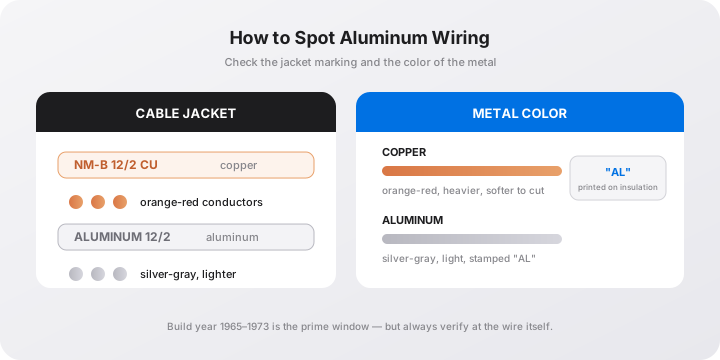
Step 2: Look at the cable jacket. In an unfinished basement, attic, or garage where the wiring is exposed, read the printing on the outer cable sheath. Aluminum cable will be marked with AL, ALUM, or ALUMINUM. Copper cable is marked CU or NM-B with no “AL” anywhere. This single step answers the question for most houses in seconds.
Step 3: Look at the wire itself. Where a wire is exposed — at the panel, or inside a junction box — check the color of the metal. Copper is orange-red. Aluminum is silver-gray and noticeably lighter, and it will feel softer and lighter in weight than copper of the same gauge. The individual aluminum conductors are also stamped AL on the insulation every foot or two.
Step 4: Check a device (power OFF). To be truly certain, shut off the breaker to one outlet, verify it is dead with a non-contact voltage tester (do not skip this step — assume every wire is live until a tester says otherwise), pull the outlet out of the box, and look at the conductors attached to it. Silver-gray wire on the screw terminals is your answer.
If you are not comfortable with step 4, stop at step 3 — the cable jacket and wire color are usually conclusive on their own. And if you would rather not open anything at all, a licensed electrician can answer the question in one service call, often while they are already there for something else like a whole-house surge protector install.
Is All Aluminum Wiring Dangerous?
No, and flattening the whole subject into “aluminum = bad” causes a lot of needless fear. The risk is very specifically about the small branch-circuit conductors — the 12 AWG and 10 AWG wire on 15- and 20-amp circuits — installed with the older, softer 1350-series alloy during that 1965–1973 window.
Two things are not a problem:
- Modern AA-8000 series aluminum, used for larger conductors (8 AWG and up) — service-entrance cable, feeder runs to sub-panels, and big appliance circuits like ranges and ovens. This alloy is harder, does not creep the same way, and has been shown to make reliable connections. It is still installed today, it is still code-compliant, and utilities have used aluminum for service drops for decades without issue.
- Copper-clad aluminum, sometimes marked “copper-clad” or “Cu-clad Al,” which is an aluminum core wrapped in copper. It is more forgiving than solid aluminum, though connections to it still benefit from the same attention.
So when you hear “this house has aluminum wiring,” the only question that matters is: which aluminum, and where? Small-gauge branch circuits from the bad era are the hazard. Everything else is usually a non-issue.
What to Do: The Two Approved Repairs
If you do have aluminum branch-circuit wiring, the fix is not “replace all the wire.” Full rewiring is the nuclear option — effective but brutally expensive, and almost never necessary. The standard, accepted approach is pigtailing: splicing a short copper wire onto the end of each aluminum conductor, so that the aluminum only ever meets copper inside a purpose-built, listed connector, and the copper pigtail is what connects to the outlet or switch.
There are two connectors recognized as permanent repairs:
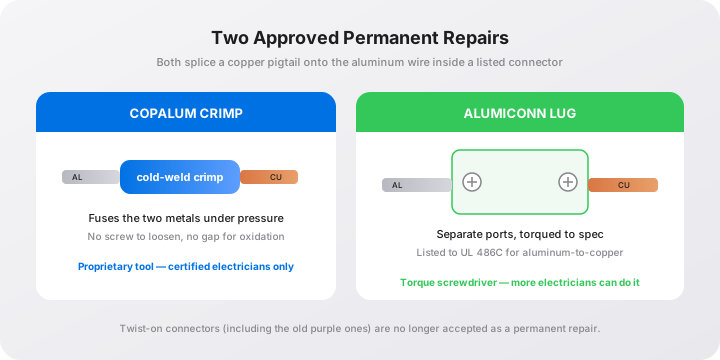
COPALUM (cold-pressure weld). A copper pigtail and the aluminum conductor are crimped together under enormous pressure with a specialized tool, cold-welding the two metals into one mass that cannot loosen because there is no screw to back off and no gap for oxidation to form. It is considered the gold standard. The catch: it requires a proprietary crimp tool that only certified electricians carry, so this is strictly a professional job.
AlumiConn (set-screw lug). The aluminum wire and copper pigtail are inserted into separate ports of a small lug and clamped down with a set screw tightened to a specific torque with a torque screwdriver. It is listed to the UL 486C standard for aluminum-to-copper connections and is the more accessible option — it does not require the special crimp tool, so more electricians can perform it.
| COPALUM | AlumiConn | |
|---|---|---|
| How it works | Cold-weld crimp fuses copper pigtail to aluminum | Set-screw lug, torqued to spec |
| Tool required | Proprietary crimp tool (certified electricians only) | Torque screwdriver |
| Permanence | Permanent, no mechanical joint to loosen | Permanent when torqued correctly |
| Typical cost per connection (illustrative) | ~$35–60 | ~$25–45 |
| Availability | Limited to certified installers | Widely available |
Both methods require the electrician to work through every outlet, switch, light fixture, and junction box in the house — which is why the labor dominates the cost even though the connectors themselves are inexpensive.
What NOT to do
- Do not use twist-on wire nuts to splice aluminum to copper. The classic purple twist-on connectors were used for this in the past, but they are no longer recognized as a permanent repair — the metals still expand and contract at different rates inside the connector, and the joint fails the same way. Treat them as a band-aid, not a fix.
- Do not just swap in CO/ALR devices and call it done. CO/ALR-rated outlets and switches (rated for aluminum wire) are a real improvement and a legitimate part of some repairs, but they do not address every splice and junction in the circuit, so they are not a complete fix on their own.
- Do not re-tighten the screws and stop there. As the “creep” section explained, an aluminum connection that has loosened will loosen again. Re-tightening is maintenance, not remediation.
What It Costs
Full remediation is priced by the connection, not by the square foot. A typical three-bedroom home has somewhere in the neighborhood of 150 to 250 connection points — every outlet, switch, ceiling light, and junction box counts. Multiply that by the per-connection rate and you get the range.
| Scenario | Connections | Illustrative total cost |
|---|---|---|
| Small home, minimal devices | ~100–150 | $2,000–$4,000 |
| Typical 3-bedroom home | ~150–250 | $3,000–$6,000 |
| Large home, many devices | 250+ | $5,000–$8,000+ |
These are illustrative ranges, not quotes — labor rates, wall access, and the number of devices all move the number. The connectors themselves are a few dollars each; you are mostly paying for a licensed electrician to methodically open, repair, and re-close several hundred boxes. It is tedious, skilled work, and it is priced accordingly.
Two cost-saving realities worth knowing: first, remediation does not usually require opening walls — the work happens inside the existing boxes, so there is no drywall repair to pay for. Second, if the electrician is opening the panel anyway, it is often the cheapest possible time to add a whole-house surge protector or upgrade a worn surge protector setup, since the mobilization cost is already sunk.
Insurance and Resale: The Part That Actually Costs You Now
The fire risk is real but slow-burning. The financial consequences of aluminum wiring hit you faster, through two channels.
Insurance. Underwriters have been aware of aluminum branch wiring since the 1970s, and some carriers will simply decline to write a new homeowners policy on a house that still has it — or will write it at a higher premium with a note that the condition must be remediated. Others are fine once you produce a certificate from a licensed electrician confirming the connections have been repaired. The practical advice: do the remediation before you shop for insurance or switch carriers, and keep the paperwork.
Resale. In most jurisdictions, aluminum wiring is a material fact that must be disclosed to a buyer. It will show up on the buyer’s home inspection regardless. Unremediated, it is a negotiation weapon against you; remediated, with the certificate in hand, it becomes a non-issue you can hand over with the rest of the house documents.
Both problems have the same solution: a proper repair and a piece of paper proving it.
Safety Checks You Can Do Yourself
You should not attempt the repair yourself — the COPALUM tool is proprietary and the AlumiConn work belongs in the hands of someone who torques connections for a living. But there are two genuinely useful checks you can run to gauge the condition of your wiring before you call anyone.
Scan for hot spots. A loose or oxidizing connection runs warmer than it should. An inexpensive infrared thermometer pointed at each outlet and switch plate will reveal a plate that is running noticeably warmer than its neighbors — that is the earliest warning sign of a degrading connection. A thermal camera does the same job across the whole wall at once, but the point-and-shoot thermometer gets you 90% of the value for a fraction of the price.
Verify circuits are dead before touching anything. If you do open a box to look at the wire, a non-contact voltage tester is non-negotiable. It is a $10–20 tool that tells you — before your fingers get anywhere near a conductor — whether the circuit is actually dead. Treat “I flipped the right breaker” as a hypothesis, not a fact.
Neither tool fixes anything, but together they tell you whether you have a calm, stable wiring situation or one that is actively heating up — and that determines how urgently you call the electrician.
The Bottom Line
Aluminum wiring is not a death sentence, and it is not a non-issue. It is a known failure mode with a known fix, and the fix is a lot cheaper than rewiring. The playbook is simple:
- Confirm you have it — check the build year, read the cable jacket, and look at the wire color. Five minutes, no tools beyond a flashlight.
- If it is on the small 15A/20A branch circuits, get a licensed electrician to pigtail it with COPALUM or AlumiConn. Keep the certificate.
- If it is only on large feeders, breathe easy — that is normal, modern, and safe.
- Handle the insurance and resale paperwork while you are at it, because that is where unremediated aluminum wiring costs you money even if it never sparks.
For most homeowners I meet, the whole thing resolves in one electrician visit and a few thousand dollars — which, measured against the alternative of a connection slowly cooking behind a bedroom wall, is the cheapest peace of mind in the house. And if your deeper worry is the broader question of whether your home’s electrical system is ready for the next outage or storm, start with my power outage preparation guide.
Frequently Asked Questions
How do I tell if my house has aluminum wiring?
Start with the year it was built: the prime window is 1965 to 1973. Then look at the cable itself. The outer jacket will be printed with AL, ALUM, or ALUMINUM (copper cable says CU or has no AL marking), and the individual conductors are stamped AL every few feet on the insulation. Aluminum wire is silver-gray and noticeably lighter than copper, which is orange-red. Check inside the electrical panel and, with the power off, at a sample outlet or switch.
Is all aluminum wiring dangerous?
No — and this is the most misunderstood part. The fire risk is specific to 15- and 20-amp branch-circuit conductors (12 and 10 AWG) made of an older, soft alloy installed from the mid-1960s to the early 1970s. Modern AA-8000 series aluminum, used for larger feeders and service-entrance cable (8 AWG and up), is safe and still installed today. If the aluminum in your walls is on the small branch circuits, that is what needs attention.
What is the proper way to fix aluminum wiring?
There are two recognized permanent repairs. COPALUM is a cold-weld crimp that permanently bonds a copper pigtail to each aluminum conductor using a special tool, applied by a certified electrician. AlumiConn is a set-screw lug connector that joins the aluminum wire to a copper pigtail under a torque screwdriver. Both are listed for aluminum-to-copper connections. Twist-on connectors (including the old purple ones) are no longer accepted as a permanent repair.
How much does aluminum wiring remediation cost?
As an order-of-magnitude figure, expect roughly $25 to $60 per connection point depending on the method and your region. A three-bedroom home typically has 150 to 250 connection points (outlets, switches, light fixtures, and junction boxes), which puts full remediation in the range of $2,000 to $6,000 for the whole house. These are illustrative ranges, not quotes — the real number depends on access, the number of devices, and local labor rates.
Does aluminum wiring affect home insurance or resale?
Yes, both. Some insurers will decline a new policy on a home with unremediated aluminum branch wiring, or will charge a higher premium until you provide proof of a certified repair. On resale, aluminum wiring is a material fact you must disclose in most jurisdictions. Remediation plus a certificate from a licensed electrician is usually what satisfies an underwriter and smooths a sale.