Best Surge Protector for RV: EMS vs Surge-Only, 30A vs 50A (2026)
You are about to plug a $60,000 RV into a $200 pedestal outlet that has spent the last decade baking in the sun, getting rained on, and being used by a thousand strangers who may or may not have known what they were doing.
I have spent my career maintaining power systems where a miswired feed is not an inconvenience — it is a week of downtime and a repair bill. The campground pedestal is the same problem in miniature: an outdoor electrical outlet with no maintenance schedule, no inspection log, and a line of RVs queued up to trust it with their electronics.
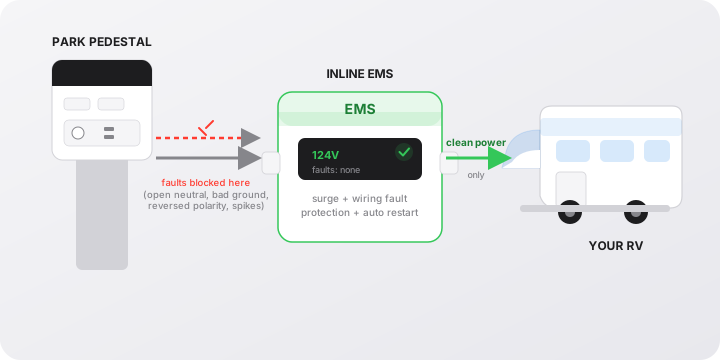
Here is what I tell every RV owner who asks what to plug between the pedestal and their rig: the cheap surge protector most people buy protects against the least likely failure — lightning — and ignores the ones that actually kill RVs. This guide covers what can go wrong at a pedestal, the difference between surge-only protection and a full EMS, and exactly what to buy for a 30A or 50A rig.
Why an RV Needs Different Protection Than a House
Your house has one electrical panel, installed by a licensed electrician, inspected, and connected to a grounded utility service. It is a known quantity. An RV plugs into a different unknown outlet every time it moves.
That changes the protection problem in three ways:
- You cannot control what is on the other end. A pedestal can be miswired from day one and never caught, because nothing fails until something expensive is plugged into it.
- Your RV has no ground reference of its own. A house has ground rods and bonded neutrals. An RV relies entirely on the pedestal for its ground — if the pedestal ground is missing, your entire chassis has no fault path.
- The loads are sensitive and expensive. Modern RVs are full of switch-mode power supplies, inverter-chargers, residential refrigerators, and televisions. A $300 converter or a $2,000 residential fridge is a lot of damage for a pedestal fault to cause in one second.
The surge protection technology itself is the same MOV technology used in home surge protectors — but at a pedestal, a spike is only one of several ways your RV can be damaged, and it is not the most common one.
What Actually Damages RVs at the Pedestal
Before buying anything, understand the enemy. These are the conditions an RV electrical system can encounter at a campground pedestal, and what each one does:
| Fault | What it is | What it does to your RV | How common |
|---|---|---|---|
| Open neutral | The neutral wire is broken or not connected | On a 50A pedestal, the two 120V legs feed through your loads in series — one leg can spike to 180V+ while the other drops below 100V. Kills converters, TVs, and control boards instantly | The classic killer, especially on 50A pedestals |
| Reversed polarity | Hot and neutral are swapped at the outlet | Appliance internal wiring can energize the chassis and anything touching it. Shock hazard, plus slow damage to electronics | Common in older, self-wired pedestals |
| Open ground | Ground pin is not connected | No fault path for your RV — surge protection cannot work, and a short turns the whole chassis into the hazard | Common — ground pins break off, wires corrode |
| High voltage | Pedestal delivers over ~130V | Overvoltage stress on every power supply. Can be a miswired 240V feed on a 120V leg | Rare but catastrophic |
| Low voltage | Pedestal sags under load, often in hot weather | Air conditioner compressors overheat and draw more current, converters brown out, electronics glitch | Very common at crowded parks in summer |
| Voltage spikes | Lightning nearby, utility switching, other campers’ appliances | Cumulative damage to MOV-protected electronics; instant death for unprotected boards | Rare per event, real over years |
The pattern to notice: lightning is near the bottom of the list. Open neutrals, reversed polarity, and missing grounds are wiring faults — and a $30 surge-only protector does nothing about any of them.
Surge-Only vs EMS: The Main Comparison
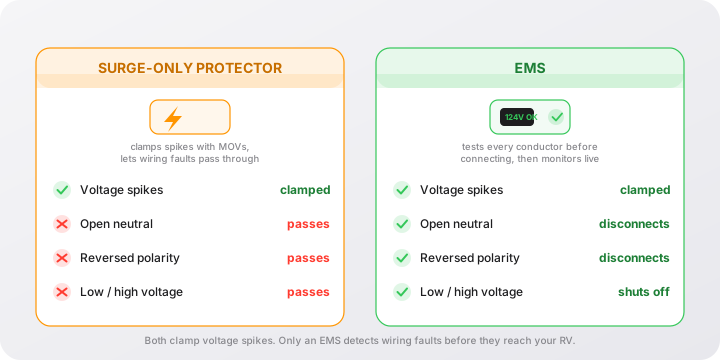
This is the decision that matters, and the names make it confusing. Every EMS contains surge protection, but a surge protector is not an EMS.
| Surge-Only Protector | EMS (Electrical Management System) | |
|---|---|---|
| Clamps voltage spikes (MOVs) | Yes | Yes |
| Detects open neutral | No | Yes — disconnects before connecting |
| Detects reversed polarity | No | Yes |
| Detects open ground | No | Yes |
| Shuts off on low / high voltage | No | Yes |
| Delays reconnection after power blip | No | Yes (protects AC compressors) |
| Typical price (30A / 50A) | $30-60 / $40-90 | $150-250 / $250-400 |
| What it protects against | Lightning and switching spikes only | Spikes plus every wiring fault above |
A surge-only protector is a passive filter. It sits between the pedestal and your RV, and when a voltage spike arrives, its MOVs clamp it to a safe level. Everything else — wrong voltage, missing neutral, swapped wires — passes straight through to your rig.
An EMS is an active guard. When you plug in, it runs a diagnostic sequence: it checks hot-to-neutral voltage, hot-to-ground voltage, neutral-to-ground voltage, and polarity on every conductor before it closes the connection. If anything is out of range, it simply does not connect — and its display tells you why. If a fault develops while you are plugged in, it disconnects in milliseconds.
There is a second, less obvious EMS benefit: reconnect delay. When park power blips and comes back, every air conditioner in the park tries to start at once. An EMS waits a few minutes before reconnecting, which keeps your AC compressor from short-cycling — the fastest way to kill a rooftop AC unit.
30A vs 50A: Know Your Service
RVers get this wrong constantly, and it matters because protection devices are amperage-specific. Two standards dominate US campgrounds:
| 30A Service (TT-30) | 50A Service (NEMA 14-50) | |
|---|---|---|
| Plug shape | 3-prong (hot, neutral, ground) | 4-prong (two hots, neutral, ground) |
| Voltage | 120V single leg | 120/240V split phase |
| Maximum power | 3,600W | 12,000W |
| Typical rigs | Small trailers, older motorhomes, most pop-ups | Large fifth wheels, modern motorhomes, rigs with residential fridges |
| What a surge spike or fault damages | Converter, fridge board, TV | Same, plus both 120V legs can swing independently |
Check your power cord plug. Three pins means 30A. Four pins means 50A. Buy the protector that matches your plug, not the pedestal you happen to be at.
If you have a 30A rig and the only open spot is a 50A pedestal, a 50A-to-30A dogbone adapter is safe — the pedestal simply supplies more than you use, and the adapter’s 30A side is the limiting point. Your 30A protector stays in the chain. The reverse situation needs respect: a 50A rig on a 30A pedestal is limited to 3,600W total, which means running the air conditioner and the water heater at the same time will trip the pedestal breaker. Use a 30A protector at the pedestal end or a 50A unit rated for the job after the adapter — and manage your loads.
Portable or Hardwired: Where the Device Lives
Once you have decided on an EMS, there is one more choice: a portable unit that plugs inline between the pedestal and your shore cord, or a hardwired unit mounted inside the RV near the power inlet.
Portable units are the most common choice for a reason. They travel with you, move easily between RVs, and several designs let you lock them to the pedestal to discourage theft. Their weakness is human: they get left at the pedestal when you pull out — I have seen more than one $300 EMS hanging from a campground post with its cord cut. If you buy portable, make it a habit to check the pedestal before you disconnect, the same way you check the water and sewer connections.
Hardwired units mount permanently in a bay or compartment near your shore power inlet. Nothing to forget, nothing to steal, and the wiring is a short, protected run. The trade-offs: installation means cutting into your power inlet wiring (straightforward for anyone comfortable with electrical work, a small electrician bill otherwise), and the unit stays with the RV if you sell it. Hardwired units also tend to cost less than portable ones at the same amperage because you are not paying for the weatherproof housing and locking hardware.
A middle path exists on some newer units: a basic hardwired protection head plus a wireless remote display you keep inside near the door, so you can read incoming voltage and error codes without walking outside. If you full-time, this is worth hunting for — the display is how you know the EMS just saved you, and how you know when the pedestal is fixed enough to reconnect.
What to Buy, By Situation
Prices here are typical 2026 street ranges for reputable equipment — they vary by brand and season:
| Situation | What to buy | Typical price | Notes |
|---|---|---|---|
| Weekend camper, well-maintained parks, budget first | Surge-only protector with LED display, matched to your plug | $30-90 | Better than nothing. Carry a plug-in tester and check every pedestal. Replace every 3-5 years. |
| Full-timer or frequent traveler | Portable EMS, matched to your plug | $150-400 | The right answer for most readers of this article. Buy once, stop worrying about pedestals. |
| Rig with a permanent power bay / minimal handling | Hardwired EMS installed near your shore power inlet | $200-350 | Nothing to steal, nothing to forget at the pedestal. Requires basic wiring or an electrician. |
| You camp where voltage sags in summer | EMS plus a voltage booster | EMS + $150-300 | The booster raises low voltage; the EMS still guards wiring faults. Do not buy a booster instead of an EMS. |
| Checking a pedestal before plugging in | Plug-in circuit tester | $10-20 | Three-light tester for polarity and ground faults. Quick pre-check on every pedestal. |
For portable units, look for a digital display that shows incoming voltage and error codes — when an EMS refuses to connect, the display is your diagnostic tool. The established brands in this category (Progressive Industries, Southwire’s Surge Guard and Watchdog lines, and Hughes’ Power Watchdog series) have been making these devices for years; portable EMS units with displays and 50A models are widely stocked, as are budget surge-only protectors.
One warning about buying used: surge protection wears out. A used EMS is a used safety device — you have no idea how many surge events its MOVs have absorbed. Buy new, and mark the purchase date on the housing.
How to Check a Pedestal Before You Plug In
Even with an EMS in the chain, a 60-second pre-check costs nothing and tells you whether the pedestal is healthy. With a multimeter set to AC voltage, check a 50A pedestal like this:
| Measurement | Healthy reading | What a bad reading means |
|---|---|---|
| L1 to Neutral | 115-125V | Outside this range = weak or overloaded park power |
| L2 to Neutral | 115-125V | Big difference between L1 and L2 = open neutral or bad park wiring |
| L1 to L2 | 230-250V | Less than ~220V under no load = undersized or faulty feed |
| Neutral to Ground | 0-2V | Reading near 120V = open neutral (the dangerous one). Reading nothing at all may mean an open ground. |
For a 30A TT-30 pedestal, check hot-to-neutral (expect 115-125V), hot-to-ground (expect 115-125V), and neutral-to-ground (expect 0-2V). If hot-to-neutral reads fine but hot-to-ground reads zero, the ground is missing. If neutral-to-ground reads 120V, the neutral is open — do not plug in.
No multimeter? A three-light plug-in tester catches reversed polarity and open grounds in seconds. It will not catch every open-neutral scenario on 50A service — that is what the EMS is for — but it filters out the most common faults.
The Bottom Line
Here is the decision framework in one paragraph:
If your RV spends most of its life plugged into your own driveway outlet, a surge-only protector is defensible. If it travels — if you plug into pedestals you have never seen before, at parks you have never visited — buy a portable EMS matched to your plug. The difference is roughly $100-300, which is less than the cost of one converter replacement, and the converter is exactly the component pedestal faults kill first.
And remember the layer you already know from home: an EMS at the pedestal protects the whole RV, but the electronics inside still deserve a quality plug-in surge protector for your TV and other gear — and if you are protecting a home shop or office too, the same surge protector vs power strip rules apply inside the RV that apply in a house. A whole-house surge protector at the panel is the equivalent protection for the home side of the driveway.
The pedestal is the weakest link in your RV’s electrical system, and it is the one part you do not get to choose. Protect against what is actually common — wiring faults — not just what is dramatic. Your converter will thank you.
Recommendations based on field experience maintaining power quality in critical infrastructure environments. Prices are typical US street ranges as of September 2026 and vary by brand and season.
Frequently Asked Questions
What is the difference between an RV surge protector and an EMS?
A surge-only protector contains metal oxide varistors (MOVs) that clamp voltage spikes, but it lets everything else through — reversed polarity, open neutrals, and low or high voltage will still reach your RV. An EMS (Electrical Management System) does surge protection plus continuous fault monitoring: it checks the pedestal for open ground, open neutral, reversed polarity, and voltage outside safe limits before it connects power, then shuts down in milliseconds if a fault appears while you are plugged in. Most EMS units also delay reconnection after a power blip so your air conditioner compressors do not fight each other. Surge-only units run about $30-90; portable EMS units run about $150-400 depending on amperage and features.
Do I need a 30A or 50A surge protector for my RV?
Match the protector to your RV's shore power inlet, not to the pedestal. If your power cord ends in a 3-prong plug (hot, neutral, ground), you have 30A service (NEMA TT-30, 120V, max 3,600W) and need a 30A protector. If it ends in a 4-prong plug (two hots, neutral, ground), you have 50A service (NEMA 14-50, 120/240V, max 12,000W) and need a 50A unit. You can use a 50A-to-30A 'dogbone' adapter to plug a 30A rig into a 50A pedestal — the protector should still match the RV, not the pedestal. Never use a 30A-to-50A adapter to draw more than 30A; the pedestal breaker will not save you.
Can a bad campground pedestal damage my RV even without lightning?
Yes — this is the part most RVers miss. The most damaging pedestal faults are wiring problems, not lightning: an open neutral on a 50A pedestal can push 180V or more down one leg while the other leg drops, which destroys converters, televisions, and refrigerator control boards. Reversed polarity energizes the chassis through appliance internals, and an open ground leaves your RV with no fault path at all. Park pedestals sit outside year-round, get hit by lawn mowers, and are wired by whoever was cheapest. An EMS catches these faults before they reach your RV; a surge-only protector does not.
Will an EMS protect my RV from low voltage at the pedestal?
An EMS will disconnect you when voltage drops below its threshold (typically around 104V, though exact cutoffs vary by brand), which protects your air conditioner compressor and converter from a damaging brownout — but it does not raise the voltage. If you regularly camp at parks with weak power, you need a separate voltage booster, a transformer-type device that raises low pedestal voltage by roughly 10-15%. Booster-type units only correct low voltage; they do not detect wiring faults, so pair one with an EMS rather than using it instead of one.
Is a cheap surge-only protector enough for occasional weekend camping?
It is acceptable if you accept the risk. If you camp a handful of weekends a year at well-maintained parks, a surge-only unit with a digital display (about $40-90) plus a $10 plug-in circuit tester gives you basic protection at low cost. If you full-time, live in the RV, or plug into unfamiliar or older parks, buy an EMS — the $150-400 difference is less than one converter replacement, and converters are exactly what pedestal faults kill first. Whichever you buy, remember the MOVs wear out: replace the unit every 3-5 years or after a known major surge event.