Buying a Used EV: The Checklist That Saves You Thousands
A friend of mine bought a used EV two years ago and spent the first month showing it off. The range was good, the price was a “steal,” and the previous owner had even left the charging cable in the trunk.
Eight months in, the range started dropping — not gradually, but in visible chunks. The car that once showed 240 miles on a full charge was showing 190. He took it in for a diagnostic. The battery had been fast-charged to 100% nearly every day of its previous life, mostly in a hot climate, and the state of health was already below 75% — right at the edge of the warranty threshold, and trending down. The “steal” was now worth thousands less than he paid, and the repair he was dreading was a five-figure battery replacement.
Every single red flag in that story was checkable before he bought the car. He just did not know to look. This checklist exists so you do.
I have spent seven years testing and maintaining battery systems for critical infrastructure — the same lithium chemistry, the same degradation physics, the same state-of-health math that runs an EV. Buying a used EV is the single best-value move in the car market right now, but only if you verify the one component that makes or breaks the purchase: the battery. Here is the full pre-buy checklist, in order of importance.
1. Battery State of Health: The Number That Decides Everything
The battery pack is the most expensive single component in the car — replacing one can run $5,000 to $20,000 depending on the model — and its condition is mostly invisible. So this is step one, and nothing else matters if you skip it.
What state of health (SOH) actually means
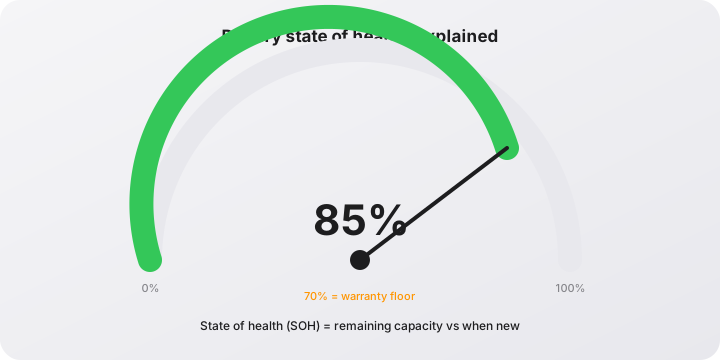
A battery’s capacity declines as it ages. State of health is that remaining capacity expressed as a percentage of what the battery could hold when new. A battery at 90% SOH stores 90% of its original energy. Simple to state, harder to measure accurately, and it is the anchor of a used EV’s value — exactly the point I make in my guide to EV depreciation.
The important nuance most buyers miss: SOH is not the same as the range the dashboard shows. The dashboard’s range estimate is calculated from recent driving behavior, temperature, and a software algorithm — it can read optimistically or pessimistically, and it can be gamed (more on that below). SOH is the underlying physical truth.
How to actually check it
There are three ways, in increasing order of reliability:
The dashboard range check (quick, approximate). Charge the car to a known state — 80% or 100% — and compare the displayed range to the original EPA figure for that model. If the car originally did 300 miles and now shows 240 at a full charge in mild weather, that hints at roughly 20% degradation. It is a rough screen, not a measurement, and it is affected by weather, tire type, and the last driver’s habits.
The OBD-II diagnostic scan (the reliable method). Every EV has an OBD-II port, and the battery management system (BMS) continuously tracks the pack’s true state of health, cell voltages, and capacity history. A Bluetooth OBD-II adapter and an app that supports your specific vehicle — the EV community has well-known tools for Teslas, Leafs, Bolts, and others — can pull the actual SOH percentage, along with cell-level data that reveals a weak cell even before the pack as a whole looks bad. This is the single most useful $30-60 you will spend on the purchase.
A professional capacity test or dealer diagnostic. The gold standard. Some dealers and independent EV shops will run a proper battery capacity test and give you a documented SOH figure. If the seller refuses to allow an independent diagnostic, treat that refusal as a red flag in itself.
What numbers are good
Most manufacturers warrant the battery to hold at least 70% capacity for 8 years or 100,000 miles. That warranty floor is your frame of reference:
| SOH reading | What it means | How to react |
|---|---|---|
| 90%+ | Excellent — a well-treated, low-degradation pack | Buy with confidence (assuming price is fair) |
| 85-90% | Typical and healthy for a 2-4 year old EV | Fine — this is the normal used-EV sweet spot |
| 80-85% | Noticeable but acceptable degradation | Fine only if the price reflects it |
| 75-80% | Approaching the warranty floor | Proceed cautiously; the discount must be large |
| Below 75% | Real risk of costly replacement in the near term | Walk away, or price in a $10k+ repair |
This is the same degradation math I apply to home battery systems: lithium packs lose roughly 1-2% capacity per year under normal use, more if they are fast-charged hard, kept at 100% for long periods, or cycled in high heat. A four-year-old EV at 91% has been treated well. A two-year-old EV at 82% has been treated badly. Both are priced by the same market — your job is to find the first one.
Watch for the “gamed” range reading
A seller who resets the driving-history memory right before you arrive, or who charges the car in a way that inflates the estimate, can make the dashboard show a flattering number. The OBD-II SOH reading is much harder to game. This is why the diagnostic scan beats the dashboard every time.
2. Warranty Transfer: The Fine Print That Protects You
The battery warranty is what makes the degradation risk acceptable, so confirm it is still in force — in writing.
Most EV battery warranties — typically 8 years / 100,000 miles — are attached to the vehicle, not the original owner, and transfer automatically on private sale. But check three things:
- The in-service date. The clock starts when the car was first sold new, not when you buy it. Get this date and do the math on how much warranty remains. A 2019 EV sold in 2026 is likely out of its battery warranty entirely.
- Voided warranties. A salvage or rebuilt title almost always voids the battery warranty. Certain aftermarket modifications can too. If the car has any title branding, the warranty may be gone even though the car looks fine.
- Manufacturer quirks. A few manufacturers require the new owner to register the vehicle to keep certain benefits (connected services, free charging, warranty support). Confirm the process before you buy, not after.
Do not take the seller’s word for any of this. Call the manufacturer with the VIN and ask, directly, what battery coverage remains and whether anything voids it.
3. Charging History: How the Previous Owner Treated the Battery
This is where my battery background makes me insist on something most car checklists skip. Two identical used EVs with identical mileage can have batteries that are 10% apart in health, and the difference is almost entirely how they were charged.
What you are looking for:
- Home Level 2 charging vs DC fast charging. A car charged gently at home on a 32-48A Level 2 charger will degrade slower than one hammered with DC fast charging. Heavy fast charging — especially to 100%, especially in heat — is the single worst thing for long-term pack health. Some vehicles log their charging history and it can be pulled with the same OBD-II diagnostic. Ask for the charging records if they exist.
- Habitual 100% charging. Keeping a battery pinned at 100% for long periods stresses the chemistry, particularly NMC packs. An owner who routinely charged to 80% for daily use and reserved 100% for trips was doing it right. An owner who plugged in and let it sit at 100% every night for three years was quietly hurting the pack.
- Climate. Batteries degrade faster in sustained heat. A desert-region car with a history of outdoor parking and fast charging is a higher-risk pack than a mild-climate, garage-kept car, all else equal. Some states even require the car to be listed with a battery report — use it.
None of these are automatic deal-breakers. They are negotiation points. A car with heavy fast-charging history deserves a lower price than one with a clean, gentle charging history — and the SOH reading in step 1 tells you how much lower.
4. Accident, Flood, and Total-Loss History
The car’s history report is non-negotiable — pull it yourself using the VIN, from the well-known reporting services, and do not rely on the seller’s screenshot.
What to look for specifically:
- Frame or structural damage. EV battery packs are often mounted in the floor, which means underbody damage — a hard hit, a rock, a poorly lifted car — can physically damage the pack even if the car drives fine. A car with floor or underbody damage history deserves a physical inspection of the pack underneath.
- Flood exposure. Water and high-voltage batteries are a dangerous combination. Flood vehicles often have corrosion in the pack and connectors that shows up months later. A car from a flood-prone region with a suspiciously clean title is worth a very close look.
- Salvage / rebuilt titles. These void the battery warranty in most cases and make the car harder to insure. The discount is usually not worth the risk you inherit.
- Multiple owners in a short window. A car that has changed hands three times in three years is telling you something. Ask why.
5. Software, Recalls, and Updates
An EV is as much software as it is hardware, and the software state matters in ways a gas car’s never did.
- Open recalls. Check the VIN against the manufacturer’s recall database. Some EV recalls involve the battery, the charging system, or software that governs both — these are not optional. Confirm any open recalls are completed before you buy, or that the manufacturer will do them for free on your schedule.
- Software version and update history. A car that is still on its original 2021 software may be missing range, charging, and safety improvements — or it may be a sign the previous owner never maintained it. Many manufacturers push updates over the air for free; confirm the car is current.
- App and connected services. If the previous owner’s account is still linked, you may be locked out of remote features, charging controls, and even the ability to use fast-charging networks tied to the account. Make sure ownership is properly transferred in the manufacturer’s system before you drive away.
6. Home Charging Setup: Check This Before You Sign
This is the step my electrician side wants you to do before you commit, because it changes the whole cost equation. An EV that forces you onto public fast charging is a completely different financial proposition than one you can charge cheaply at home overnight — I lay out the full math in my EV vs gas total cost of ownership comparison, but the short version is that home charging is what makes an EV cheaper to run at all.
Before buying, check:
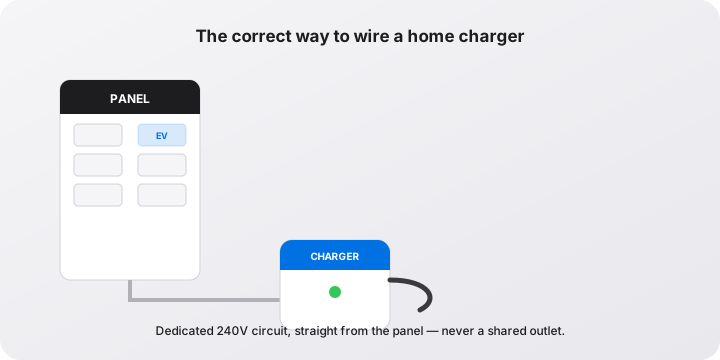
- Your panel and service size. A Level 2 charger needs a dedicated circuit — 40A for a 32A charger, 50A for 40A, 60A for 48A — and room in your electrical panel. If your panel is full or you have only 100A service, factor in a panel or service upgrade. The full cost breakdown will tell you whether your charger is a $700 job or a $4,000 job.
- The 80% rule. A circuit feeding a continuous load like an EV charger must not be loaded past 80% of its rating. A 50A circuit means a 40A charger, max. This is why the “cheap” installs that skip the math can melt outlets — I have seen it.
- Your electricity rate and off-peak options. Know your per-kWh rate and whether your utility offers off-peak or EV-specific rates. This number determines your fuel cost for years.
- Surge protection. While the electrician is in the panel, a whole-house surge protector is cheap insurance for the charger and the car’s onboard charger — one of the most expensive electronics you will ever own, wired to an always-energized 240V circuit.
7. The Red Flags That Cost Thousands Later
Let me compress the whole guide into the specific warnings, the ones my friend ignored:
- A seller who refuses an independent diagnostic or OBD-II scan. Walk away. A healthy battery is the seller’s best selling point — if they hide it, there is a reason.
- A suspiciously low price with no explanation. The used-EV market is efficient enough that a car priced 20% under comparable listings has a reason. Find it before you buy it.
- A salvage, rebuilt, or flood title. These void the battery warranty and pile on risk that no discount fully prices.
- SOH below 80% without a correspondingly huge discount. You are buying a car near the warranty floor with a five-figure repair in its future.
- No home charging and no plan for it. You will pay gasoline-equivalent prices at public chargers and lose the main reason to go electric.
- An open battery or charging recall. Complete it first, on the manufacturer’s dime, not yours.
The Pre-Buy Checklist, in One Place
Print this or screenshot it. Run every line before you hand over money.
| # | Check | How | Pass / fail |
|---|---|---|---|
| 1 | Battery SOH | OBD-II scan + app for the specific model | 85%+ is ideal; below 80% needs a big discount |
| 2 | Battery warranty | Call manufacturer with VIN, get in-service date | Confirm remaining term and transfer |
| 3 | Charging history | OBD-II log + ask for records | Gentle home charging preferred |
| 4 | History report | Pull your own report from the VIN | No salvage/flood/structural damage |
| 5 | Open recalls | Manufacturer recall database | All completed or scheduled free |
| 6 | Software current | Check version + update history | Current, or updatable for free |
| 7 | Account transfer | Confirm previous owner’s account is cleared | You can access connected services |
| 8 | Home charging | Panel capacity + rate + install quote | Charger install budgeted |
| 9 | Insurance quote | Real quote on the specific VIN | Premium fits your budget |
| 10 | Undercarriage | Physical inspection of the pack | No damage or leaks |
The Bottom Line
A used EV is the smartest money in the car market right now — you let the first owner absorb the brutal early depreciation and still collect years of cheap home charging and low maintenance. But the entire value proposition rests on one component you cannot see without looking: the battery.
Before you buy, verify the battery’s state of health with a proper diagnostic scan, confirm the warranty still stands, check how the car was charged, and rule out accident, flood, and salvage history. Then confirm you can charge at home and what it will cost to wire the charger in.
Do all of that, and a used EV is one of the best financial decisions you can make. Skip the battery check, and you are gambling a five-figure repair on a seller’s word. My friend learned the hard way. You do not have to.
Frequently Asked Questions
How do I check a used EV's battery health before buying?
The most reliable method is a diagnostic scan of the battery management system through the OBD-II port, using an OBD-II adapter and an app that reads the specific vehicle — this gives you state of health (SOH) as a percentage. For a quick check, you can read the range the car shows at a full or 80% charge and compare it to the original EPA rating, but that number is an estimate that can be gamed. Ideally, get a battery capacity test or a dealer diagnostic report, and always compare the number against the manufacturer's degradation warranty.
What battery health percentage should a used EV have?
Most manufacturers warranty the battery to retain at least 70% capacity for 8 years or 100,000 miles. A used EV with SOH above 90% is excellent, 85-90% is typical and healthy for a 2-4 year old car, and 80-85% is acceptable if the price reflects it. Below 80% you are approaching the point where range loss becomes noticeable and a future battery replacement — which can run $5,000 to $20,000 — becomes a real risk, so the discount had better be substantial.
Does the battery warranty transfer to a second owner?
Usually yes. Most EV battery warranties (typically 8 years/100,000 miles) are attached to the vehicle, not the original buyer, and transfer automatically on private sale. But there are exceptions and fine print: some used EVs bought through dealers may have had the warranty voided (for example, by a salvage title or aftermarket modification), and a few manufacturers require the new owner to register. Confirm in writing and get the vehicle's in-service date so you know exactly how much warranty remains.
Is it risky to buy a used EV with a lot of DC fast charging?
DC fast charging is not automatically harmful, but heavy, sustained use of it — especially frequent charging to 100% in hot weather — accelerates battery degradation measurably over years. A battery with 50,000 miles of mostly fast charging will often show several percent more degradation than one charged gently at home. This is why checking the vehicle's charging history matters as much as checking the mileage. It is not a deal-breaker; it is a negotiation point.
Should I buy a used EV without a home charging setup?
You can, but it changes the math. Without home charging, you will rely on public fast chargers that cost $0.40-0.60 per kWh — roughly the same per mile as gasoline — and you lose most of the cost advantage of driving electric. Before buying, check your electrical panel has spare capacity for a Level 2 charger (a 32-48A unit needs a dedicated 40-60A circuit), and budget the install cost into the purchase.