Circuit Breaker Keeps Tripping? The Electrician's Triage Guide (2026)
A breaker that trips once is an event. A breaker that keeps tripping is a message - and most people read it wrong. They reset it and move on, or they decide the breaker is “going bad” and ask someone to install a bigger one. Both responses make the real problem worse, because the breaker is not the problem. It is the alarm - and it is the cheapest alarm your house will ever have.
I have spent more than seven years maintaining critical-infrastructure power systems, where an open breaker is never treated as an annoyance. It is data: something asked for more current than the circuit could safely deliver, or current found a path it was never supposed to take. Houses run on the same physics, just smaller. Every trip has a timing and a cause, and the timing is the fastest route to the cause.
This guide is the triage I would run in my own house: read the timing, count the watts, isolate the load - and know exactly when to stop touching it and make the call.
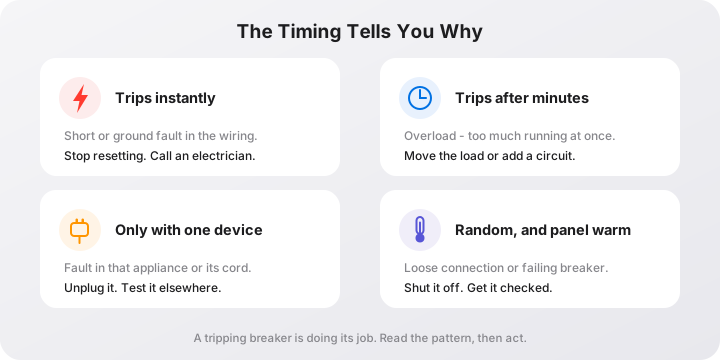
The Five-Minute Triage: What the Timing Tells You
| What you observe | Most likely cause | What to do first |
|---|---|---|
| Trips instantly when you reset it, even with nothing plugged in | Short circuit or ground fault in the wiring | Stop resetting. This is electrician territory. |
| Holds, then trips after 5-30 minutes of normal use | Overload - too much load on the circuit | Tally the watts (table below). Move the biggest load or add a circuit. |
| Trips the moment one specific appliance starts | A fault in that appliance or its cord | Unplug it. Test it on another circuit. Repair or replace. |
| Trips now and then, often with motor loads like a vacuum | AFCI nuisance trip or a shared-neutral issue | Run the isolation drill. Never swap in a standard breaker. |
| Trips rarely, and the breaker face is warm or smells odd | Loose connection or a failing breaker | Shut that circuit off. Have the panel inspected now. |
Notice that the first two rows are different problems wearing similar clothes. “Keeps tripping” while the house runs normally is usually an overload - a lifestyle-versus-wiring conversation. “Trips instantly, even when reset” is a wiring fault, and it is the one you do not keep testing. Everything below sorts the causes along that line.
How a Breaker Decides to Trip
A standard breaker packs two trip mechanisms into one small case.
The thermal element - a bimetallic strip that bends as it heats - handles overloads, and it is deliberately slow. A modest overload trips it in minutes, not milliseconds, because everyday loads (a fridge compressor starting, a motor spinning up) briefly pull more than their running current, and those moments should not kill the circuit.
The magnetic element handles short circuits: when current spikes to hundreds of amps, a solenoid trips the breaker in a fraction of one cycle.
That difference explains a pattern that confuses everyone: “it ran fine for months, and now it trips.” Heat is cumulative and conditions drift. An extra appliance appeared, the panel runs hotter in a garage that sees 100-degree afternoons, a space heater that used to run for thirty minutes now runs for three hours. The thermal element keeps score - and when the score runs out, it trips.
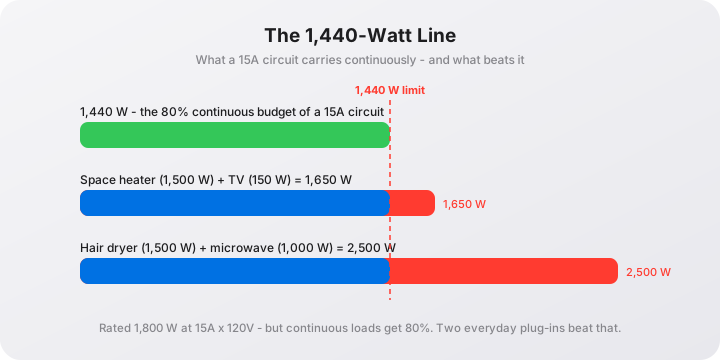
The other number worth committing to memory is the 80% rule. Breakers are listed to carry 80% of their rating continuously - three hours or more. A 15A circuit that sounds like 1,800 watts is really 1,440 watts of continuous load; a 20A circuit is 1,920 watts of its 2,400-watt headline. This single fact explains most mystery trips. A 1,500-watt space heater is already 83% of a 15-amp circuit’s rating by itself. Add a TV and a phone charger, and the math is not close.
And one design fact that matters later: the breaker is sized to protect the wire, not the appliance. 14-gauge copper wire gets a 15A breaker; 12-gauge gets 20A. That is why “just put in a bigger breaker” is a sentence you should never accept.
The Six Causes, and How to Confirm Each One
1. Overload: The Most Common Verdict
The circuit is being asked for more than it can give. The signature: it holds for minutes or longer, then trips - usually with a big load running. The confirm test is arithmetic, not tools.
| Common household load | Typical draw |
|---|---|
| Space heater (high setting) | 1,500 W |
| Hair dryer (high) | up to ~1,800 W |
| Iron | 1,000-1,800 W |
| Toaster or toaster oven | 800-1,800 W |
| Microwave (input draw) | 900-1,700 W |
| Coffee maker (brewing) | 600-1,200 W |
| Vacuum cleaner | 600-1,200 W |
| Refrigerator (running) | 150-250 W |
| Desktop PC plus monitor | 200-500 W |
| TV | 50-150 W |
For numbers you can trust, a plug-in power meter (about $20-40) turns this from guesswork into measurement - you plug the appliance into it and read the actual draw over a day.
The classic overloads I get called about: a bedroom running a space heater (1,500 W) plus a gaming PC (400-500 W) on one 15-amp circuit - 1,900-plus watts against a 1,440-watt budget, which trips in 10-40 minutes, right about when the room finally gets warm. Or a kitchen counter with a coffee maker, a toaster, and a microwave sharing one older 20-amp circuit - roughly 3,000 watts of breakfast.
The fix is either discipline or copper. Heat loads get scheduled like a one-seat kitchen: one at a time. If the load is legitimate and constant - a home office that genuinely needs a heater all day - the honest fix is a dedicated circuit, priced below. What does not work: resetting, hoping, and a bigger breaker.
2. Short Circuit: Fast, Loud, Not Negotiable
Here the hot conductor touches neutral - or another hot - and current bypasses the load entirely. Resistance drops to nearly zero, current spikes into the hundreds of amps, and the magnetic element trips instantly.
Where they come from: a cord crushed under furniture, a cable punctured by a nail or screw during a renovation or a picture-hanging spree, rodent damage in a garage or crawlspace, a receptacle or switch whose internals have failed. Often there is extra evidence - a scorch mark, a burning smell, a buzz at one device.
The confirm test: unplug every load on the circuit - truly every one - and reset once. Trips again instantly? The fault is in the wiring. Stop resetting. Each reset pushes fault current through the exact point that is damaged, heating it further. A short you keep re-energizing is how a small problem becomes a fire. If you can pin the smell or buzz to one device, leave that circuit off until it is repaired.
3. Ground Fault: The Rainy-Day Tripper
A ground fault is a short that found its path through ground - the box, the conduit, or anything wet. The usual culprit is water or degraded insulation: an outdoor outlet after a storm, landscape lighting, an irrigation valve, a garage receptacle at floor level, a well or sump pump circuit.
Its signature can be instant or intermittent, and it often tracks conditions: trips after rain, after the sprinklers, in humid weather. If the circuit has GFCI protection, the GFCI device may trip before the breaker does - which is why the thing you find tripped after a storm is usually a GFCI receptacle, not the panel. Fix the water first: covers, gaskets, drainage. Replace any device that got soaked. If it repeats, get the circuit inspected - moisture degrades insulation a little more each cycle.
4. Loose Connections and Failing Breakers: The Slow, Quiet Category
This is the reason to take repeated trips seriously even when they seem harmless. A loose termination - behind a receptacle, in a junction box, at the panel - has resistance where there should be none. Current through resistance makes heat; heat loosens the connection further; eventually the circuit trips. Intermittently. Under load. Often after an hour. Then more often.
Warning signs: a breaker face noticeably warmer than its neighbors, discolored wire or a scorched smell at the panel, a receptacle that only fails under load, a plug that feels loose, flickering on one circuit. Aluminum branch-circuit wiring (common in homes built roughly 1965-1973) lives in this category permanently - its terminations are the weak point, and our guide to identifying aluminum wiring covers what to do about it.
This category is where house fires start, because the current involved is often too small to trip anything quickly - it just sits there, hot, for years. If the panel cover is warm or anything smells like burning: shut off the main and make the call now. In a newer home, a loose termination is a warranty item - the new construction walkthrough guide covers how to get it fixed on the builder’s dime.
5. AFCI and GFCI Breakers: Working as Designed (and Sometimes Too Eagerly)
If your tripping breaker has a TEST button, it is not a plain breaker - it is electronics judging current, and it plays by different rules. An AFCI watches the current waveform for arc signatures; it can be fooled by the normal electrical noise of brushed motors (vacuums, treadmills, older power tools). A GFCI compares hot and neutral current and trips at about 5 milliamps of leakage - a level chosen to protect people, not equipment.
Known nuisance patterns: a vacuum that takes out the bedroom circuit every time, a treadmill, a shared-neutral multiwire circuit that confuses the electronics. But the discipline matters: you do not get to decide an AFCI trip is a nuisance until you have isolated the cause, because some of those trips are real arcs - that is what the device is for. And nobody ever fixes the problem by installing a standard breaker in its place; that removes a required safety device. Our GFCI vs AFCI guide covers both devices and their own drills in detail.
6. The Appliance Itself
Sometimes the drill fingers one device, reliably. Space heaters with failing elements, refrigerators and freezers with aging compressors, pumps, treadmills, hair dryers with worn cords - a failing appliance can pull far past its normal draw, or leak current to ground. The test: run the same device on a different circuit. Inspect its cord and plug for cracks, scorch marks, or warmth after use. If the appliance reproduces the trip and its plug warms up, it is done - a $40 space heater is not worth a house. Cords are sometimes replaceable; failing heating appliances never are.
The Isolation Drill: 15 Minutes to the Culprit
This is the same logic we use on industrial systems, scaled down to your panel. Run it when the house is calm - not at 11 p.m. with a deadline.
- Map the circuit first. Find every outlet, switch, and fixture the breaker controls, using a circuit breaker finder or by turning the breaker off and walking room to room. Note the surprises - the hallway, the garage, the second bedroom you call storage. Half of all mystery trips are loads you did not know were on that circuit.
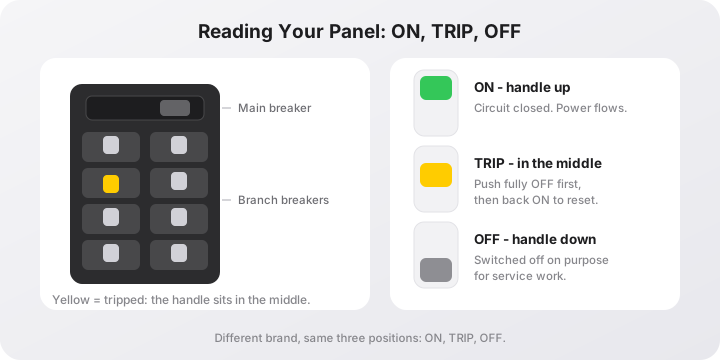
- Reset it once, properly. Push the handle fully to OFF first, then back to ON. A tripped handle sits in the middle position and must reach full OFF before it will reset - this one trick saves a surprising number of “broken breaker” service calls.
- If it tripped instantly: unplug and switch off everything on the circuit (note any hardwired loads - a furnace, a disposal - that cannot be unplugged). Reset once more. Trips again with nothing connected? Stop here - wiring fault, electrician. Holds? Continue.
- Add loads back. All at once if there are few; otherwise add half, then narrower, resetting between steps. When it trips, the most recently added load is the suspect.
- Isolate the suspect. Test that device on a different circuit. Same trip there - the device is the problem. Trips only on the original circuit - suspect the circuit: an overload combination, or a connection you have not found yet.
- Let the timing finish the diagnosis. Instant trips point to short and ground faults; delayed trips point to overload and heat. Keep a one-week log - time, weather, what was running - and the pattern usually finishes the job for you.
Safety rules that are not optional:
- Never tape, wedge, or prop a breaker handle in the ON position. That is how people turn a warning into a fire.
- Never install a breaker larger than the wire is rated for - 14-gauge gets 15A, 12-gauge gets 20A - to stop nuisance trips. The wire overheats before the breaker cares.
- Never reset a breaker that sparks, buzzes, or smells. Shut it off and call.
- A panel cover off is electrician territory. Even experienced people work de-energized, one-handed, with the right tools - and most homeowners should watch from the other side of the door.
- Tell the electrician what changed: a new appliance, a storm, recent work, a handyman visit. That one sentence often ends the mystery before the van arrives.
When the Fix Is a New Circuit (and What It Costs)
If the tally says the circuit is overloaded by the way you actually live, the honest fix is more circuit, not more discipline. Illustrative 2026 US costs: a straightforward new circuit typically runs about $250-600; finished walls, long runs, or awkward routes push it toward $600-1,200 and up, and every number varies with region and access. If the panel is full or the service is modest (60-100A serving modern loads), an upgrade conversation starts in the low thousands of dollars. Get two or three quotes, and ask what the price includes.
Two things worth doing while an electrician is already in the panel: a whole-house surge protector, since the labor is the expensive part (the installation walkthrough covers what is involved), and a load calculation if an EV charger is anywhere in your future - charger projects live or die on panel capacity and load math, which our EV charger installation cost guide walks through.
When to Call an Electrician Today (Not Tomorrow)
- Trips instantly with everything unplugged, or will not reset at all
- Buzzing, sparking, or a burning smell at the panel or any outlet
- A warm panel cover, or one breaker hot versus its neighbors
- Aluminum branch wiring combined with any repeated trip
- Water in or near the panel, rust, or any damage after flooding
- Repeated trips after you have isolated and removed the suspicious load
- House lights flickering in step with the trips - this can be a loose service connection, possibly on the utility’s side, so call them too
- You have run the drill, and the answer is the wiring. That is where DIY stops.
Tools That Turn Guessing Into Knowing
Everything a homeowner should reasonably do here runs on a small kit: a receptacle tester (about $15-30) for outlets and polarity, a non-contact voltage tester ($20-40) before touching anything, the plug-in power meter from above ($20-40) for counting an appliance’s real draw, and the circuit breaker finder ($30-60) for mapping. Call it under $150 for the set. A clamp meter is the electrician’s version of the power meter, worth having if you already own tools. What not to buy: plug-in AFCI testers, which cannot create a real arc and give unreliable verdicts - the TEST button is the listed method, as our GFCI vs AFCI guide explains.
The Bottom Line
A tripping breaker is the cheapest warning in your house: it costs nothing, it happens before the damage, and it never lies. Treat every repeat trip as three questions - when does it trip, what was running, and does it hold with nothing connected. The answers sort it: overload (most common, fix with redistribution or a new circuit), short or ground fault (stop resetting, call), a failing connection (the quiet one - never ignore warmth or smell), a protective breaker doing its job, or one bad appliance. Fix the cause. Never the messenger.
Frequently Asked Questions
How many times should I reset a tripping breaker?
Once, and only after removing the load that was running. If it trips again immediately, stop - each reset pushes current through the damaged point that caused the trip, and that point heats up a little more every time. The right sequence: unplug everything on the circuit, reset once, and see if it holds. If it holds with nothing connected and trips when a specific device is added, you have found the culprit. If it trips with nothing connected, that is a wiring fault, and the next person to touch it should be an electrician. The old advice about resetting three times is folklore, not a rule.
Why does my breaker trip only sometimes?
Two words: heat and timing. Breakers trip on a thermal curve, so a modest overload trips in minutes, not instantly - whether it trips depends on how long the loads ran and how warm the breaker already was. A panel in a hot garage or attic runs hotter in summer, and heat lowers the margin. The second family of causes is genuinely intermittent: a loose connection that only acts up under certain loads, moisture that only appears after rain, an appliance that misbehaves as it ages. Keep a one-week log - time, weather, what was running - and the pattern usually fingerprints the cause.
Can I replace a 15A breaker with a 20A breaker to stop the tripping?
No - not without checking the wire, and that check belongs to an electrician. Breakers are sized to protect the wire, not to match your appliances: 14-gauge copper gets a 15A breaker, 12-gauge gets 20A. A 20A breaker on 14-gauge wire lets the wire overheat long before the breaker notices, which is exactly how house fires start. The honest fixes for a genuinely overloaded circuit are redistributing the load or running a new circuit. If someone offers to just swap in a bigger breaker, treat that as a red flag, not a solution.
Why does my breaker trip when it rains?
Because water is reaching somewhere it should not: an outdoor receptacle after a storm, landscape lighting, an irrigation valve, a garage outlet at floor level, a pump circuit. Water plus electricity equals a ground fault, and ground faults trip breakers - sometimes instantly, sometimes only after enough moisture soaks in. The fix starts with the water path: covers, gaskets, drainage, and replacing any device that got soaked. If it repeats, have the circuit inspected - each soak degrades insulation a little more, and moisture faults do not improve on their own.
Is a warm breaker dangerous?
A slightly warm breaker under heavy load can be normal. A breaker noticeably warmer than its neighbors, or a warm panel cover, is not - it is the classic signature of a loose connection or a failing breaker, the slow category that starts fires because the current involved is often too small to trip anything quickly. Add a burnt smell, discoloration, or flickering on that circuit and you should stop using the circuit and get it checked. Do not wait to see if it settles. Breakers are cheap; the alternative is not.