Electrical Panel Upgrade Cost in 2026: 100A vs 200A, Real Numbers, and When You Don't Need One
The quote lands and the number is not for the panel. It is for the service. A homeowner who asked me to look at “a panel upgrade” had been quoted $6,900 by one contractor and $2,400 by another, and neither quote described the same job. One was replacing a 100A panel with another 100A panel and calling it an upgrade. The other was replacing the mast, the meter base, the service-entrance conductors, and the grounding system to deliver a real 200 amps. Both contractors were honest. Only one of them was answering the question the homeowner thought he had asked.
That gap — between what people say and what the work actually is — is where most of the money in this category gets lost. I have spent seven years on the maintenance side of power distribution, the person who inherits somebody else’s panel work a decade later and finds out whether it was done right. This guide is the version of the conversation I would have at your kitchen table: what each job actually is, what it costs in 2026, what drives your number up, and — the part nobody sells you — how to find out you do not need the expensive one.
Four Different Jobs Wearing One Name
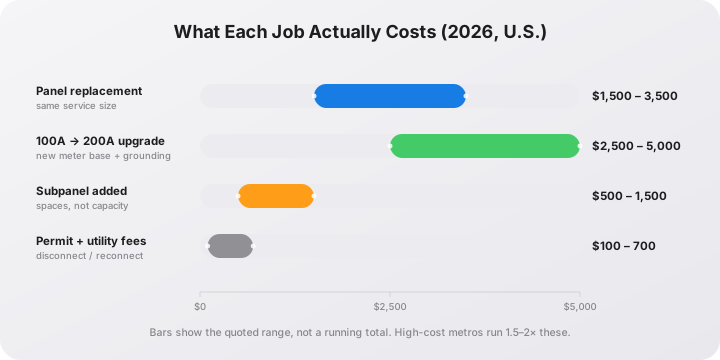
“Panel upgrade” gets used for four distinct projects, and they differ in price by a factor of five. Before you collect a single quote, decide which one you are actually buying.
| What you are really buying | What it involves | Typical 2026 cost (U.S.) |
|---|---|---|
| Panel replacement, same service size | New enclosure and breakers, existing 100A (or 200A) service reused | $1,500 – $3,500 |
| Service upgrade, 100A → 200A | New panel, new meter base, new service-entrance conductors, grounding upgrade, utility coordination | $2,500 – $5,000 |
| Subpanel addition | 60–100A feeder from the main panel to a second box | $500 – $1,500 |
| Main breaker or single-circuit repair | One breaker, one termination, one problem | $250 – $600 |
The first two are the ones people confuse, and the confusion is expensive in both directions. Replacing a tired 100A panel with a new 100A panel fixes rust, nuisance trips, and a lack of spaces. It does not give you capacity for an EV charger, a heat pump, or a tankless water heater. A service upgrade does — and it is the only one of the four that requires the utility to show up.
What a Real Quote Contains
Here is the line-item structure of a competent 200A service upgrade. When you compare bids, compare these lines, not the bottom line — a cheap quote is almost always a quote with lines missing.
| Line item | Typical range | Notes |
|---|---|---|
| 200A panel with main breaker and branch breakers | $400 – $900 | Panel quality varies; a $180 panel and a $700 panel are not the same object |
| Labor, 1–2 days, licensed electrician | $800 – $1,800 | Crew size and region drive this more than anything |
| Meter base and service-entrance conductors | $400 – $1,200 | Often mandatory; utilities frequently refuse to reconnect to an old meter base |
| Grounding electrode system | $200 – $600 | Ground rods, bonding, water-pipe bond — inspectors look here first |
| Mast, weatherhead, or conduit (overhead services) | $300 – $1,000 | Frequently discovered mid-job, rarely in the first quote |
| Permit | $100 – $400 | Should be in every legitimate quote |
| Utility disconnect / reconnect fee | $0 – $500 | Varies wildly by utility; some charge nothing, some charge a lot |
| Drywall repair and paint | $200 – $800 | Rarely included; ask explicitly |
| Total, typical | $2,500 – $5,000 | Add 50–100% in the highest-cost metros |
Two things about this table matter more than the numbers. First, the panel itself is the cheap part. The labor, the service entrance, and the grounding are where the money lives — which is why “the panel is only $600 on the internet” never survives contact with a real install. Second, a quote that is missing the permit, the meter base, or the grounding is not a cheaper version of the same job. It is a different, non-compliant job that will cost you more later, usually at resale or after a failure.
What Drives Your Number Up
Six variables separate a $2,400 job from a $5,500 job on the same house:
Service entrance type. An overhead service with a mast and weatherhead is more work than an underground feed, and a mast that fails inspection means new conduit, new fittings, and a second utility appointment. If your service enters through a wall at the meter and your jurisdiction wants a mast, budget for it.
Distance and location. A panel in a finished basement, behind drywall, or on the far side of the house from the meter adds labor and materials. So does a panel you want moved — that is a different project with a different price, and it is the single most common cause of a mid-job change order.
Panel brand and condition. A Federal Pacific Stab-Lok or Zinsco panel is not just old; it is a known failure pattern and an insurance flag. Replacing one is often non-negotiable, and some insurers ask for it in writing. Corrosion, rust streaks, or a panel that has been wet moves you from “replace” to “replace and investigate.”
What your inspector wants. Replacing a panel usually drags the circuits you touch into current code: AFCI protection on the circuits your code cycle covers (bedrooms and living areas everywhere, kitchens and laundry in newer cycles), GFCI where required, proper grounding and bonding. That is not upselling — it is the difference between passing and failing — but it is real money, often $300 to $900 in breakers alone.
Aluminum service conductors. Common and perfectly serviceable on 200A services when terminated correctly, with the right antioxidant and torque. If a contractor tells you aluminum wire means the house must be rewired, get a second opinion; if they tell you it is fine and then skip the torque specification, get a third. Our aluminum wiring guide covers how to tell branch-circuit aluminum from service aluminum, which are very different problems.
Region and season. Coastal and high-cost metros run 1.5 to 2 times the national ranges. Emergency or same-week scheduling adds a premium. Winter in cold climates can add time for exterior work.
100A vs 200A: The Math Nobody Shows You
A service size is a ceiling on simultaneous power, not a count of outlets. The arithmetic is simple and worth doing once.
| Service | Capacity at 240V | What it comfortably carries |
|---|---|---|
| 60A | 14.4 kW | Small older homes, gas everything, no central A/C |
| 100A | 24 kW | Gas range, gas dryer, gas heat, central A/C, ordinary lighting and outlets |
| 150A | 36 kW | The above plus one large electric load — a modest EV charger or a heat pump |
| 200A | 48 kW | All-electric kitchen, heat pump, EV charger, hot tub, shop tools — with margin |
| 320A / 400A | 76.8 / 96 kW | Very large homes, dual EV chargers, electric resistance heat, outbuildings |
Now the loads that actually eat a service. These are circuit sizes, not average draw — a service has to be sized for the worst realistic simultaneous case, which is why the numbers look alarming next to a monthly bill.
| Load | Typical circuit | Why it matters |
|---|---|---|
| Level 2 EV charger | 40A or 60A (32A or 48A continuous) | The single most common reason people look at their panel in 2026 |
| Electric tankless water heater | 120A–150A at 240V | Effectively forces a 200A service on its own |
| Heat pump with electric backup strips | 30A–60A | Backup strips are the hidden load; a “heat pump” quote can mean 60A |
| Induction or electric range | 40A–50A | All-electric kitchens add up fast |
| Central A/C | 30A–40A | Runs at the same time as everything else on a hot evening |
| Hot tub | 50A | Continuous-ish, outdoors, often added later |
| Electric dryer | 30A | Cheap to keep, expensive to add if the service is tight |
| Level 1 EV charging | 15A | Practically free capacity-wise — 1.4 kW |
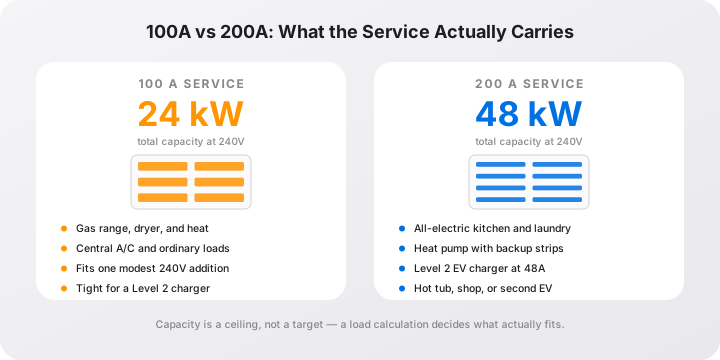
The pattern: a 100A service and a gas house are a fine match. A 100A service and an all-electric house with an EV is a math problem. Two or three big loads can put a 100A service over its limit without a single breaker tripping — the main just runs hot, the lights dim on motor starts, and nothing announces the problem until something fails.
The Load Calculation, in Plain English
Every jurisdiction works from the National Electrical Code, and the code gives an optional method for existing dwellings (Article 220.82) that is more forgiving than the nameplate-sum approach people try at the kitchen table. The shape of it:
- Add the general lighting and receptacle load for the square footage, plus the small-appliance and laundry circuits.
- Take 100% of the first 10 kVA, then 40% of everything above that. This is why a house full of ordinary outlets does not actually consume 24 kW.
- Add the largest of heating or cooling at 100%, the range and dryer at their code demand factors, and any large fixed appliance.
- Compare the total to the service rating. In practice I want headroom: a calculation that lands above roughly 80% of the service rating is a service with no room left for the next thing you buy, even if it technically passes today.
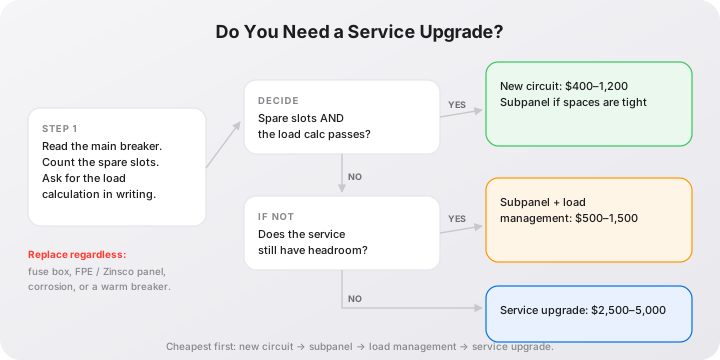
You do not need to run this yourself to get value from it — you need to ask for it. “Did you run a load calculation, and can I see the numbers?” is the single best question a homeowner can ask. A contractor who answers with a page of arithmetic is a contractor who is thinking. A contractor who answers “you need 200 amps because you want a charger” is guessing, and guessing is how people spend $4,000 to solve a $600 problem.
Signs You Actually Need the Upgrade
| What you are seeing | What it usually means | Urgency |
|---|---|---|
| Fuse box, split-bus panel, or no main breaker | Service equipment from another era | Before adding any load |
| Federal Pacific Stab-Lok or Zinsco panel | Known failure pattern, insurance flag | High — plan replacement |
| Rust, water staining, or corrosion inside the panel | Water intrusion, failing enclosure | High — inspect now |
| Warm breaker, scorched wire, burning smell | Loose termination or failing breaker | Stop using that circuit |
| Zero spare slots, tandems everywhere | Panel is full; any addition needs capacity math | Before the next project |
| 100A service with electric heat, range, dryer, and A/C | Already near the ceiling | Before adding anything |
| Adding an EV charger, heat pump, hot tub, or ADU | New large 240V load | Run the calculation first |
| Panel mounted outdoors with a rusted cover, or in a wet basement | Enclosure past its service life | Plan replacement |
Notice that “I want an EV charger” is not on that list as a standalone reason. It is a reason to run the calculation — which is a different and much cheaper step.
Signs You Do Not (And What to Do Instead)
This is the half of the conversation contractors do not get paid to have.
You have spare slots and the load calculation passes. The job is a new circuit, not a new service. A 240V circuit for a charger or a heat pump runs $400 to $1,200 depending on distance — a fraction of an upgrade. Our EV charger installation cost guide breaks that number down line by line.
Your panel is full but your service has headroom. A subpanel ($500–$1,500) buys you spaces without touching the service. This is the correct answer for a workshop, a detached garage, a finished basement, or a house where every slot is occupied by tandems but the actual load is modest.
Your load is real but intermittent. A load-management device — sometimes called an EV energy management system — watches the service and pauses or throttles the charger when the house approaches its limit. The code permits this approach for EV charging, it typically costs $500 to $1,500 installed, and it can turn a $4,000 upgrade into a $900 solution. It is not right for every house, but it is right more often than it gets offered, because it is not profitable to offer.
You can downsize the charger. A 32A charger on a 40A circuit delivers roughly 25 miles of range per hour. For most drivers that is a full overnight charge. The 48A unit is a status purchase more often than a necessity.
You can choose gas for the new appliance. A gas range, gas dryer, or gas tankless water heater sidesteps the electrical question entirely. This is not an option for everyone — venting, gas availability, and personal preference all matter — but it belongs on the list of honest alternatives.
The Day Itself: What to Expect
A straightforward service upgrade runs like this:
Week 0: Quote, contract, permit application. Ask what the permit covers and who pulls it. If the answer is “you do,” find another contractor.
Week 1–2: The utility schedules a disconnect. Some utilities require the electrician to call in the morning of the work; others give a window. This appointment, not the electrician’s calendar, is usually the long pole.
Day 1, morning: Utility pulls the meter. Power is off. The crew removes the old panel, mounts the new one, lands the service conductors, rebuilds the grounding, and terminates branch circuits. This is the noisy, dusty part.
Day 1, afternoon: Inspection. Depending on your jurisdiction, the inspector may need to see the panel open before the utility will reconnect. If the inspection does not happen the same day, your power stays off overnight.
Day 1 evening or Day 2: Utility reconnects, the crew tests every circuit, and you get a labeled directory. If the panel is not labeled when they leave, ask them to do it — our panel labeling guide shows what a usable directory looks like, and a label maker plus twenty minutes fixes whatever they left vague.
Power off for four to eight hours is normal; overnight is not rare. Plan for it. A charged portable power station covers the router, phones, and a lamp; a UPS keeps the desktop and NAS alive through the swap, which is exactly the scenario in our UPS buying guide. If anyone in the house depends on medical equipment, that conversation happens before scheduling, not on the morning of. Our outage preparation guide has the checklist.
How to Read a Quote Like an Electrician
- Permit line present? If not, the job is being done off the books, and your insurance company will care.
- Meter base and service conductors listed? A 200A panel fed by 100A conductors is a 100A service with a misleading label.
- Grounding listed? Ground rods, water bond, and bonding of metal piping. Inspectors check this first because it is what makes breakers work.
- AFCI/GFCI breakers itemized? Code-required protection on the circuits being touched. If it is missing, it will appear as a change order.
- Utility fees listed? Ask who pays the disconnect/reconnect and whether it is in the number.
- Exclusions in writing? Drywall, paint, mast replacement, and panel relocation should each be named as included or excluded.
- License and insurance requested by you, not offered. Verify the license number with your state or local board. It takes two minutes.
- Warranty on labor, not just parts. One year on workmanship is normal; ask.
Red flags worth walking away from: a quote given without looking inside the panel, a price that is less than half the others with no exclusions listed, pressure to sign the same day, and any suggestion that the permit is optional.
Where the Money Actually Saves
Bundle. If you are already paying for a service upgrade, the incremental cost of adding a 240V charger circuit, a generator interlock, or a whole-house surge protector is far below doing it separately later. The panel is open, the permit is pulled, and the electrician is already there.
Do not move the panel. Relocation adds conduit, wire, drywall, and inspection complexity for zero functional gain. Keep it where it is unless there is a real reason — flooding, clearance, or a remodel that forces it.
Do not buy 400A “for the future” unless the calculation says so. A 200A service with a load-management device handles two EVs in most households. Extra capacity you cannot use is money that never comes back.
Ask about utility and state incentives. Several utilities offer rebates or favorable rates for panel upgrades tied to electrification — heat pumps, EVs, induction. Programs vary by state and change annually, so check your utility’s current rebate page rather than trusting a blog. Be careful with any contractor who offers to “handle the rebate” by inflating the quote.
When to Stop and Call Someone
Panel work is not homeowner territory. The incoming service lugs stay energized with the main breaker off — that is not a caution, it is the reason this job has a license attached. A non-contact voltage tester is a twenty-dollar habit worth owning for outlets and switches, but it does not make anything inside that enclosure safe to touch. Call an electrician for anything behind the deadfront, and call one today for a warm panel, a burning smell, scorch marks, water inside the enclosure, or a main breaker that trips repeatedly. Our breaker triage guide walks through what each symptom means and which ones cannot wait.
If you are building or buying, the panel conversation belongs earlier. Our new construction electrical inspection checklist covers what to look at before the drywall goes up, and the home battery installation cost guide explains why storage projects so often end in a panel upgrade they did not budget for.
The Bottom Line
Most people who think they need a panel upgrade need one of three cheaper things: a new circuit, a subpanel, or a load-management device. The ones who genuinely need the upgrade usually already know why — a fuse box, a recalled panel brand, corrosion, or a house that has quietly become all-electric on a 100A service.
So the sequence is not “get three quotes.” It is: read your main breaker, count your spare slots, ask for a load calculation, and only then start collecting prices. Do that in that order and the quotes you get will describe the same job — and you will know which of them is answering the question you actually asked.
A service upgrade is one of the few home projects where the cheap version is genuinely dangerous and the expensive version is genuinely optional. Knowing which one you are looking at is worth more than any discount.
Frequently Asked Questions
How much does it cost to upgrade from 100 amp to 200 amp service?
In 2026, most U.S. homeowners pay $2,500 to $5,000 for a true 100A-to-200A service upgrade, with $3,000 to $3,800 being the common middle. That number includes the new 200A panel and main breaker, a new meter base and service-entrance conductors, an upgraded grounding electrode system, the permit, and the utility disconnect/reconnect. It does not always include drywall repair, a new mast if your service is overhead and the old one is undersized, or moving the panel to a new location. High-cost metros (California, New York, Seattle, Boston) routinely run 1.5 to 2 times these figures; rural areas can come in below them.
Do I need a 200 amp panel to install an EV charger?
Not automatically, and this is where a lot of money gets spent for no reason. A 40A charger needs a 50A circuit; a 48A charger needs 60A. On a 200A service with two spare slots and an ordinary load profile, that fits without any upgrade. On 100A service it often does not — but the fix is not always a $4,000 service upgrade. A 32A charger on a 40A circuit, or a load-management device that pauses charging when the house approaches its limit, can keep you legal and safe for a few hundred dollars. The only honest way to know is a load calculation on your actual house.
How long does a panel upgrade take, and how long is the power off?
Plan on one to two days on site for a straightforward 200A service upgrade, plus one to three weeks of lead time for the permit and the utility disconnect appointment. The power itself is usually off for four to eight hours on the main day — the utility pulls the meter in the morning and reconnects after the new service passes inspection, which sometimes means overnight without power. That gap is the part nobody plans for: move frozen food, charge backup batteries, and have a plan for medical equipment before the crew arrives.
Can I just add a subpanel instead of upgrading the service?
Only if your existing service has capacity to spare. A subpanel adds breaker spaces; it does not add capacity. If your 100A service is already carrying an electric range, a dryer, and central air, a subpanel full of new circuits will simply trip the 100A main more often. Where a subpanel is the right answer — a detached garage, a workshop, a finished basement, or a panel that is physically full of tandems but has headroom in the load calculation — it costs $500 to $1,500 installed and saves you thousands.
How can I tell whether my panel is 100A or 200A?
Open the door and read the largest breaker at the top: the number on its handle is your service size — 100, 150, or 200. If the main is not labeled, look for the manufacturer's sticker inside the door, which lists the panel's rating, or read the meter base outside. Two warnings: the sum of the branch breakers tells you nothing about service size, and a 200A-rated panel can be fed by a 100A service. When the label and the main disagree, the main breaker and the incoming wire gauge win, and that is a question for an electrician.