EV Battery Degradation: How Fast It Really Happens & When to Replace
In the equipment room where I work, we do not wait for a battery to die before we replace it. We pull the string on a schedule — every three to five years for the sealed lead-acid banks that keep our UPS systems alive — because by the time a battery fails a load test, it is already too late. The day we need it is exactly the wrong day to discover it only holds 60% of what it did when it was new.
An EV battery is the same physics, just better managed and much slower. The lithium-ion cells in your car lose capacity the same way our UPS batteries do: through irreversible chemistry that happens every time you charge, every time you discharge, and every day the battery simply sits there existing. The difference is that an EV’s battery management system works constantly to slow that loss down.
Here is what I have learned watching battery banks degrade in real time, and how it applies to the battery in your driveway.
The Chemistry, Without a Textbook
You do not need a PhD to understand why an EV battery loses capacity. It comes down to a few reactions that happen inside every lithium-ion cell.
A lithium-ion cell stores energy by moving lithium ions back and forth between two electrodes — an anode (graphite) and a cathode (a metal oxide like nickel-manganese-cobalt). Every full cycle, those ions shuttle across, and every trip does a tiny amount of permanent damage:
- The SEI layer. On the very first charge, a thin film called the solid electrolyte interphase (SEI) forms on the anode. It is necessary — the cell would not work without it — but it consumes a little lithium in the process. Over time the SEI keeps thickening, slowly trapping lithium ions so they can no longer shuttle back and forth. That trapped lithium is lost capacity. This is the dominant degradation mechanism in most EVs, and it happens even if the car sits unused.
- Lithium plating. If you charge too fast, especially when the battery is cold or already nearly full, lithium can deposit as metal on the anode instead of intercalating into the graphite. That metallic lithium is essentially lost forever, and in the worst case it can grow into structures that shorten the cell. This is why fast charging is hard on a battery.
- Cathode wear. High voltage (a full charge) and high temperature stress the cathode’s crystal structure, slowly reducing how many ions it can accept. This is why sitting at 100% — which holds the cell at its highest voltage — accelerates aging.
Notice what I did not list: the battery “wearing out” from being used too much. Cycle life is real, but for most EV owners it is not the limiting factor. Two separate clocks are running, and they both matter.
Calendar aging is the loss that happens with time, whether or not you drive. It is driven by temperature and the state of charge the battery is stored at. A ten-year-old EV with only 30,000 miles on it will still have lost a meaningful chunk of capacity, because the clock has been ticking since the day the pack was built.
Cycle aging is the loss from actually using the battery — charging and discharging. A full cycle (0% to 100%) costs more than two half-cycles (20% to 70% twice), which is why shallow, partial charging is gentler on the pack.
For a low-mileage driver, calendar aging dominates. For a high-mileage driver, cycle aging catches up. Either way, the battery is degrading; the only question is how fast.
The Real-World Degradation Curve
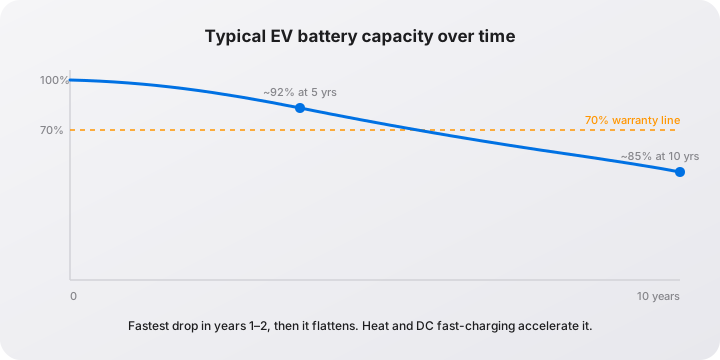
The good news, and the thing most “your EV battery will die in five years” articles get wrong, is that degradation is not linear. It is an S-curve: a slightly steeper drop in the first year or two, then a long, flat plateau, then (many years later) an accelerated decline as the pack genuinely reaches end of life.
Here is what real fleet data shows. Telematics studies across hundreds of thousands of EVs consistently land in the same ballpark:
| Vehicle age | Typical remaining capacity | Notes |
|---|---|---|
| New | 100% | Includes a small hidden buffer you never see |
| 1 year | 97–98% | The initial “break-in” drop |
| 3 years | 94–95% | Roughly 1.5–2% per year so far |
| 5 years | 90–92% | Still 250+ miles on a 300-mile EV |
| 8 years | 85–88% | Around the warranty milestone for most packs |
| 10 years | 80–85% | A 300-mile EV still delivers ~250 miles |
| 12–15 years | 75–80% | Approaching the warranty “70%” line for some packs |
These are typical ranges, not guarantees — I am giving you the center of the bell curve, and your result depends heavily on climate and habits. A car kept in a hot climate and fast-charged daily might hit 85% at five years; a temperate-climate LFP car charged gently at home might still be at 95%.
The manufacturer’s own data tells the same story. Tesla has published figures showing its packs retaining roughly 90% of capacity after 200,000 miles of driving, and independent tracking of long-range Model 3s and Model S vehicles consistently shows 88-92% retention at the 100,000-mile mark. Modern packs are not the fragile things people feared a decade ago.
The single most important variable is not how far you drive — it is where you live and how you charge.
What Actually Kills an EV Battery, Ranked
I have watched this same physics play out in the UPS batteries I maintain. A sealed lead-acid string kept at a high float voltage in a warm room dies years early; an identical string kept cool and at a moderate float voltage lasts its full life. The mechanisms are different, but the lesson is the same: heat and holding a battery at a high state of charge are the two things that do the most damage.
Here is what actually moves the needle on an EV pack, in rough order of impact:
| Factor | Severity | What it actually does | What to do instead |
|---|---|---|---|
| Heat (hot climate, parking in sun) | High | Accelerates every degradation reaction; sustained temps above ~86°F (30°C) speed up SEI growth and cathode wear | Park in shade or a garage; use a thermal-managed charger in extreme heat |
| Sitting at 100% charge | High | Holds cells at maximum voltage, stressing the cathode; worst when combined with heat | Keep daily charge at 80%; charge to 100% only before a long trip |
| Daily DC fast charging | Medium–High | High-rate charging generates heat and can plate lithium on the anode | Fast charge only on road trips; use Level 2 for daily charging |
| Deep discharge (regularly to 0%) | Medium | Running the pack to empty and leaving it there stresses cells | Plug in before you get below 10–20% |
| Charging when very cold | Medium | Lithium can plate if you fast charge a cold-soaked battery | Precondition before fast charging in winter; the car does this automatically |
| Occasional fast charging, normal driving | Negligible | Modern BMS throttles the rate to protect cells | Don’t overthink it |
The worst-case combination is a car that lives in Phoenix or South Florida, gets DC fast charged as the owner’s only source of fuel, and is parked at 100% every night. That car will degrade at the top of the range. The best case is a mild climate, home Level 2 charging, and a daily limit of 80%.
The thing worth internalizing: the battery is never “fine, fine, fine, then dead.” It is a slow slide. The difference between good and bad habits is the difference between losing 1% a year and losing 2.5% a year — which over eight years is the difference between a car that still does 285 miles and one that does 240.
Chemistry Matters: NMC vs LFP
Not all EV batteries age the same, and it is worth knowing which one you are buying.
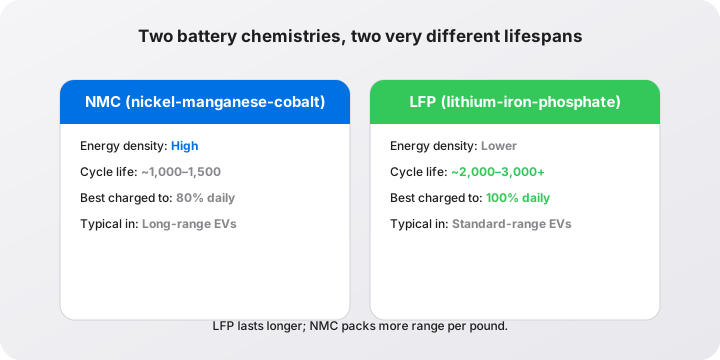
NMC and NCA (nickel-manganese-cobalt and nickel-cobalt-aluminum) are the high-energy chemistries used in long-range vehicles. They pack more energy per pound, but they are more sensitive to sitting at 100% and more affected by heat. These are the batteries where the “keep it between 20% and 80%” advice matters most.
LFP (lithium iron phosphate) is the chemistry showing up in more base-model and standard-range EVs every year. It stores slightly less energy per pound, but it degrades more slowly, tolerates a daily 100% charge far better, and lasts more cycles. LFP packs are routinely rated for 3,000 to 5,000 full cycles — enough for a million miles in many vehicles — versus roughly 1,000 to 1,500 full cycles for NMC.
| Characteristic | NMC / NCA | LFP |
|---|---|---|
| Energy density | Higher (longer range per pound) | Lower (slightly heavier pack) |
| Calendar degradation | ~1.5–2% per year typical | Often under 1% per year |
| Cycle life | ~1,000–1,500 full cycles | ~3,000–5,000 full cycles |
| Sensitivity to 100% charge | Higher — best kept at 80% daily | Lower — a daily full charge is generally fine |
| Sensitivity to heat | Higher | Lower |
| Typical use | Long-range, performance trims | Standard range, base trims, fleet vehicles |
Here is the practical takeaway: if you buy an LFP car, you can charge it to 100% every night and barely think about it. If you buy an NMC car, the 80% habit genuinely extends its life. Either way, the pack will almost certainly outlast the rest of the car in most climates.
How to Actually Check Your Battery’s Health
You cannot measure battery health by looking at the dashboard range, because range is a forecast, not a measurement. It shifts with temperature, driving style, and recent history. The car’s guess is useful, but it is not the same thing as knowing the actual state of health.
There are three ways to get a real number:
The in-car estimate, used correctly. Charge to a known level (say 80%) on a consistent day and compare the displayed range to what the car showed at 80% when new. If you have tracked it, this gives a rough long-term trend. It is coarse, but it costs nothing.
An OBD-II dongle and an app. A cheap Bluetooth OBD-II reader plus an app that reads the battery management system (like the popular third-party EV telemetry apps) will report state of health (SOH) as a percentage, along with cell voltage spread and total battery capacity in kilowatt-hours. This is the same data a technician sees, and it is the most accurate consumer-level check available. You are looking for SOH — anything above 90% on a several-year-old car is excellent, 80-90% is normal, and below 70% is where warranties and serious range questions begin.
A dealer or manufacturer diagnostic. Tesla offers a battery health test in the service menu, and most manufacturers can run a diagnostic through the dealer network. This is the number that matters if you are considering a warranty claim, because it is the one the manufacturer will use.
What you are looking for is not just the headline number. Watch the cell voltage spread — if one cell group reads meaningfully lower than the others under load, that is an early sign of a weak cell, and a weak cell can fail long before the rest of the pack.
When Do You Actually Replace It? The Honest Answer
Here is the part where I stop the panic. The 70% number that gets thrown around is a warranty threshold, not a functional one. It is the line below which a manufacturer must do something about the battery during the warranty period. It is not the line where the car stops working.
A battery at 75% of original capacity is not broken. It is a car that used to go 300 miles and now goes 225. If your daily commute is 40 miles, that difference is irrelevant — the car still does everything you need, you just plug in a little more often.
The honest test for replacement has nothing to do with a percentage:
- Does the car still meet your daily needs? If you can do your commute, errands, and routine driving without anxiety, the battery does not need replacing, no matter what the SOH reads.
- Is there a hard failure? A dead cell, a BMS fault, or a pack that throws error codes and refuses to charge is a genuine replacement situation — but that is a component failure, not degradation.
- Has range fallen below a trip you actually take? If a regular weekend trip now requires a charging stop you used to skip, and that genuinely bothers you, then replacement becomes a financial decision.
If you do get to that point, here is what replacement actually costs, so you can weigh it against the car’s value:
| Replacement scenario | Rough cost | Notes |
|---|---|---|
| Third-party refurbished pack | $3,000–$8,000 | Independent shops; limited warranty, mixed quality |
| Single module replacement | $2,000–$5,000 | Fixes a weak module, not full-capacity restore |
| OEM pack for a mainstream EV (e.g., Bolt, Leaf) | $5,000–$12,000 | Dealer price; newer packs are cheaper per kWh |
| OEM pack for a premium/long-range EV (e.g., Model S/X, Lucid) | $12,000–$20,000+ | Large packs, expensive cells |
These are estimates based on public pricing, not quotes, and they are the main reason almost nobody replaces an EV battery proactively. The pack in a ten-year-old car can cost more than the car is worth, which is exactly why most degraded batteries stay in service until the car is retired — not because the battery “died,” but because the economics of the whole vehicle stopped making sense.
That is the real answer to “when should I replace my EV battery”: almost never, as a maintenance item. You replace it when a cell fails, or when the whole car has reached the end of its economic life. Degradation below the warranty line is not the same thing as failure.
The Bottom Line
Your EV battery will lose capacity — that is chemistry, not a defect — but it will do it slowly. Expect roughly 1-2% per year, a bit faster in the first two years, and around 85-90% capacity remaining at the eight-year mark for a well-treated pack.
The two habits that actually protect it cost you nothing: keep the daily charge at 80% (unless it is LFP, which is happy at 100%), and avoid making DC fast charging your only source of fuel. Heat is the enemy you cannot fully control, but parking in shade and avoiding a full charge on the hottest days helps more than most people realize.
Do not confuse the warranty’s 70% threshold with the point where the car stops working. A 75% battery still serves most drivers perfectly. Check your actual state of health with an OBD-II reader before you worry, and do not let a low dashboard range on a cold morning convince you the pack is dying — it is usually the weather, not the battery.
If you are setting up home charging to be gentle on the pack, start with my EV charger installation cost guide — a properly sized Level 2 charger is the single best thing you can do for battery longevity. The same lithium chemistry and degradation math also governs the home battery systems that back up your house, and the Powerwall alternatives I have evaluated wear out on the same schedule.
Frequently Asked Questions
How much does an EV battery degrade per year?
For a modern NMC or NCA battery, expect roughly 1% to 2% of capacity lost per year after a slightly faster drop in the first year or two. Real-world fleet data averages around 1.8% per year, so a typical EV holds roughly 90% of its original capacity after five years and 80-85% after ten. LFP (lithium iron phosphate) batteries degrade slower, often losing less than 1% per year. Temperature, charging habits, and how often you DC fast charge all move that number up or down.
When does an EV battery need to be replaced?
There is no hard mileage number. Most manufacturers warrant the battery against dropping below about 70% of original capacity within 8 years or 100,000 miles, so 70% is the number people treat as the replacement line. Functionally, a battery at 75% still works fine — it just has less range. You only really need to replace a pack when it no longer meets your daily driving needs, or when a cell fails outright. Full replacement typically costs $5,000 to $15,000, which is why most people keep a degraded-but-working battery for years.
What kills an EV battery the fastest?
Heat is the number one accelerator, especially sustained high temperatures combined with a battery sitting near 100% charge. Storing the car at 100% for long periods stresses the cells because the voltage stays high, and DC fast charging frequently adds heat and can cause lithium plating on the anode. The worst combination is a hot climate, daily DC fast charging, and parking the car full every night. Occasional fast charging and the occasional full charge for a road trip are harmless.
Does DC fast charging really damage the battery?
Occasional DC fast charging is fine — the car's battery management system throttles the charge rate to protect the cells. The damage comes from making it your only charging method, because repeated high-rate charging generates heat and can plate lithium onto the anode, permanently reducing capacity. If you charge at home on Level 2 most of the time and fast charge only on road trips, you will not meaningfully shorten the battery's life. If fast charging is your daily routine, expect degradation on the higher end of the range.
Is the range loss from an old battery, or something else?
Most of the time when a driver notices less range, it is not capacity loss. Cold weather, a heavy foot, roof racks, tire pressure, and cabin heating all cut range far more than a few percent of degradation. Before you blame the battery, compare range on a warm day driving gently with the climate off. The only reliable way to know actual battery health is to read the state-of-health percentage from the battery management system, either in a service menu or through an OBD-II dongle and an app.