EV Battery Warranty: What's Actually Covered (and the Fine Print)
A driver I know was convinced his car’s battery was about to be replaced for free. It was seven years old, down to about 74% of its original range, and he had read somewhere that “batteries are warrantied to 70%.” He figured he was four percentage points away from a brand-new pack at the manufacturer’s expense.
He was wrong, and it took an hour with the warranty text to see why. The warranty covered defects and premature failure — not the slow, normal loss of capacity his car had experienced. His battery was aging exactly the way batteries age, and that was explicitly not covered.
I buy and maintain industrial battery banks for a living, and the fine print in an EV battery warranty reads exactly like the fine print in the contracts I sign for UPS battery strings: the vendor covers a battery that fails early or falls short of spec, but “normal aging” is on you. The difference is that when my battery banks underperform, I call a supplier who knows the rules. Most EV owners never read the rules until the moment they need to make a claim — which is the worst time to learn them.
Here is what an EV battery warranty actually covers, what it does not, and how to protect yourself.
The Legal Minimums You Should Know
EV battery warranties in the United States are not just marketing — they are required by regulation. The federal government treats the battery as an emissions-related component, and under federal rules every EV and plug-in hybrid battery sold in the U.S. must be warranted against failure and excessive degradation for at least 8 years or 100,000 miles, whichever comes first.
California — and the states that follow its air-quality rules — go further, requiring 10 years or 150,000 miles for qualifying vehicles. Since California is the largest EV market in the country, a meaningful share of the EVs on U.S. roads carry that longer floor.
Most manufacturers voluntarily exceed the federal minimum anyway, which is why the “standard” numbers you see vary:
- Hyundai and Kia: 10 years / 100,000 miles with a 70% capacity retention guarantee.
- Ford, BMW, Volkswagen, GM, and most others: 8 years / 100,000 miles, generally with a 70% threshold.
- Tesla: 8 years, with mileage varying by model — 100,000 for Standard Range Model 3/Y, 120,000 for Long Range and Performance, and 150,000 for Model S and X.
- Rivian: 8 years / 150,000 to 175,000 miles depending on model and battery pack, with a 70% threshold.
The warranty transfers to a subsequent owner in almost all cases, which is one reason a used EV’s remaining battery warranty has real value when you are shopping.
The 70% Threshold, and the Fine Print Behind It
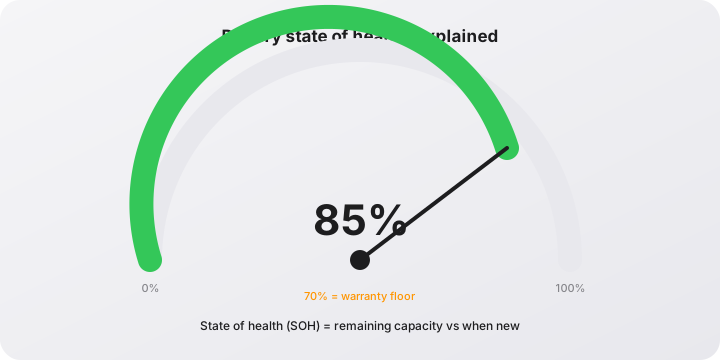
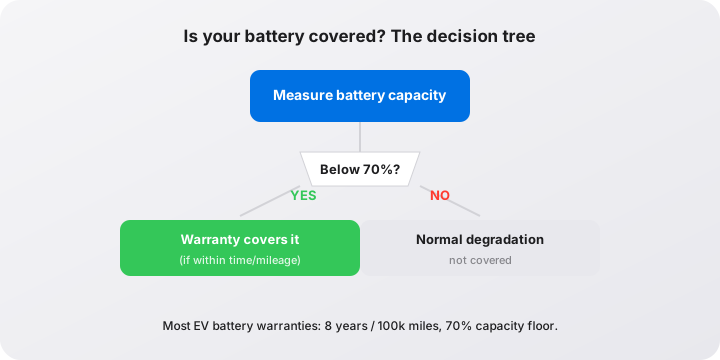
The number you have probably heard is “70%.” Most manufacturers promise that if your battery’s capacity drops below 70% of its original capacity within the warranty window, they will repair or replace it to restore at least that much. That sounds generous until you understand three things.
First, 70% is a hard line, not a sliding scale. A battery at 69% is a warranty claim; a battery at 71% is not. There is no partial credit for “almost” hitting the threshold. That is fine — it is how thresholds work — but it explains why so many owners near the line get frustrated. Their car lost nearly a third of its range and the manufacturer owes them nothing.
Second, “normal degradation” is excluded. This is the fine print that trips up the most people. Nearly every warranty contains language to the effect of “gradual capacity loss over time and use is not covered.” The warranty covers a battery that fails early or drops below threshold because of a defect — not a battery that simply aged the way batteries age. My 74%-capacity friend was a perfect example: his car was seven years old, and losing 26% over seven years is on the normal end of the curve, not a defect.
Third, the thresholds are not all 70%. Nissan’s Leaf historically used a “bar” system where the capacity warranty kicked in at 9 of 12 bars — roughly 66% — rather than 70%. Some early GM packs used 60%. And Tesla’s warranty famously publishes no specific percentage at all, covering “defects” and excluding “gradual” loss without ever naming a number. That vagueness cuts both ways: it gives Tesla discretion, and it makes a Tesla capacity claim harder to pin down than one from a brand that states 70% in black and white.
The practical takeaway: a warranty claim is almost always about a hard failure — a dead cell, a pack that stops charging, a BMS fault — not about a battery that slowly got less efficient. Slow capacity loss is the one thing you can count on the warranty not to cover.
Battery Warranty vs Drivetrain vs Bumper-to-Bumper
One of the most common confusions is which warranty covers what. A new EV actually ships with several overlapping warranties, and the battery one is separate from the rest:
| Warranty type | Typical length | What it covers |
|---|---|---|
| Bumper-to-bumper (basic) | 3 years / 36,000 miles | Nearly everything except wear items, tires, and the battery’s long-term coverage |
| Powertrain / drivetrain | 5 years / 60,000 miles | Motor, gearbox, axles, and mechanical drive components |
| Battery (and electric drive unit) | 8–10 years / 100,000–150,000 miles | The high-voltage battery pack against defects and capacity loss below threshold; often bundled with the electric motor/inverter |
| Rust/perforation | Varies (often 5–12 years) | Body corrosion |
The key point: the battery is covered separately and longer than the rest of the car. Your 3-year bumper-to-bumper warranty expiring does not mean your battery coverage expired — the battery keeps its 8-year (or longer) clock running. Many owners do not realize this and pay out of pocket for a battery issue in year five that would have been covered.
There is also a subtle split within the battery warranty itself. On some vehicles, the “battery warranty” and the “electric drive unit / propulsion warranty” are listed together, covering both the pack and the motor/inverter that drives the wheels. Others split them. Worth knowing which one you are dealing with before you file a claim.
What Voids the Warranty
Manufacturers are not looking for reasons to deny a legitimate battery claim, but there are clear lines that will void coverage, and most of them are common sense once you hear them:
| Action | Effect on warranty | Why |
|---|---|---|
| Salvage / branded title | Voids coverage | The manufacturer has no knowledge of the vehicle’s condition after a total loss |
| Physical damage to the pack (accident, rock strike, off-roading) | Voids for the damaged component | Damage is an external event, not a defect |
| Water ingress / submersion | Voids | Usually from an accident or off-roading, not a manufacturing fault |
| Unauthorized modifications or third-party “unlock” software | Voids | Tampering with the BMS or cells is explicitly excluded |
| Third-party battery repair/rebuild | Voids | Only manufacturer-authorized work is covered |
| Rideshare / commercial use (where excluded) | May void | Tesla and others exclude taxi/Uber-style use unless the vehicle was sold for it |
| Neglecting maintenance (battery coolant) | May void | Failure to follow the service schedule |
Notice what is not on the list: high mileage, home charging, occasional DC fast charging, charging to 100%, and daily driving. None of those void an EV battery warranty. The warranty does not require you to baby the battery — it requires you not to damage it, tamper with it, or drive it as a taxi without telling anyone.
The two claims I see denied most often in the real world are salvage titles (people buy a flooded or totaled EV cheaply and are shocked the battery is not covered) and physical damage that the owner assumed was covered. Neither is a surprise if you read the exclusions first.
Manufacturer Comparison at a Glance
Here is a representative look at the major EV battery warranties. Treat these as the headline numbers — exact terms shift by model year, and the fine print always wins over the summary:
| Manufacturer | Years / miles | Capacity threshold | Notable fine print |
|---|---|---|---|
| Tesla | 8 / 100k–150k | Not published | Covers “defects”; excludes gradual capacity loss without a stated % |
| Hyundai / Kia | 10 / 100k | 70% | Among the longest; strong capacity guarantee |
| Ford (Mustang Mach-E, F-150 Lightning) | 8 / 100k | 70% | Battery + electric drive components |
| GM (Chevy Bolt, Equinox EV) | 8 / 100k | 60–70% (varies by year) | Threshold has shifted over model years |
| BMW (i4, iX) | 8 / 100k | 70% | Clear, straightforward percentage |
| Volkswagen (ID.4) | 8 / 100k | 70% | Covers battery and drive unit |
| Nissan Leaf | 8 / 100k | ~66% (“9 bars”) | Uses a bar-based capacity gauge, an outlier |
| Rivian | 8 / 150k–175k | 70% | Longest mileage coverage in the segment |
The pattern is consistent: almost everyone covers you for 8 years and 100,000 miles against failure, and most state 70% as the capacity line. The meaningful differences are at the margins — Hyundai’s extra two years, Rivian’s extra mileage, Tesla’s missing percentage — and those margins are exactly what you should compare if you are deciding between two cars and plan to keep it long-term.
How to Protect Your Claim
The warranty is only as good as your ability to document a problem while it is still covered. Here is how to protect yourself, drawn from how I handle battery-bank warranty claims on the job:
Document the health early and often. Have the dealer run a battery health diagnostic once a year, or pull your own state-of-health reading with an OBD-II dongle and a telemetry app. A dated record showing the battery at 95% at year two makes a “it was always like this” claim at year six much harder for a manufacturer to dodge. The owner who can show a clear downward trend is in a far stronger position than the one who calls only after the battery stops working.
Follow the maintenance schedule. For most EVs the main battery-related maintenance item is the coolant, which the thermal management system relies on. Skip it, and you hand the manufacturer a reason to deny a claim. Keep the receipts.
Do not tamper. Third-party “range unlock” software, cell modifications, and unauthorized repairs are the fastest ways to void a warranty. Nothing you can buy on a forum is worth losing an 8-year battery warranty over.
Report problems promptly, in writing. If you see a sudden range drop or a warning light, contact the dealer and get it on record before the warranty expires. A documented complaint during the warranty period protects you even if the diagnosis drags past the end date. Email is better than a phone call, because it leaves a timestamped trail.
Know your threshold and your number. Before you file a capacity claim, know what your manufacturer’s stated threshold is — 70%, 66%, or, in Tesla’s case, nothing at all — and know your actual measured state of health. Walking in with a measured 68% and a documented history is a very different conversation from walking in with “it feels like the range dropped.”
The Bottom Line
Your EV battery warranty is a real, legally-required safety net that covers defects and premature failure for 8 to 10 years and 100,000 to 150,000 miles. It is not — despite what a lot of forum chatter suggests — a promise to give you a free new battery when your range slowly declines. Normal degradation is excluded, and the 70% threshold is a hard line that most well-treated batteries never cross during the warranty window anyway.
So protect yourself the practical way: know your specific warranty’s years, miles, and capacity threshold; document your battery’s health annually; follow the maintenance schedule; and do not tamper. If your battery genuinely fails or falls below threshold ahead of schedule, a well-documented owner has a strong claim. If it merely aged normally, no amount of range anxiety turns that into a warranty — and honestly, a battery that has degraded to 82% over eight years is not broken. It is just a used car battery, doing exactly what batteries do.
If you want to slow that degradation in the first place, the habits that matter — daily 80% charging, home Level 2 over DC fast — are covered in my battery degradation guide. And a properly installed home charger is both the gentlest way to charge and the setup that makes home-off-peak savings possible.
Frequently Asked Questions
What is the standard EV battery warranty?
The federal minimum for EVs sold in the U.S. is 8 years or 100,000 miles, whichever comes first, covering the battery against defects and excessive capacity loss. California and states following its rules require 10 years or 150,000 miles for qualifying vehicles. Most automakers meet or exceed this: Hyundai and Kia offer 10 years or 100,000 miles, Tesla offers 8 years with 100,000 to 150,000 miles depending on the model, and Rivian offers 8 years with up to 175,000 miles.
What does the 70% battery warranty threshold mean?
Most manufacturers promise that if the battery's capacity falls below 70% of its original capacity within the warranty period, they will repair or replace it. The fine print matters: this only covers abnormal degradation, not the normal gradual loss every battery experiences. A battery that drops to 71% — even a month before the warranty ends — is not covered, because 70% is a hard cutoff, not a sliding scale. Some brands use 60% or 66%, and Tesla publishes no specific percentage at all, which makes its standard harder to pin down.
What voids an EV battery warranty?
The big ones: a salvage or branded title, physical damage to the pack (from an accident, rock strike, or off-roading), water ingress, unauthorized modifications or third-party repairs, and using the vehicle for commercial rideshare in the cases where the manufacturer excludes it. Neglecting required maintenance — mainly the battery coolant — can also void coverage. Normal driving, home charging, occasional DC fast charging, and even a high-mileage battery do not void the warranty on their own.
Does gradual battery degradation get covered by warranty?
No, and this is the single biggest misconception about EV battery warranties. The warranty covers defects and premature failure, plus capacity loss below the stated threshold — not the normal, expected loss of a few percent per year that every battery experiences. If your battery degrades from 100% to 82% over five years, that is normal aging and is not a warranty claim, even though you have lost range. The warranty only kicks in if the pack fails outright or falls below the capacity threshold well ahead of schedule.
How do I protect my EV battery warranty claim?
Document everything. Keep your service records, follow the manufacturer's maintenance schedule — especially battery coolant — and have the dealer run a battery health diagnostic periodically so you have a dated record of state of health. If you suspect excessive degradation, get it documented by the dealer or with an OBD-II reading before the warranty expires. Never tamper with the battery, avoid third-party 'unlock' or 'range hack' software, and report problems promptly in writing so there is a paper trail.