EV Charger Installation Cost in 2026: Level 2 Home Charger Guide
A homeowner called me out last month to look at a “charger that won’t charge.” He had bought a 48A Level 2 charger online, mounted it himself next to a dryer outlet he never used, and wired it in with an adapter he found on a marketplace site. The charger was fine. The 30-amp dryer circuit he had tapped into was not — the outlet was melted, the breaker was tripping, and the wire in the wall had been running hot for weeks before he noticed the smell.
The charger cost him $500. Fixing the circuit — replacing the outlet, the damaged wire, and adding a proper dedicated 240V circuit — cost him $1,800, and he is lucky the wall did not catch fire.
This guide exists so you pay the right price the first time. Here is what a home EV charger install actually costs in 2026, and what determines whether your number is $700 or $5,000.
The Real Cost Breakdown
EV charger installs have a frustratingly wide price range because the “simple” version and the “complicated” version are different jobs wearing the same name. Here is what a typical single-family-home Level 2 install costs, line by line:
| Component | Typical cost (2026) | Notes |
|---|---|---|
| Level 2 charger unit (32-48A) | $350 – $700 | Quality hardwired-capable units from reputable brands. Basic 32A portable units run $250-400. |
| Electrician labor | $300 – $800 | Straightforward install: panel in the garage, charger within ~25 ft. |
| Wire and conduit | $50 – $200 | 6 AWG for 48A, 8 AWG for 32-40A. Longer runs add $5-15/ft. |
| Breaker (50-60A, 2-pole) | $15 – $40 | Matches the charger amperage. |
| Permit and inspection | $50 – $250 | Varies widely by municipality. |
| Total, straightforward install | $700 – $1,600 | Most people land around $1,000-1,300. |
| Panel upgrade (100A → 200A) | $1,500 – $3,500 | Only if needed. |
| Service upgrade (full replacement) | $2,000 – $5,000 | Old panels, federal panels, or undersized service. |
| Long wire run (garage far from panel) | +$5 – $15/ft | Detached garage or panel on the opposite side of the house. |
These are real ranges from quotes I have reviewed, not brochure numbers. If a quote comes in under $500 for a hardwired install with a permit, ask what is being skipped — it is usually the permit, or the breaker, or the “hardwired” part.
Level 1 vs Level 2: The Numbers That Matter
The single most common mistake is buying a Level 2 charger when a Level 1 setup — the cord that came with your car, plugged into a standard wall outlet — would have been plenty. Or the reverse: limping along on Level 1 and being perpetually short on range.
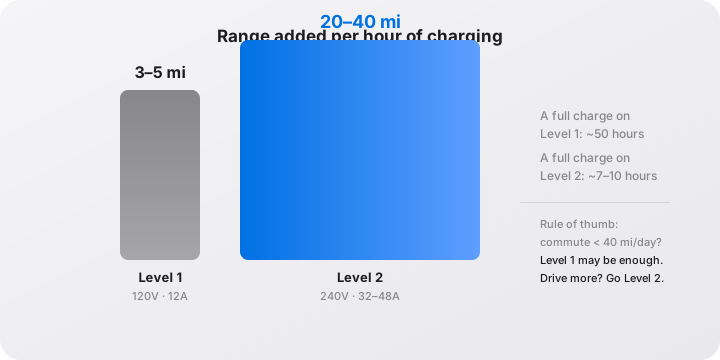
Here is the honest comparison for a typical EV (roughly 3.5 miles of range per kilowatt-hour):
| Level 1 (120V) | Level 2 (240V) | |
|---|---|---|
| Power delivered | ~1.4 kW (12A) | 7.7 – 11.5 kW (32-48A) |
| Range added per hour | 3 – 5 miles | 20 – 40 miles |
| Full charge (75 kWh battery) | ~50 – 55 hours | ~7 – 10 hours |
| Overnight charge (10 hrs) | 30 – 50 miles | 200 – 400 miles |
| Install cost | $0 (existing outlet) | $700 – $1,600 |
| Best for | Short daily commutes, occasional drivers | Most EV owners, long commutes, multi-EV homes |
The rule of thumb: if your daily round-trip commute is under 40 miles, Level 1 gets you through the week if you plug in every night. If you drive more, take frequent weekend trips, or your EV has a large battery, Level 2 removes the anxiety entirely.
NEMA 14-50 Outlet vs Hardwired: The Real Trade-Off
When you do go Level 2, you have two ways to connect the charger, and they are not equivalent:
| Feature | NEMA 14-50 outlet | Hardwired |
|---|---|---|
| Max charging speed | 40A (9.6 kW) — limited by the 80% rule | 48A (11.5 kW) — full speed |
| Equipment cost | Outlet + charger | Charger only (no outlet needed) |
| Install cost | $200 – $500 (outlet only) | $300 – $700 |
| Portability | Unplug and take the charger with you | Must be removed by an electrician |
| GFCI nuisance tripping | Possible (2020 NEC+ requires GFCI on 240V outlets) | Not an issue (charger has internal protection) |
| Best for | Renters, people who may move, flexibility | Homeowners planning to stay, fastest charging |
The 80% rule is the part most people miss: a circuit used for continuous loads like EV charging must not be loaded past 80% of its rating. A 50-amp outlet means a 40-amp charger, max. A hardwired charger on a 60-amp circuit can run at 48 amps — about 20% faster.
There is also the GFCI issue. Since the 2020 National Electrical Code, any 240-volt receptacle installed for EV charging requires GFCI protection. The problem: many chargers have GFCI built in, and two GFCI devices on the same circuit can trip each other for no reason. Hardwiring sidesteps this entirely, which is one reason electricians increasingly recommend it.
If you want flexibility and a plug-in setup, a quality NEMA 14-50 EV outlet paired with a well-reviewed portable Level 2 charger is a solid path. For a permanent, fastest-charging install, a 48A hardwired Level 2 charger is the better tool.
The Panel Upgrade Nobody Mentions
The charger itself is the cheap part. The expensive surprise is almost always the electrical panel.
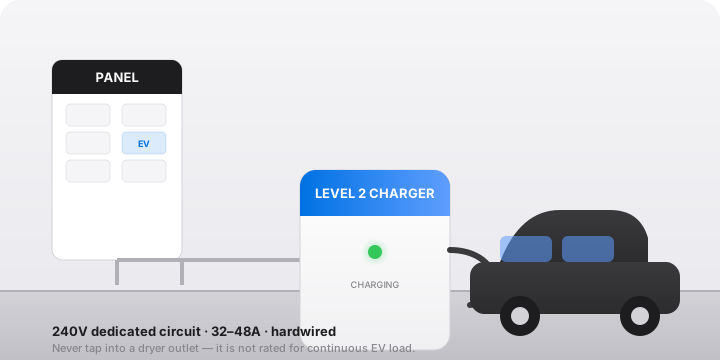
A 48A Level 2 charger needs a dedicated 60-amp circuit. A 40A charger needs 50 amps. If your panel has two spare breaker slots and your home has 200-amp service, you are fine. If your panel is full, or your service is only 100 amps, the conversation changes:
- Full panel: A sub-panel or a panel replacement. A sub-panel adds $500-1,200; replacing the panel is $1,500-3,500.
- 100-amp service: A 48A charger draws 60A by itself. Add your AC, dryer, oven, and range, and you can trip the main breaker while charging overnight. The fix is a service upgrade to 200A, typically $2,000-5,000 depending on your utility and whether the meter base needs replacing.
The workaround that saves a lot of people: install a 32A charger on a 40A circuit. It charges a typical EV from 20% to 80% in about 7 hours, which is plenty for overnight charging, and it usually fits on existing 100A or 150A service without an upgrade. You trade a couple hours of charging time for $3,000 you do not spend.
A licensed electrician should run a load calculation — a documented tally of every circuit against your service size — before quoting anything. If an electrician quotes an EV charger install without once looking at your panel or asking about your service size, get a second quote.
Surge Protection: The Add-On You Should Not Skip
An EV charger is a permanently wired, always-energized 240V appliance sitting in your garage. When a surge hits your home — lightning nearby, or the utility switching events I write about elsewhere — the charger is a direct path for that energy into your car’s onboard charger, which is one of the most expensive single components on the vehicle to replace.
At minimum, install a whole-house surge protector at the panel. For a home with an EV charger, this is not an optional upgrade — it is cheap insurance (roughly $250-700 installed) protecting both the charger and everything downstream of it. If you have already been thinking about surge protection, this is the moment to do it, because the electrician is already in your panel for the charger install. You can read the full cost breakdown and what drives the price in my whole-house surge protector cost guide.
Permits: Not Optional
EV charger installs require an electrical permit in nearly every jurisdiction, and the inspector will check for exactly the things people skip: the dedicated circuit, the correct wire gauge, the 80% rule, and (for outlets) the GFCI requirement.
The permit costs $50-250 and adds a small amount of time. Skipping it saves a little money and can cost you far more later — insurance claims after an electrical fire get denied over unpermitted work, and unpermitted chargers are a red flag when you sell the house. This is the same logic as a generator transfer switch install — the permit is proof the work was done to code, not a tax on your project.
DIY vs Hiring an Electrician
I am a licensed electrician, and I still want you to hire someone for this. A Level 2 install means running a new 240V circuit from your panel, which means opening the panel and working near conductors that are live even with the main breaker off. There is no switch that de-energizes the incoming service side. This is how experienced people get hurt.
Beyond the shock hazard, there is a less obvious failure mode: an outlet that was never rated for continuous EV load. EV charging is the most demanding continuous load most homes ever see — hours at a time, night after night, at near the circuit’s limit. A cheap receptacle or a loose connection that would survive a dryer’s intermittent use will melt under that duty cycle. I have seen the melted outlets. They all looked fine until the night they did not.
Hire a licensed electrician, pull the permit, and specify an industrial-grade outlet if you go the 14-50 route. The labor is the smaller part of the bill, and this is one job where the expertise is worth every dollar.
EV Charger + Home Battery + Backup Power
If you are going to invest in your home’s electrical system, think about how the pieces fit together.
An EV is, effectively, a massive battery parked in your garage. It holds 10-20 times the capacity of a typical home battery backup system. Bidirectional charging — using your car to power your house during an outage — is arriving in more vehicles every year. If you are choosing a charger today and have any interest in that future, hardwired is the safer bet, and it is worth telling your electrician so the install is ready for it.
A more immediate consideration: a portable generator will not meaningfully charge your EV during an outage. A 240V Level 2 charger draws 32-48 amps, far beyond what most portable generators deliver, and most portable generators’ 240V output is not clean enough for an EV’s onboard charger to accept. If backup power matters to you, understand the limits of each option — I cover the trade-offs in home battery vs generator and what a home standby generator actually costs. For most EV owners, the smarter long-term play is off-peak charging plus a modest home battery, not a generator sized to charge the car.
The Bottom Line
For a straightforward install, budget $700 to $1,600 for a Level 2 EV charger: $350-700 for the charger, $300-800 for labor, and $100-300 for permits and materials. Before you buy anything, have an electrician look at your panel and run a load calculation — that single step tells you whether your number stays under $1,600 or jumps past $4,000 with a panel upgrade.
Start with Level 1 if your commute is short. When you upgrade, hardwire if you own the home, use a 14-50 outlet if you value flexibility, and do not skip the surge protection or the permit. The cheapest EV charger install is the one done correctly the first time.
Frequently Asked Questions
How much does it cost to install a Level 2 EV charger at home?
For a straightforward install — charger mounted in the garage, panel in the same garage with spare capacity — budget $700 to $1,600 turn-key. That breaks down as a quality Level 2 charger unit ($350-700), electrician labor ($300-800), a permit ($50-250), and wire/conduit ($50-200). If your panel is full or your electrical service is only 100A, add a panel or service upgrade of $1,500 to $3,500 on top. A longer wire run from the panel to the charger location adds $5-15 per foot.
Level 1 vs Level 2 charging: which do I actually need?
Level 1 (a standard 120V wall outlet) adds roughly 3-5 miles of range per hour. It is fine if you drive under ~40 miles a day and have all night to charge. Level 2 (240V) adds 20-40 miles per hour, so a full charge takes a few hours instead of a full day. For most EV owners, Level 2 is worth the one-time install cost: it removes range anxiety, lets you charge during cheap off-peak windows, and future-proofs you for a bigger battery. Level 1 costs nothing to set up, so start there and add Level 2 only if your daily driving outpaces it.
NEMA 14-50 outlet vs hardwired EV charger: which is better?
A NEMA 14-50 outlet ($200-500 to install) is more flexible — you can unplug the charger and take it with you when you move, and you can use the outlet for other 240V loads. Hardwiring ($300-700) is slightly cheaper overall, supports the fastest 48A charging (a 14-50 is limited to 40A by the 80% rule), and avoids the GFCI-related nuisance tripping that newer code requires for 240V outlets. My practical take: hardwire if you own the home and plan to stay; use a 14-50 outlet if you rent, may move soon, or want the flexibility.
Do I need an electrical panel upgrade to install an EV charger?
Only if your panel is full or your service is undersized. A 48A Level 2 charger needs a 60A dedicated circuit; a 40A charger needs 50A. If your home has 200A service with spare breaker space, no upgrade is needed. If you have 100A service — common in homes built before the 1990s — a 48A charger plus your existing loads can overload it, and you may need a service upgrade to 200A ($2,000-5,000). A load calculation by a licensed electrician is the only reliable way to know; many people install a lower-amperage 32A charger to avoid the upgrade entirely.
Can I install an EV charger myself?
Technically yes if your jurisdiction allows homeowner electrical permits, but I do not recommend it for most people. A Level 2 install means running a new 240V circuit from your panel, which involves working inside a live electrical panel — the same enclosure where the incoming service conductors are always energized. Done wrong, the risks are a fire in your walls or a melted outlet that was never rated for continuous EV load. The labor is the smaller part of the bill. Hire a licensed electrician, pull the permit, and you get a safe install plus documentation your insurance company will appreciate.