EV Charging Cost Per Mile: The Real Math vs Gas
A customer once told me his EV “costs almost nothing to drive.” He had done the math in his head: his car showed 4 miles per kWh, and he had seen a utility ad promising electricity at “about 9 cents.” So he figured he was paying two cents a mile and saving a fortune.
Then I read his actual bill. His all-in rate was $0.34 per kWh — the 9-cent figure was the supply charge only, before delivery, transmission, taxes, and fees. And he charged on-peak at 6 PM because that was when he got home. His real cost was 8.5 cents a mile, not 2, and he was doing it every single day.
The math behind “what does it cost to drive an EV” is not hard, but almost everyone does it wrong at least once. As someone who reads utility meters and reconciles energy bills as part of my job, let me show you how to do it right.
The One Formula That Matters
Every EV cost question collapses into a single division problem:
Cost per mile = price per kWh ÷ miles per kWh
That is it. Two variables, both of which people get wrong.
The first variable — miles per kWh — is your car’s efficiency, the electric equivalent of miles per gallon. The second — price per kWh — is what you actually pay for electricity, not the teaser rate. Get those two numbers right and you know exactly what a mile costs. Get either wrong and you are fooling yourself.
Let us take a typical EV: a Model 3, a Hyundai Ioniq 5, a Ford Mustang Mach-E, or a Chevy Equinox EV — all of which land around 3.5 miles per kWh in real-world mixed driving. At the national average residential electricity rate of about $0.16 per kWh, the math is:
$0.16 ÷ 3.5 = $0.046 per mile — about 4.6 cents.
Now change either number and watch the result move. Double your electricity rate to $0.32 and you are at 9 cents a mile. Drive a big electric pickup that only manages 2 miles per kWh and you are at 8 cents even at the national average. Drive an efficient sedan at 4 miles per kWh on cheap $0.08 off-peak power and you are at 2 cents a mile.
The range is enormous, which is why one-size-fits-all answers about EV cost are useless. Let me give you the numbers for each side of the equation.
Your EV’s Real Efficiency, by Vehicle Class
The miles-per-kWh number on the window sticker is a best-case estimate, and real-world driving almost always lands below it — cold weather, highway speeds, and cabin heating all eat into efficiency. Here is what different vehicle classes actually return in mixed driving:
| Vehicle class | Real-world efficiency | Example models | Cost per mile at $0.16/kWh |
|---|---|---|---|
| Efficient compact/sedan | 4.0 – 4.5 mi/kWh | Model 3 RWD, Ioniq 6, Lucid Air | 3.6 – 4.0¢ |
| Midsize crossover/SUV | 3.2 – 3.8 mi/kWh | Model Y, Ioniq 5, Mach-E, Equinox EV | 4.2 – 5.0¢ |
| Full-size SUV | 2.5 – 3.0 mi/kWh | Rivian R1S, Model X | 5.3 – 6.4¢ |
| Electric pickup | 1.8 – 2.3 mi/kWh | F-150 Lightning, Cybertruck, R1T | 7.0 – 8.9¢ |
Two things stand out. First, bigger is worse, exactly like gas — a full-size EV truck can cost more per mile than a gas hybrid despite being electric. Second, the “efficiency” side of the equation is mostly out of your control once you have chosen the vehicle; the price side is where the real money gets decided.
Home Charging: Where the Savings Live
Home charging is why EVs win the cost argument. Your home electricity rate is almost always far cheaper than the per-kWh price at a public charger, and far cheaper than gasoline. Here is the per-mile cost of home charging across realistic electricity prices:
| Electricity price (all-in) | Cost per mile (3.5 mi/kWh EV) | Cost per month (1,000 miles) |
|---|---|---|
| $0.06/kWh (cheap off-peak, hydro states) | 1.7¢ | $17 |
| $0.10/kWh | 2.9¢ | $29 |
| $0.16/kWh (U.S. average) | 4.6¢ | $46 |
| $0.25/kWh | 7.1¢ | $71 |
| $0.35/kWh (high-cost states, peak) | 10.0¢ | $100 |
| $0.45/kWh (CA peak tier) | 12.9¢ | $129 |
There is one correction you should always apply: charging is not 100% efficient. Converting the AC power from your wall into stored DC power in the battery loses roughly 8-15% to heat in the onboard charger and the battery itself. So if your car’s meter says you used 30 kWh of battery energy, you actually pulled about 33-35 kWh from the wall. For the monthly figure, that means a 3.5 mi/kWh EV covering 1,000 miles uses about 286 kWh of battery energy, but you pay for roughly 320-330 kWh at the meter. I factor that into the table above.
The practical bottom line: for most U.S. drivers, home charging lands between 2 and 5 cents a mile, with the exact number set by your local utility rate.
Public Charging: The Road-Trip Trap
The moment you leave your garage, the math changes, because public charging prices are set by a commercial operator who is paying demand charges and building out infrastructure — and passing the cost to you.
There are two tiers of public charging, and they are not the same thing:
| Charging type | Typical price | Cost per mile (3.5 mi/kWh EV) | When to use it |
|---|---|---|---|
| Public Level 2 (AC) | $0.20 – $0.50/kWh, sometimes free | 5.7¢ – 14.3¢ | Destination charging — hotels, workplaces, malls |
| DC fast charging | $0.35 – $0.65/kWh | 10.0¢ – 18.6¢ | Road trips and emergencies only |
DC fast charging is the trap. At $0.50 per kWh — a common real-world price — a 3.5 mi/kWh EV costs 14 cents a mile. That is more expensive than a 50-mpg hybrid, and roughly the same as or more than a gas car. Tesla Superchargers are often a bit cheaper (around $0.35-0.50 per kWh), but non-Tesla networks like Electrify America routinely run $0.48-0.64 depending on location and time of day, plus occasional session fees.
None of this means road-tripping an EV is a bad idea — it just means you should not confuse the road-trip price with your everyday price. If you fast charge daily because you do not have home charging, you are paying near-gasoline prices for electricity and forfeiting most of the EV’s financial advantage.
EV vs Gas: The Honest Per-Mile and Per-Month Math
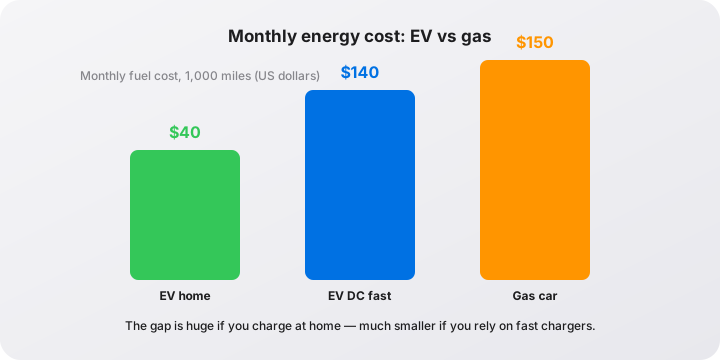
Let me put gasoline and electricity side by side, using current typical prices — about $3.25 per gallon for regular and the U.S. average residential rate of $0.16 per kWh:
| Fuel option | Efficiency | Fuel price | Cost per mile |
|---|---|---|---|
| EV, home charging | 3.5 mi/kWh | $0.16/kWh | 4.6¢ |
| EV, home off-peak | 3.5 mi/kWh | $0.08/kWh | 2.3¢ |
| EV, DC fast charging | 3.5 mi/kWh | $0.50/kWh | 14.3¢ |
| Gas pickup (inefficient) | 17 mpg | $3.25/gal | 19.1¢ |
| Gas sedan (average) | 28 mpg | $3.25/gal | 11.6¢ |
| Gas compact | 35 mpg | $3.25/gal | 9.3¢ |
| Hybrid | 50 mpg | $3.25/gal | 6.5¢ |
Now the monthly view, for a driver covering 1,000 miles a month — about the U.S. average:
| Scenario | Monthly fuel cost | Annual fuel cost |
|---|---|---|
| EV, home charging at $0.16/kWh | ~$46 | ~$550 |
| EV, home off-peak at $0.08/kWh | ~$23 | ~$275 |
| Hybrid (50 mpg) | ~$65 | ~$780 |
| Gas sedan (28 mpg) | ~$116 | ~$1,390 |
| Gas pickup (17 mpg) | ~$191 | ~$2,290 |
The takeaway is not that EVs are universally cheapest — a hybrid at 50 mpg beats an EV that only fast-charges. The takeaway is that the EV’s advantage is entirely a function of where and when you charge. Home charging at off-peak rates beats everything by a wide margin. Fast charging on the road gives most of that advantage back.
The Hidden Costs That Move the Number
The clean division problem assumes a perfectly efficient car, and real cars are not perfectly efficient. Three things quietly push your true cost per mile above the paper number, and they are worth knowing so they do not surprise you.
Charging losses. I flagged this earlier, but it bears repeating: charging is not free of losses. Between 8% and 15% of the electricity you pay for is lost as heat in the onboard charger and battery, so a car that reports 30 kWh of battery energy actually cost you 33-35 kWh at the meter. The losses are largest on Level 1 (slow charging spends more time running its overhead) and smallest on a well-matched Level 2 setup.
Cold-weather efficiency loss. Your miles-per-kWh number is a warm-weather number. In winter, cabin heating, a cold battery, and denser air combine to cut efficiency by 20-40% in many EVs — meaning a 3.5 mi/kWh car might only deliver 2.5 mi/kWh in January. That does not change your price per kWh, but it changes the cost per mile: at $0.16/kWh, a winter mile costs 6.4 cents instead of 4.6. Preconditioning the cabin while still plugged in helps, because you heat the car with grid power instead of battery power.
Phantom and standby drain. An EV left unplugged slowly loses charge to background systems — battery thermal management, connectivity, sentry-style monitoring. It is typically a few miles of range a day, but it is not free, and on a car that sits for days between drives it adds up. The fix is simple: keep the car plugged in when it is parked at home, and let the car manage its own top-up.
None of these are dealbreakers. They just mean your real cost per mile runs a touch above the clean calculation — usually a half-cent to a cent and a half — and in a cold climate, noticeably more in winter. Factor them in and you will never be surprised by a bill that does not quite match the math on the sticker.
Reading Your Electric Bill Like a Metering Tech
The single most common error I see is people using the wrong price per kWh. Here is how to get the number that actually matters.
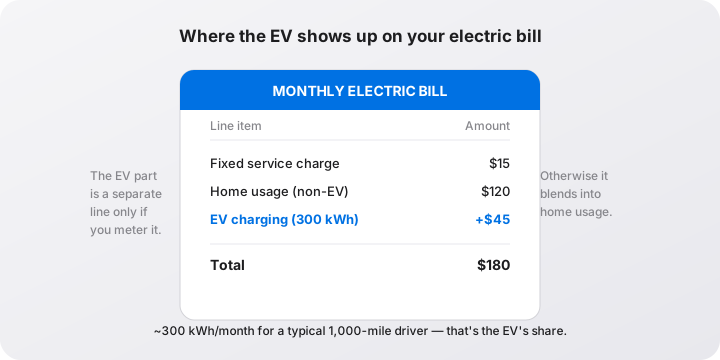
Use the all-in rate, not the teaser rate. Your bill has at least two line items: a supply/generation charge (what the electricity itself costs) and a delivery/distribution charge (the wires, poles, and maintenance). Many utility ads and even the first page of the bill quote only one of them. To get your true cost, divide your total bill in dollars by your total kWh used. That all-in number is what you divide by your miles per kWh.
Check whether you are on a time-of-use plan. A growing share of utilities now charge dramatically different prices by time of day. A typical split might be $0.06-0.10 per kWh from midnight to 6 AM, $0.16-0.20 mid-day, and $0.30-0.50 from 4 PM to 9 PM. If you charge your EV at 7 PM because that is convenient, you could be paying five times what the same charge would cost at 2 AM. Most modern chargers and many EVs can be scheduled to charge only during the cheap window, which is the single biggest lever most people leave unpulled.
Watch for tiered pricing. Some utilities charge a higher rate once you cross a monthly kWh threshold. An EV can push you into a higher tier, which means not just the EV’s own electricity gets more expensive — your whole bill does. This is the hidden interaction between your EV and your home’s overall electrical load that I cover in more depth elsewhere.
Look for a dedicated EV rate. Many utilities now offer an EV-specific or “time-of-use EV” rate that gives you a super-off-peak window (often midnight to 6 AM) at a steep discount, sometimes $0.04-0.08 per kWh. If you drive enough, this can cut your fuel cost to under 2 cents a mile. Call your utility and ask — these plans exist in most major markets and are chronically under-enrolled.
The Bottom Line
The honest answer to “how much does it cost to drive an EV per mile” is: about 4 to 5 cents at home, 10 to 18 cents at a public fast charger, and roughly 11 to 12 cents for a typical gas car. The EV wins decisively when you charge at home, and loses much of that edge when you rely on fast charging.
Do the math once, correctly: pull your real all-in rate off a recent bill, divide it by your car’s actual miles per kWh, and multiply by your monthly miles. That single calculation tells you more than any generic article — including this one — because your utility rate is the only number that really matters.
To make the home-charging savings real, you need a properly installed Level 2 charger, ideally one you can schedule to run only in the cheap overnight window. And if you are pairing that charger with a whole-house surge protector, you protect both the charger and the car’s expensive onboard electronics at the same time. The cost advantage is real — you just have to charge where the cheap electricity is.
Frequently Asked Questions
How much does it cost to charge an electric car per mile?
For home charging at the U.S. average electricity rate of about $0.16 per kWh and a typical EV that gets 3.5 miles per kWh, the cost is roughly 4.5 cents per mile. At cheap off-peak rates of $0.06-0.08 per kWh, that drops to under 2 cents per mile; at high-cost states around $0.30-0.40 per kWh, it climbs to 9-11 cents. The math is simple: divide your price per kilowatt-hour by your car's miles per kilowatt-hour.
Is charging an EV cheaper than buying gas?
Almost always, if you charge at home. A 30-mpg gas car burning $3.25-per-gallon fuel costs about 11 cents per mile, while home-charged EV fuel costs 4-5 cents per mile at average electricity rates — roughly 60-70% cheaper. The exception is public DC fast charging, which at $0.40-0.60 per kWh costs 11-17 cents per mile and can match or exceed gasoline on a road trip. The savings live in your garage, not at the highway fast charger.
How much does an EV add to your monthly electric bill?
Figure on roughly 300-350 kWh per month for 1,000 miles of driving in a typical 3.5 mi/kWh EV, once you include charging losses. At the national average rate that is about $50-55 a month. At cheap off-peak rates it is $25-35; at expensive peak or tiered rates it can reach $100 or more. A gas car covering the same 1,000 miles costs roughly $110-130 a month in fuel at current prices, so the EV saves most drivers $60-90 a month on home charging.
What does DC fast charging cost per kWh?
Public DC fast charging runs roughly $0.35 to $0.65 per kilowatt-hour, with Tesla Superchargers often around $0.35-0.50 and networks like Electrify America frequently $0.48-0.64 depending on location and time of day. At $0.50 per kWh, a 3.5 mi/kWh EV costs about 14 cents per mile — more than a hybrid and close to or above a gas car. Use DC fast charging for road trips, not as your everyday fuel, or you will erase most of the EV's cost advantage.
How do I figure out what I actually pay per kWh for charging?
Do not use the teaser rate on the first page of your utility's website. Pull your bill and divide your total electric charges by your total kilowatt-hours — that gives you the all-in rate including supply, delivery, taxes, and fees. Then check whether you are on a time-of-use plan, because the rate that applies while you sleep may be half what you pay at 6 PM. For the most accurate number, look at the kilowatt-hours a charger added over a month and compare it to the dollars that month's bill changed.