How Much an EV Adds to Your Electric Bill (and Your Home's Load)
The first question a homeowner asks when they are thinking about an EV is almost always about the car. The second question — the one they should ask — is about the house. Because an EV is the largest new electrical load most homes will ever add, and it changes two things at once: your monthly bill, and the physical load on your home’s electrical system.
I spend my working life sizing power distribution for equipment that has to keep running no matter what. A 48-amp EV charger is a bigger continuous load than a lot of the equipment I maintain, and it gets plugged into houses that were never designed for it. The good news is that the numbers are knowable in advance — you do not have to be surprised by an $80 bill jump or a tripped main breaker.
Here is exactly what an EV does to your bill and your electrical load, and how to plan for both.
How Many Kilowatt-Hours an EV Actually Adds
Before we talk dollars, we need kilowatt-hours, because that is what your utility actually bills you for. The calculation is the same one from my cost-per-mile guide:
Monthly kWh = (monthly miles ÷ miles per kWh) × charging-loss factor
A typical EV returns about 3.5 miles per kWh. Charging is not perfectly efficient — you lose roughly 8-15% to heat in the onboard charger and battery — so the power you pull from the wall is about 12% more than the energy that ends up stored in the battery. A car that used 30 kWh of battery energy actually drew about 34 kWh from your meter.
Here is what that means at different driving levels:
| Monthly miles | Battery energy used | kWh drawn from the wall (incl. ~12% loss) | Vehicle type |
|---|---|---|---|
| 500 | 143 kWh | ~160 kWh | Light city driving |
| 750 | 214 kWh | ~240 kWh | Below-average commute |
| 1,000 | 286 kWh | ~320 kWh | U.S. average driver |
| 1,500 | 429 kWh | ~480 kWh | Long commute or frequent trips |
| 2,000 | 571 kWh | ~640 kWh | Heavy use, rideshare-style |
A quick sanity check: the average U.S. home uses around 850-900 kWh per month for everything — lights, appliances, HVAC, the works. Adding a typical EV at 1,000 miles a month means adding roughly 320 kWh, or about a 35-40% increase in your total home electricity use. That is the real scale of what an EV does to your household energy picture.
What That Does to Your Bill in Dollars
Now apply your rate. The all-in price you pay per kWh — the number on your bill after supply, delivery, and fees — determines the dollar impact.
| Monthly miles | kWh added | Cost at $0.08/kWh (off-peak) | Cost at $0.16/kWh (U.S. avg) | Cost at $0.32/kWh (high-cost/peak) |
|---|---|---|---|---|
| 500 | ~160 kWh | $13 | $26 | $51 |
| 1,000 | ~320 kWh | $26 | $51 | $102 |
| 1,500 | ~480 kWh | $38 | $77 | $154 |
| 2,000 | ~640 kWh | $51 | $102 | $205 |
Two conclusions fall out of this table. First, for the average driver, the EV adds roughly $50 a month to the electric bill — which sounds alarming until you realize the gasoline it replaced was costing $110-130 a month. Second, the rate you pay matters more than the car. The same 1,000-mile month costs $26 on cheap overnight power and $102 on expensive peak power — a fourfold swing with zero change in driving.
The Load Side: What Your Charger Draws From the House
The bill is only half the story. An EV charger also adds physical electrical load, and this is where the power-distribution side of my job comes in.
There are two charging levels, and they are very different animals:
| Charging setup | Voltage / amperage | Power drawn | Circuit required | Range added per hour |
|---|---|---|---|---|
| Level 1 (standard outlet) | 120V / 12A | ~1.4 kW | Existing 15A outlet | 3–5 miles |
| Level 1 (upgraded) | 120V / 16A | ~1.9 kW | Dedicated 20A circuit | 5–7 miles |
| Level 2 (16A) | 240V / 16A | ~3.8 kW | 20A circuit | 11–15 miles |
| Level 2 (32A) | 240V / 32A | ~7.7 kW | 40A circuit | 22–28 miles |
| Level 2 (40A) | 240V / 40A | ~9.6 kW | 50A circuit | 28–35 miles |
| Level 2 (48A) | 240V / 48A | ~11.5 kW | 60A circuit | 33–40 miles |
Level 1 — just plugging into a standard wall outlet — draws only 1.4 kW, which most houses will not even notice. The catch is that it adds range so slowly it only works for short commutes. Level 2 is where the load gets real: a 48-amp charger pulls 11.5 kW, which is more than a central air conditioner and about half of a typical electric dryer’s circuit.
There is one electrical principle you need to understand before anything else, because it drives the whole install: the 80% rule. The National Electrical Code treats EV charging as a continuous load — one that runs at maximum for three hours or more — and continuous loads must be sized at 125% of their draw. In plain English, a 48-amp charger needs a 60-amp breaker (48 × 1.25 = 60), and a 40-amp charger needs a 50-amp breaker. You can never put a 48-amp charger on a 50-amp circuit, no matter how tempting the math looks.
This is also why the cheapest part of the whole project is usually the charger itself, and the expensive part is whatever the electrical system needs to feed it. I break down those costs line by line in my EV charger installation cost guide.
Do You Need a Panel or Service Upgrade?
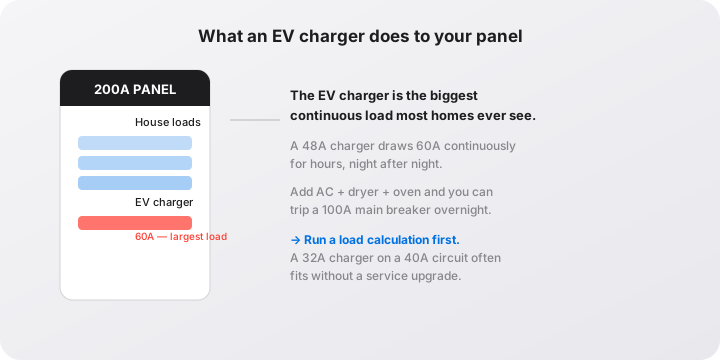
This is the question that determines whether your install costs $1,000 or $5,000, and the answer comes from a load calculation — a documented tally of every circuit in your home against your service size, as required by code.
The rule of thumb by service size:
| Service size | Typical homes | What it can handle |
|---|---|---|
| 100A | Pre-1990s homes | Tight. One 48A charger plus AC, dryer, and electric range can overload it. Usually needs a 32A charger or a service upgrade. |
| 150A | 1990s–2000s homes | Usually fine for one 48A charger with modest other loads. A load calculation confirms. |
| 200A | Most modern homes | Fine for one charger, often two. Two high-power chargers may need load management. |
If your panel is full — no spare breaker slots — you also need either a sub-panel ($500-1,200) or a panel replacement ($1,500-3,500), even if your service size is adequate.
Here is the part most people do not realize: you do not have to install a 48-amp charger. A 32-amp charger on a 40-amp circuit charges a typical EV from 20% to 80% in about seven hours, which is more than enough for overnight charging for almost everyone. Choosing 32 amps instead of 48 often lets you keep a 100-amp service and skip a $3,000 upgrade, in exchange for charging a couple hours slower while you sleep. That is a trade I make for people constantly.
The one thing you should never do is skip the load calculation and hope. An undersized panel with a charger bolted onto it is exactly how you end up tripping the main breaker at 2 AM — or worse, running conductors hot inside your walls. A licensed electrician should run the numbers before quoting anything.
Time-of-Use: Cut the Bill in Half Without Driving Less
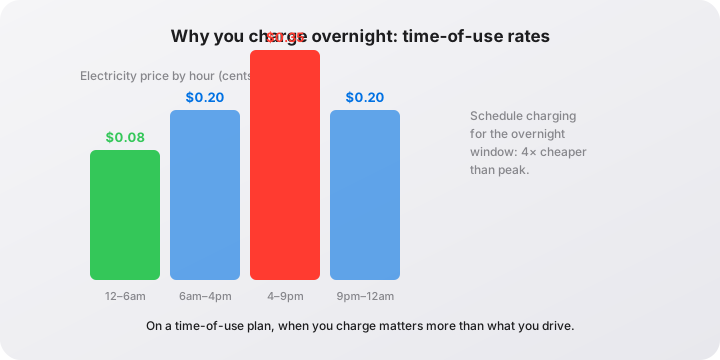
The cheapest electricity you will ever buy is the electricity you buy while everyone else is asleep. Most utilities now offer time-of-use (TOU) rates, and the spread between overnight and evening prices is often enormous:
| Time window | Typical TOU rate | Charging cost for 320 kWh/month |
|---|---|---|
| Off-peak (12 AM – 6 AM) | $0.05 – $0.10/kWh | $16 – $32 |
| Mid-peak (daytime) | $0.15 – $0.20/kWh | $48 – $64 |
| On-peak (4 PM – 9 PM) | $0.30 – $0.50/kWh | $96 – $160 |
The strategy is embarrassingly simple: tell your car or charger to charge only during the off-peak window. Nearly every modern EV has a charge scheduler built in, and most smart chargers do too. You plug in when you get home, but the car waits until midnight to actually draw power. Set it once, and you save 50-70% on your EV’s electricity every single month, forever.
Many utilities also offer an EV-specific rate with a “super off-peak” window — sometimes $0.04-0.08 per kWh from midnight to 6 AM. If you drive a meaningful amount, these plans are the single best way to keep an EV’s bill impact small, and they are chronically under-enrolled. Call your utility and ask whether one exists in your market.
What It Does to Your Existing Circuits
A properly installed EV charger should have zero effect on your other circuits, because code requires it to be on its own dedicated circuit. It draws from the panel’s total capacity, not from the wiring that feeds your kitchen or garage.
The problems — and I have seen every one of them — happen when that rule is ignored:
- Tapping an existing circuit. The most common DIY mistake is wiring a charger into a dryer outlet or a garage circuit “because it is there.” A 30-amp dryer circuit cannot safely feed a 48-amp charger, and the result is a melted outlet, a tripping breaker, or a fire inside the wall. This is the exact scenario I opened my charger install guide with.
- A marginal main panel. If your panel is near capacity and you add a charger, the symptom is usually the main breaker tripping when the charger, the AC, and the dryer all run at once. That is not the charger “drawing too much” — it is the panel being asked to deliver more than it is rated for.
- Surge exposure. An EV charger is a permanently wired, always-energized 240V appliance sitting in your garage, and it is a direct path for a utility surge into your car’s onboard charger — one of the most expensive single components on the vehicle to replace. A whole-house surge protector at the panel is cheap insurance for both the charger and everything downstream of it.
The takeaway: an EV charger does not compete with your other appliances for their individual circuits. It competes for your panel’s total capacity. Keep it dedicated, keep the panel correctly sized, and it plays fine with everything else in the house.
The Bottom Line
An EV adds roughly 320 kWh and about $50 a month to the electric bill of the average driver, and it adds one of the largest continuous loads your home has ever carried. Both of those facts are manageable — the first with a time-of-use rate, the second with a correct load calculation and, if needed, a lower-amperage charger.
Plan for the electrical side before you buy the car. Know your service size, run the load calculation, and if you are on 100-amp service, seriously consider a 32-amp charger over a 48-amp one — the cost difference in your install will dwarf any difference in charging speed you will ever notice overnight.
Set the charge schedule to the off-peak window and the bill impact drops from $50 to $25 or less. Do all of that, and the “EV added to my electric bill” line becomes a non-event — a few dollars a week for fuel that used to cost you a few hundred dollars a month at the pump.
Frequently Asked Questions
How much will an EV increase my electric bill?
For 1,000 miles of monthly driving in a typical 3.5 mi/kWh EV, expect about 320-350 kilowatt-hours added to your bill, including charging losses. At the U.S. average rate of $0.16 per kWh that is roughly $50-55 a month. It scales with how much you drive and what you pay: a 500-mile month is about $25, a 2,000-mile month about $100, and a cheap off-peak rate can cut any of those numbers in half.
Does charging an EV overload my home's electrical panel?
Not if the install is done correctly. A Level 2 charger is a large continuous load — a 48-amp unit needs a dedicated 60-amp circuit, and a 32-amp unit needs 40 amps. On a modern 200-amp service with spare breaker space, one charger is usually fine. On an older 100-amp service shared with air conditioning, a dryer, and an electric range, a full-power charger can overload the main breaker, and you may need a lower-amperage charger or a service upgrade. Only a load calculation can tell you for certain.
Do I need an electrical service upgrade to charge an EV at home?
Only if your service is undersized for the charger plus your existing loads. Homes with 200-amp service almost never need an upgrade for one charger. Homes with 100-amp service — common before the 1990s — often do if you want full 48-amp charging alongside electric appliances, and an upgrade to 200 amps runs $2,000-5,000. The common workaround is installing a 32-amp charger on a 40-amp circuit, which charges most EVs overnight and usually fits without an upgrade.
How can I keep my EV charging from raising my electric bill so much?
Move your charging to off-peak hours. Most utilities with time-of-use rates charge $0.05-0.10 per kWh overnight versus $0.30-0.50 during the 4-9 PM peak, so scheduling your car to charge from midnight to 6 AM can cut your EV's fuel cost by 50-70%. Many utilities also offer a dedicated EV rate with a steep super-off-peak discount. Set the charge schedule in your car or charger app once, and the savings happen automatically every night.
Does an EV charger affect the other circuits in my house?
It should not, if it is on its own dedicated circuit — which code requires for EV charging. A properly installed charger only draws from the panel's overall capacity, not from any shared circuit. Problems arise when people tap an EV charger into an existing circuit, like a dryer or garage outlet, which is against code and causes overheating and tripped breakers. The one legitimate shared impact is on your main panel's total capacity, which is why the load calculation matters.