Why EVs Depreciate So Fast (and Which Hold Value Best)
A neighbor bought a brand-new electric SUV three years ago for $55,000, before the tax credit was even factored in. Last month he went to trade it in for a new model. The dealer’s offer: $27,500. He stood there doing the mental math — fifty percent gone in three years — while the salesperson explained that the new version of the same SUV now costs $46,000 and goes 80 miles farther on a charge.
That conversation is happening in dealerships across the country right now, and it is the single biggest reason people are nervous about buying an EV. It is not range anxiety anymore. It is resale anxiety.
This guide is the honest, data-driven version of what is happening: why electric cars depreciate faster than gas cars, the four specific forces pushing used values down, which models hold value best, and what all of it means if you are deciding between buying and leasing. I have spent seven years maintaining battery systems for critical infrastructure, so I am going to pay special attention to the part most car guides gloss over — the battery itself, and why it anchors an EV’s value the way an engine never quite anchors a gas car’s.
How Much Do EVs Actually Depreciate?
Let me start by being straight about the numbers, because this topic is full of cherry-picked statistics designed to make EVs look terrible or wonderful depending on who is writing.
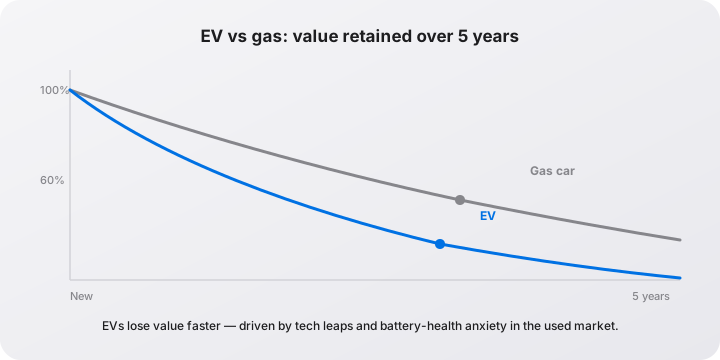
The honest picture from independent studies that track actual resale transactions — not MSRP math, which ignores the $7,500 credit and any discounts — is that EVs have depreciated somewhere in the range of 40-50% over five years, compared with roughly 35-40% for the average gasoline car over the same period. That is a real gap, but it is a 5-15 point gap, not the “your EV is worthless in three years” doomsday you see in comment sections.
Here is the crucial caveat, and it is the one that makes all the difference: the spread between models is enormous. A short-range EV from 2019 with a 120-mile battery has lost far more than half its value, because it is now obsolete twice over. A long-range model with a good brand reputation and over-the-air updates has lost far less — in some cases tracking a premium gas car almost exactly.
| Vehicle type | Typical 5-year value retention (estimate) | What drives it |
|---|---|---|
| Average gasoline car | ~60-65% retained | Mature tech, predictable used demand |
| Average EV (all models) | ~50-60% retained | Dragged down by short-range early models |
| Short-range / early EVs (2018-2020) | ~35-45% retained | Obsolete range + battery anxiety |
| In-demand long-range EVs | ~55-65% retained | Brand, software, fast-charging network |
These are estimates based on widely reported resale data, not a promise. The point of the table is the pattern, not the exact digits: EVs do not depreciate uniformly, and the reason they depreciate at all is more specific than “people don’t want them.”
Why EVs Depreciate Faster: The Four Forces
Depreciation is not a mystery force. It is the market pricing a used car against everything else you could buy instead. For an EV, four forces push that used price down, and gas cars face none of them at the same intensity.
1. The Technology Is Still Improving Fast
This is the big one, and it is the closest thing to the “iPhone problem” that people half-joke about.
A 2019 gasoline car is, mechanically, almost identical to a 2026 gasoline car. The engine is a little more efficient, the infotainment screen is bigger, but fundamentally a six-year-old Corolla does what a new Corolla does.
A 2019 EV is a fundamentally different product from a 2026 EV. The first wave of mainstream EVs had real-world ranges of 120-180 miles. Current models routinely do 250-350. Charging speeds have doubled. Battery chemistry has shifted from NMC to more durable LFP in many models. The cars got dramatically better, fast — and when the new thing gets dramatically better, the old thing gets cheap. Nobody wants to pay top dollar for a used car that goes half as far and charges half as fast as the new one sitting next to it on the lot.
2. Battery Health Anxiety in the Used Market
This is where my day job gives me a slightly different view than a car reviewer’s.
Used-car buyers do not know how to evaluate a battery the way they know how to evaluate an engine. They understand “150,000 miles, one owner, no accidents.” They do not understand “91% state of health, mostly Level 2 charged.” So they do what nervous buyers always do: they over-discount for the unknown.
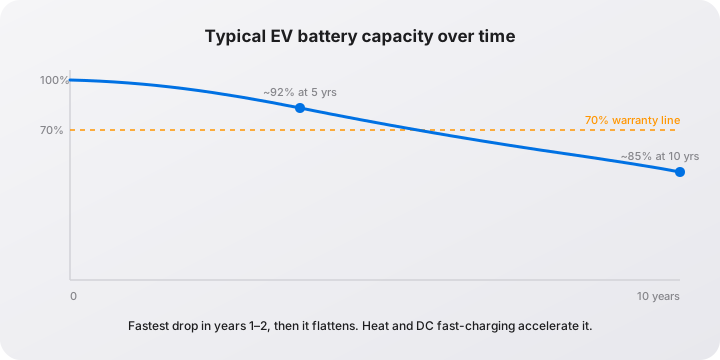
The irony is that the fear is usually bigger than the reality. Most modern EV batteries degrade slowly — roughly 1-2% capacity loss per year under normal use — and the vast majority will comfortably outlast the 8-year/100,000-mile warranty that covers them. But the used market prices in the worst case, not the typical case. A buyer cannot see the battery’s history the way they can see a car’s oil-change records, so the battery becomes a discount lever rather than an asset.
I see the same psychology with home backup batteries. A home battery system that tests at 95% health still gets talked down by buyers who only remember the one news story about a battery that failed early. The underlying chemistry is fine; the perception is what moves the price.
3. New-Car Price Cuts Reset the Whole Market
You cannot sell a used car for more than a new one, and when new EV prices fall, used EV prices fall right behind them.
This happened in a very public way in 2023-2024, when the leading EV maker cut new-car prices repeatedly — in some cases by $10,000 or more on popular models. Every one of those cuts hit two groups: the person who bought at the old, higher price (their trade-in value cratered overnight), and the person trying to sell a used version (who now had to price below a brand-new car with a full warranty).
Gas cars get discounts too, but they are quieter, seasonal, and rarely double-digit-percentage cuts on the sticker across the whole lineup. The EV market’s price discovery is happening in real time, in public, and it is brutal on resale.
4. The Federal Tax Credit Sits on Top of It All
The $7,500 federal credit for new EVs is great for the person buying new. It is quietly terrible for the person who already owns one.
Here is why: the credit effectively lowers the price of a new EV by $7,500 for eligible buyers. A lightly used EV therefore has to be priced below the after-credit cost of a new one to make any sense at all. Why buy a two-year-old car with 20,000 miles when a brand-new one, after the credit, costs the same or less?
There is a used-EV credit too (up to $4,000, on cars under $25,000, with income limits), which helps used buyers — but the new credit is what keeps a ceiling on used values. The math is unavoidable: a subsidy on new cars is, by definition, a tax on used ones.
The Battery: The Real Anchor of an EV’s Value
Let me spend a moment on the component that makes EV depreciation different from gas depreciation at a technical level, because understanding it is what lets you buy smart instead of just scared.
A gasoline engine has a well-understood failure curve. It wears gradually, it has a known maintenance schedule, and a 100,000-mile engine with records is a known quantity. The car depreciates mostly on age and mileage.
An EV’s battery is both the most expensive single component in the car — replacing one can run anywhere from roughly $5,000 to $20,000 depending on the model — and the one whose past treatment matters most to its future. Two identical used EVs with the same mileage can have batteries that are 10% apart in health, purely because one owner charged gently at home and the other hammered the car with DC fast charging in the heat.
That is why battery state of health (SOH) is the single most important number on a used EV, and it is why I wrote a full checklist for buying a used EV that starts there. The short version: a battery that tests at 90% SOH is worth measurably more than one at 75%, because the buyer is not just buying range — they are buying time until an expensive repair.
The good news that does not get enough airtime: modern batteries, especially LFP chemistry, are degrading slower than the early models did. The fear is priced in faster than the technology actually declines. That gap — between the worst case the market fears and the typical case the data shows — is exactly where a smart used-EV buyer finds value.
Which EVs Hold Value Best (and Worst)
I am going to give you the pattern rather than a fake-ranked leaderboard, because precise “top 10” lists with made-up percentages are exactly the kind of thing I do not trust, and neither should you.
What makes an EV hold value, based on what actually moves resale prices:
- Long real-world range. The #1 predictor. A car with 300+ miles of range today still feels current in five years. A 150-mile car feels old the day you buy it.
- Over-the-air software. Cars that get meaningful updates hold value because a two-year-old version is not missing features the new one has.
- A good fast-charging network. Access to reliable, fast public charging removes the single biggest objection a used buyer has.
- Durable battery chemistry and a strong warranty. LFP batteries and longer warranties reduce the “will this fail on me” discount.
- Brand price discipline. Manufacturers who do not slash new prices protect their used values.
The flip side, the things that accelerate depreciation:
- Short range and slow charging. The early compliance cars and first-gen short-range models are the ones you see at 40% retained value or worse.
- Discontinued models. When a manufacturer kills an EV line, owners learn what it costs to own an orphan — parts, software support, and resale all suffer.
- Rapid-fire new-model refresh cycles. If a brand releases a meaningfully better version every 12 months, last year’s model ages in dog years.
The practical conclusion: the cheapest EV to buy today is rarely the cheapest to own. A deeply depreciated, short-range, discontinued model can look like a steal and turn into a millstone. A moderately depreciated, long-range, current-generation model is usually the better value despite the higher sticker.
Buying vs Leasing: Where the Depreciation Risk Lands
This is the question the whole topic really comes down to, so let me answer it directly.
Leasing is the sensible hedge against depreciation. When you lease, the manufacturer — not you — is on the hook for the residual value risk. If the market crashes and your car is worth half what was projected at lease end, you hand back the keys and walk away. The lease also effectively passes the full $7,500 federal credit to you (it is built into the deal) regardless of your income, which is why so many people who do not qualify for the credit by income end up leasing instead of buying.
The downside is equally real: you pay for the hedge. Leasing costs more per month than financing the same car, you own nothing at the end, and you are locked into mileage limits and a schedule of getting a new car every few years whether you want one or not.
Buying is the sensible choice if you plan to keep the car a long time. Depreciation only hurts you when you sell. If you buy an EV and drive it for 8-10 years, the resale hit matters far less than the money you save on fuel and maintenance over that decade. The car that depreciated 50% in three years is, by year eight, a fully-paid-off asset with cheap running costs — and that is where EV ownership actually wins, which I break down in detail in my total cost of ownership comparison.
Buying used is the sharpest move of all. Let the first owner eat the steepest part of the depreciation curve. Buy a two-to-three-year-old, long-range, current-generation EV that still has most of its battery warranty left, after checking the battery’s actual health. You get 80% of the car for 50% of the money. This is also why having home charging sorted out before you buy matters — the best used-EV deal is one you can charge cheaply at home from day one.
The Bottom Line
EVs do depreciate faster than gas cars — figure roughly 40-50% over five years versus 35-40%, with a wide spread by model. The gap is driven by four forces: fast-improving battery and range technology, used-market anxiety about battery health, new-car price cuts that reset the whole market downward, and the federal tax credit that puts a hard ceiling on used values.
None of this means an EV is a bad financial decision. It means the timing and structure of how you buy matters as much as which car you pick.
If you want the newest technology and zero resale risk, lease. If you want to own long-term and let fuel and maintenance savings pile up, buy — and keep it. If you want the best value per mile, buy a two-to-three-year-old used EV with a verified-healthy battery and a long-range, current-generation design, and charge it at home.
The people who get hurt by EV depreciation are the ones who buy new at peak price and trade in three years later. Everyone else has a way to win. The trick is knowing which camp you are in before you sign.
Frequently Asked Questions
Why do EVs depreciate faster than gas cars?
Four forces stack up at once: battery and range technology improves so fast that a three-year-old EV feels dated, used buyers worry about battery health and over-discount it, manufacturers keep cutting new-EV prices (which directly resets used values lower), and federal tax credits make a discounted new EV compete against lightly used ones. None of these forces hits gas cars the same way, which is why the gap exists.
How much do EVs depreciate in 5 years?
Independent studies that track actual resale transactions (not MSRP math) have found EVs losing roughly 40-50% of value over five years on average, compared with about 35-40% for the average gas car. The spread is wide by model — a few in-demand EVs lose far less, while early short-range models lose far more. Treat any single percentage as a rough, model-dependent estimate, not a guarantee.
Do Tesla cars hold their value better than other EVs?
Historically yes — Tesla's brand, over-the-air software updates, and the Supercharger network propped up resale better than most rivals, so depreciation tracked closer to a premium gas car. But Tesla's aggressive new-car price cuts in 2023-2024 wiped out a lot of that advantage for owners who bought near the peak. Buying used is now the smartest way into a Tesla specifically because of that reset.
Should I lease an EV instead of buying to avoid depreciation risk?
Leasing is the sensible hedge if you want the newest range and software every few years and do not want to eat the residual risk. The manufacturer takes the depreciation hit and you get the full $7,500 federal credit rolled into the lease regardless of your income. The catch: you own nothing and pay for the convenience. If you plan to keep a car 8+ years and drive it into the ground, buying — especially buying used — usually wins.
Does a home charger help an EV hold value?
Indirectly, yes. A used EV that was mostly charged at home on a Level 2 charger tends to have a healthier battery than one hammered with DC fast charging, and a home already wired for Level 2 charging is a selling point for the next EV buyer. It does not directly raise the car's blue-book number, but a documented home-charging history and a healthy battery report are the two things that justify a higher asking price on the used market.