Why EV Repair Costs So Much (Compared to Gas Cars)
A friend of mine backed her two-year-old electric crossover into a low concrete post in a parking garage. It was a walking-pace impact — the kind that, on a gas car, means a scuffed bumper cover and a $400 bill from the local body shop. Her insurance estimate came back at just under $11,000. The bumper was the cheap part. The expensive part was a rear radar sensor that had to be replaced and recalibrated against the manufacturer’s specifications, plus a wiring harness routed through a zone the repair manual flagged as “battery-adjacent.”
She is not an outlier. The uncomfortable truth about electric vehicles is that the “cheap to maintain” story everyone repeats is only half the picture — and the missing half is expensive.
Let me be clear about where I am coming from. I am a licensed electrician, not a body shop estimator or an insurance adjuster. I work on power systems, battery storage, and electrical distribution. But batteries are my day job, and the way an EV is built around its battery is the single most important fact in this entire conversation. My goal here is not to talk you out of an EV. It is to make sure you understand the real cost of repairing one, so the first accident does not catch you by surprise.
The Maintenance Myth Is Half True
First, let me defend the part of the story that is actually correct, because it is correct.
Routine maintenance on an EV is genuinely cheaper and simpler than on a gas car. There is no engine oil to change, no oil filter, no spark plugs, no ignition coils, no transmission fluid, no timing belt, no serpentine belt, no exhaust system, no catalytic converter, no fuel pump. The entire internal-combustion engine — thousands of moving parts, each a potential failure point — is replaced by an electric motor with essentially one moving part and a fixed-ratio gearbox.
Brake pads last dramatically longer because regenerative braking recaptures energy and slows the car without the friction brakes doing most of the work. It is common for EV brake pads to still have life left past 100,000 miles. Tires are the one exception — EVs are heavy and produce instant torque, so tires often wear faster than on a comparable gas car, but that is a consumable, not a repair.
So the claim “EVs need less maintenance” is true. If all you ever do with a car is drive it, change the wiper blades, and rotate the tires, an EV will cost you less, year over year.
The problem is that “maintenance” and “repair” are not the same thing, and most of what makes a car expensive to own is not scheduled maintenance. It is the surprise — the collision, the parking-lot hit, the road debris, the deer. That is where the EV story flips completely, and where the “cheaper to run” math quietly falls apart.
Collision Repair Is a Different Universe
Here is the core distinction that almost every EV-versus-gas comparison glosses over:
Routine maintenance: EVs win. Oil changes, tune-ups, and the slow drip of wear items cost less, full stop.
Collision repair: gas cars win, and often by a wide margin. When metal gets bent, the two vehicles are not just different — they are built on different assumptions about what “fixable” means.
On a traditional gas car, a collision is generally a mechanical-and-body problem. A fender is a stamped piece of steel bolted to a frame. A bumper is a plastic cover over an energy absorber. Body shops have been fixing these cars for decades, there are tens of thousands of independent shops competing on price, and aftermarket and salvage parts are everywhere. Damage is localized: you fix the part that got hit, and the rest of the car is unaffected.
An EV is a different machine. The most expensive, most safety-critical component — the battery pack — is typically a huge flat assembly running through the floor of the entire vehicle, from wheel to wheel and door to door. That single design choice, made for weight distribution and range, changes the economics of every accident the car is ever in.
Why the Battery Pack Changes Everything
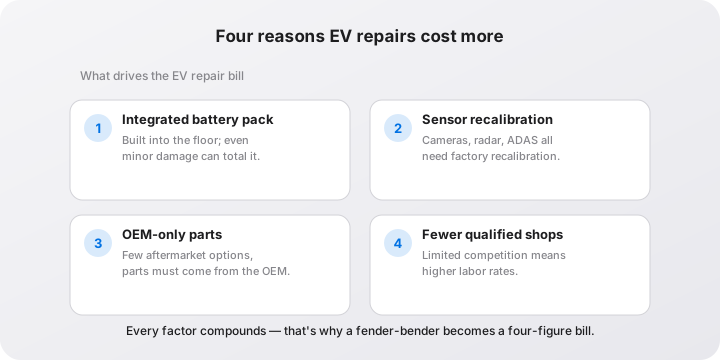
The single biggest reason EV repair costs are high is structural battery integration. This is worth understanding in detail, because it drives everything downstream.
Early EVs bolted the battery in as a somewhat separate component. Modern EVs — and especially the ones designed as EVs from the ground up, rather than conversions of gas platforms — increasingly make the battery pack part of the vehicle’s structure. The pack is a rigid aluminum enclosure with the battery cells inside, and it is engineered to bear crash loads. The car’s crash safety actually relies on the pack as a structural member.
That is great for rigidity, safety, and range. It is terrible for repairability, for three reasons:
First, the pack is huge. Because it spans the floor, a hit almost anywhere along the bottom edge of the car can reach it. A rocker panel, a door sill, a low-speed side impact — on a gas car these are localized body repairs. On a structural-pack EV, the same hit can crack or deform the pack enclosure, which means the battery is now involved.
Second, battery enclosures are not really repairable. A bent fender can be hammered straight or replaced. A damaged battery enclosure cannot — it is a sealed, precision-machined aluminum structure holding hundreds of pounds of cells at hundreds of volts. If the enclosure is compromised, the standard manufacturer response is to replace the entire pack, not to patch the dent. And a replacement pack is the single most expensive component on the vehicle, often costing more than the entire used value of the car.
Third, even the threat of pack damage drives up cost. Because a damaged or water-ingressed lithium battery is a fire and safety risk, insurers, repairers, and manufacturers are extremely conservative. If there is any doubt about whether the pack took a hit, the response is often to total the car or replace the pack rather than take the risk. That conservatism shows up directly in your repair bill and your insurance premium.
Sensor Recalibration: The Hidden Line Item
Here is the repair cost most people have never heard of until the bill arrives: sensor and camera recalibration.
Modern cars — gas and electric alike — are packed with sensors for automatic emergency braking, lane-keeping assist, adaptive cruise control, blind-spot monitoring, and parking. After a collision, even a low-speed one, those sensors and cameras usually need to be recalibrated to the manufacturer’s exact specifications. A camera that is a degree or two out of alignment can misread the road, and the systems will not work correctly.
The calibration itself is often $500 to $1,500 or more, and it requires either a special static target setup or a road test with manufacturer diagnostic software. On top of that, many manufacturers require that certain sensors be replaced rather than reused after a crash — a radar unit or ultrasonic sensor that survived the impact may still be condemned by the repair procedure.
Here is the thing: EVs tend to carry more of these sensors as standard equipment, and because EV-specific diagnostic and calibration access is more tightly controlled, the calibration work often has to happen at a dealer or certified shop rather than a corner body shop. The result is that the same-looking fender bender costs more on an EV because the “hidden” line items — sensors, cameras, wiring, calibration — are bigger and less negotiable.
OEM Parts and the Shortage of Independent Shops
Competition is what keeps repair prices down, and in the EV repair world, there is not much of it.
When a gas car needs a new fender, a new alternator, or a new bumper, the market is flooded with options: OEM parts, quality aftermarket parts, and a nationwide supply of salvaged parts. And you can take the car to almost any of the tens of thousands of independent repair shops in the country, most of whom have been fixing that brand for decades.
When an EV needs a battery, a drive unit, a high-voltage wiring harness, or even certain body parts, the story is different:
- Parts are scarce and expensive. There is a limited aftermarket for EV-specific parts, so repairers are often locked into OEM parts at OEM prices. A high-voltage cable, a cooling manifold, or a charge port that has no third-party equivalent can only be bought one way.
- Access is controlled. Battery repair procedures, diagnostic software, and specialized tools are not freely available. Many manufacturers restrict high-voltage work to their own network or to “certified” shops that have paid for training and tooling — a cost those shops pass on in higher labor rates.
- Independent shops are years behind. The independent repair industry is slowly building EV capability, but high-voltage work requires training, insulated tooling, and a safe work environment that most shops do not yet have. In many regions, if your EV needs anything beyond tires, brakes, and suspension, your practical choices are a dealer or a certified shop.
Less competition, proprietary parts, and restricted access — that combination is why an EV repair that should be mechanically simple still costs what it does.
The Real Cost Comparison
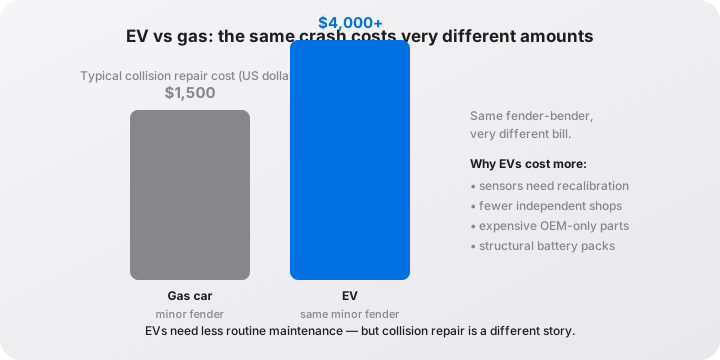
Let me put this in a table so the contrast is clear. These are ranges based on the widely reported patterns in insurance and repair-industry data, not precise figures, and they will vary by model, region, and the specific shop:
| Cost category | Gas car | Electric car | Why the difference |
|---|---|---|---|
| Oil changes / engine maintenance | $100 – $200 per year | $0 | EV has no engine oil, plugs, belts, or filters |
| Brake wear | Pads every 30,000 – 70,000 miles | Pads often 100,000+ miles | Regenerative braking does most of the stopping |
| Minor collision (bumper/fender) | Often $500 – $3,000 | Often $2,500 – $8,000+ | Sensor replacement and recalibration on top of body work |
| Moderate collision reaching battery | n/a (no battery) | Frequently a total loss | Pack replacement can exceed the car’s value |
| Independent shop availability | Extensive | Limited, still growing | High-voltage work is gated behind training and tooling |
| Part availability | OEM + aftermarket + salvage | Mostly OEM, thin aftermarket | Fewer third-party EV parts exist |
The pattern is not subtle. The places where an EV is cheaper are the small, predictable, routine items. The places where it is more expensive are the large, unpredictable, accident-related items. The “EVs are cheaper to own” claim holds up for a car that never gets hit. The moment metal meets metal, the calculus reverses.
What This Means for Buyers
None of this is a reason to avoid EVs. It is a reason to go in with your eyes open and your numbers straight.
If you are comparing an EV against a gas car, do the comparison honestly: add up the routine maintenance savings on one side, and put a realistic number on the collision-repair risk on the other. For most people the EV still wins over the long run — but the margin is a lot thinner than the brochure suggests, and it depends heavily on how you insure and how you drive.
A few practical steps:
- Shop for repairability, not just range. A high-volume, popular model has a bigger pool of parts, more shops that can work on it, and a faster-growing independent repair ecosystem. A low-volume or exotic model is more likely to lock you into dealer-only repair.
- Check your local repair options before you buy. Call a couple of body shops near you and ask if they work on the model you are considering. If the answer is “dealer only,” factor that into your decision.
- Understand your insurance. Because EVs reach total-loss status faster (I cover the math in detail in my EV total-loss explainer), gap insurance matters more, and your collision premium is going to reflect the higher repair costs I have described here.
- Protect the car’s expensive electrical systems. A whole-home surge protector is cheap insurance for the onboard charger when you are charging at home — the kind of component that is expensive to replace if a utility surge reaches it through your EV charger installation.
The Bottom Line
The honest summary is this: EVs cost less to maintain and more to repair. The routine stuff — oil, filters, belts, brakes — is cheaper or nonexistent, and over years of ordinary driving that saving is real. But the accident-related stuff — collision damage, sensors, battery involvement, and OEM-only parts — runs higher than a comparable gas car, and a single bad accident can erase years of maintenance savings in one claim.
This is not a flaw in the technology. It is a consequence of how EVs are designed: a giant structural battery, a wall of sensors, and a repair ecosystem that is still catching up. As the independent repair market matures and battery repair becomes more accepted, the gap will narrow. Until then, the smartest thing an EV owner can do is understand exactly where the costs live — and drive, insure, and shop accordingly.
If you are thinking about an EV and want to understand the other half of the cost equation, start with why EV insurance is so expensive and what happens when a small crash totals an electric car. And if you are planning a home charger, read my EV charger installation cost guide before you buy anything.
Frequently Asked Questions
Do electric cars actually cost more to repair than gas cars?
Yes, and it is mostly concentrated in collision and accident repair, not routine maintenance. The single biggest driver is the battery pack: on many EVs it is a structural part of the floor, so damage that would be a simple subframe or rocker repair on a gas car can force a battery replacement that costs more than the car is worth. Add expensive OEM-only parts, mandatory sensor recalibration after even minor hits, and far fewer independent shops that can legally work on high-voltage systems, and the average repair bill runs noticeably higher than a comparable gas car.
Do EVs really need less maintenance than gas cars?
Yes — this part is true, not marketing. No oil changes, no spark plugs, no transmission fluid, no timing belts, no exhaust system, and brake pads that can last well over 100,000 miles because regenerative braking does most of the stopping. Over five years of routine ownership, an EV is generally cheaper to maintain than a gas car. The problem is that this saving shows up slowly in small amounts, while a single accident repair can erase it in one bill.
Why does minor damage cost so much to fix on an EV?
Two reasons that do not apply to gas cars. First, modern sensors and cameras (for automatic emergency braking, lane keeping, and driver assistance) usually need to be recalibrated against manufacturer specifications after a collision, even a low-speed one — that is often $500 to $1,500 of the bill before a single body panel is painted. Second, if a hit reaches the battery pack or its enclosure, many manufacturers require the pack to be replaced rather than repaired, and a replacement pack can cost more than the vehicle is worth.
Are there independent repair shops for EVs?
Far fewer than for gas cars, and that is a deliberate consequence of how EVs are built. High-voltage work requires specialized training, tools, and equipment, and access to battery parts, diagnostic software, and repair procedures is tightly controlled by manufacturers. Independent body shops and mechanics are slowly catching up, but in many regions your realistic choices for anything beyond tires and suspension are a dealer or a manufacturer-certified shop — and less competition means higher labor rates.
How can I keep EV repair costs under control?
Choose a common, high-volume model with a strong aftermarket parts and repair ecosystem, and check what certified independent shops exist near you before you buy. Maintain your insurance carefully, since a modest fender bender on an EV can run to a total-loss claim faster than on a gas car. And drive defensively — not because EVs are fragile, but because the financial stakes of even a small accident are higher than most owners expect.