EV Total Loss: Why a Small Crash Can Write Off an Electric Car
A totaled car usually looks totaled — crumpled doors, a twisted frame, airbags hanging out of the dash. So it is genuinely unsettling when an EV with what looks like a dented rocker panel gets written off as a total loss. The owner looks at the car, looks at the insurance letter, and thinks the same thing everyone thinks: but it barely looks damaged.
That reaction is understandable, and it is exactly why this topic deserves a clear explanation. Because when you understand why a small crash can total an electric car, the whole insurance and depreciation picture around EVs starts to make sense — and you stop being surprised by the math.
I should be upfront about my lane. I am a licensed electrician, not an insurance adjuster or a collision estimator. But batteries and their enclosures are my professional territory, and the total-loss phenomenon is, at its core, a battery story. Let me walk you through the mechanics, the math, and what it means for your wallet.
The Battery Is the Floor
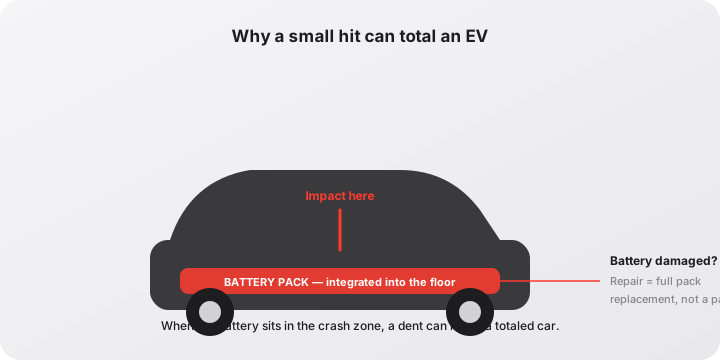
The single most important fact in this entire article is a design choice most EV buyers never think about: on a modern electric vehicle, the battery pack is not a replaceable part bolted under the trunk. It is a giant structural slab that forms the floor of the car.
For most dedicated EVs — the ones designed as electric cars from the ground up rather than adapted from gas platforms — the battery pack is a large, flat, sealed aluminum enclosure that runs between the wheels, from the front axle line to the rear, and door to door. The cells sit inside it. The car’s crash structure is engineered around and through this pack, and in many cases the pack itself is load-bearing — it helps the car absorb and distribute impact forces.
This design is brilliant for what it achieves: a low center of gravity, excellent rigidity, better crash safety, and more range. But it has a brutal consequence for repairability that I want you to internalize:
Because the battery is the floor, almost any impact to the underside or lower sides of the car can reach the battery. A rocker panel, a door sill, a low-speed side hit, a run over a high curb, a chunk of road debris — on a gas car these are localized body repairs. On a structural-pack EV, that same hit can deform, crack, or puncture the battery enclosure, which suddenly makes the single most expensive component on the vehicle part of the repair.
Why the Battery Can’t Just Be “Fixed”
When a gas car’s gas tank gets damaged, you replace the gas tank. It is a modest stamped-steel or plastic part, it costs a few hundred dollars, and it bolts out and bolts in. The car is not written off over a gas tank.
An EV battery is not a gas tank. It is the most expensive component on the vehicle, and it is built in a way that resists repair by design.
The enclosure is a sealed, precision-machined aluminum structure holding hundreds of pounds of lithium cells at several hundred volts, with integrated cooling channels, high-voltage bus bars, and battery management electronics. If that enclosure is compromised — dented, cracked, punctured, or subjected to an impact the manufacturer cannot verify — the standard response from most manufacturers is not to repair the enclosure. It is to replace the entire pack.
There are a few reasons for this conservatism, and none of them are unreasonable:
- Safety. A damaged lithium-ion pack is a genuine fire and thermal-runaway risk. A cell that was crushed or shorted in a crash may not fail immediately — it can fail days or weeks later. Manufacturers and insurers are extremely reluctant to gamble on that.
- Warranty and liability. Repairing a structural battery to a non-factory standard leaves the manufacturer exposed. They would rather replace the pack than certify a repair.
- Water and corrosion. Once the sealed enclosure is breached, water ingress can destroy the pack over time. A “fixed” pack that fails months later is a liability no one wants.
The result is that battery damage usually becomes battery replacement — and battery replacement is where the total-loss math kicks in.
To be fair, this is slowly changing. Some manufacturers use modular packs where individual modules or sections can be replaced instead of the entire assembly, and a growing independent battery-repair industry is learning to service, rebalance, and rebuild packs safely. Right-to-repair rules in the European Union and several US states are pushing manufacturers to open up battery access and diagnostic information. Those developments will gradually soften the total-loss problem. But as of 2026, full replacement rather than repair is still the default response to a structurally damaged pack, and the conservative math below still governs most claims.
The Math of a Total Loss
Here is the actual arithmetic, and it is simpler than people think.
When you have an accident, your insurer has three numbers to work with:
- The repair cost — what it would take to fix the car, estimated by the shop and adjuster.
- The actual cash value (ACV) — what the car is worth on the open market at the moment of the crash, before the damage.
- The salvage value — what the insurer can recover by selling the damaged car to a salvage buyer.
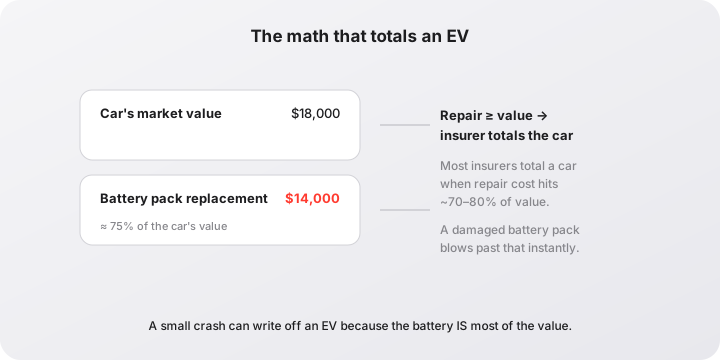
The insurer totals the car when the repair cost plus the salvage value exceeds a set threshold — a percentage of the car’s actual cash value. That threshold is commonly around 70% to 80%, though it varies by state and by insurer. In other words, the question is not “is this car repairable?” It is “does repairing this car still make financial sense?”
Here is the same logic in a table, using illustrative numbers to show the mechanism (these are representative, not a specific real-world case):
| Gas sedan | Electric car | |
|---|---|---|
| Actual cash value at time of crash | $28,000 | $28,000 |
| Repair estimate (same moderate side hit) | $9,000 | $19,000 (battery pack included) |
| Repair cost as % of car’s value | ~32% | ~68% |
| Illustrative total-loss threshold (75%) | Well below — repairable | Approaching — likely totaled |
| Outcome | Fixed and returned | Written off |
The value of the two cars is identical. The damage to the two cars looks similar. But because the repair estimate on the EV includes a battery pack that the gas car simply does not have, the same accident lands in two completely different categories.
Now watch what happens on an EV in detail:
- The repair estimate is higher. If the battery is involved, the repair estimate jumps by the cost of a full pack — often $10,000 to $20,000 or more on larger or newer models, before labor. Add sensor recalibration, OEM-only parts, and certified-shop labor, and the number climbs fast.
- The actual cash value has often dropped. EVs depreciate quickly, partly because battery technology improves year over year and partly because used-EV demand is volatile. A car that cost $50,000 new might have an actual cash value of $28,000 two years later.
Now the equation looks very different. A gas car worth $28,000 with a $9,000 repair estimate is comfortably repairable — well under the threshold. An EV worth $28,000 with a $20,000 battery replacement in the estimate is not. The repair alone is over 70% of the car’s value, and once you add salvage value and the other line items, the car is totaled.
That is the whole story in one sentence: an EV’s repair costs are higher, and its used value is lower, so the gap between “fix it” and “total it” closes dramatically. A hit that a gas car shrugs off can push an EV over the threshold.
Depreciation Makes It Worse
The depreciation side of this equation deserves its own mention, because it is the part that catches owners off guard.
Two forces are pulling EV values down in the used market. First, new EV prices have been falling as battery costs drop and competition increases — and when new cars get cheaper, used cars get cheaper too, because no one pays near-new money for a used car. Second, buyers of used EVs are wary of battery health, which depresses prices further.
The consequence for the total-loss question is direct: the faster your EV depreciates, the sooner an accident totals it. A car worth less money hits the total-loss threshold at a lower repair cost. It is not that your EV is more fragile — it is that the same damage represents a larger fraction of a smaller number.
This is also why the “but it barely looks damaged” reaction is so common. The car looks like it has $3,000 worth of cosmetic damage, but it is worth $20,000 and the repair is $18,000. The mismatch between how the car looks and the insurance outcome is entirely explained by the numbers, not by anything the owner did wrong.
What a Total Loss Means for You
Now the practical part. If you own — or are about to own — an EV, here is what the total-loss reality means for your decisions.
Gap insurance matters more. If you finance or lease, there is a window of time when you owe more than the car is worth — and on an EV, that window is longer and deeper because depreciation is steeper. If the car is totaled during that window, your insurer pays the actual cash value, not your loan balance, and you are left covering the difference. Gap insurance covers that gap, and it is cheap relative to the risk. If you are financing an EV, this is close to a no-brainer, and I recommend it to anyone who would struggle to write a check for the shortfall.
Buy with total-loss math in mind. The cars most likely to be totaled after a minor crash are the ones with the steepest depreciation and the highest battery replacement costs. If you are choosing between models, a mainstream, high-volume EV with strong parts availability and a healthy used market is a safer financial bet than a niche model. Insurance and repair costs are now legitimate purchase criteria, not afterthoughts.
Protect against the depreciation risk. If you are sensitive to depreciation, consider a shorter ownership window, a lease (which transfers residual-value risk to the lessor), or buying a lightly used EV that has already taken the steepest part of its depreciation hit. The person who eats the biggest depreciation is the first owner — and the first owner is also the one most exposed to a total-loss gap.
Understand the salvage upside. Here is a small silver lining. A totaled EV still has a valuable battery, and that battery often has a long second life in stationary energy storage — the same kind of equipment I work with professionally. Salvage buyers pay real money for EV packs, which is part of why insurers can recover value from a totaled EV. It does not help the owner who is upside-down on a loan, but it does mean the “wreck” is not worthless, and it is a sign of where the used-battery economy is heading.
The Bottom Line
An electric car gets totaled after a small crash for one structural reason: the battery is the floor, the battery is the car’s most valuable component, and a damaged battery usually means a full replacement that costs more than the car is worth. Combine a higher repair estimate with a lower used value, and the total-loss threshold — the point where fixing no longer makes financial sense — arrives much sooner than it does on a gas car.
None of this is a hidden defect. It is the direct, predictable consequence of building the car around a giant structural battery, and it is something every EV owner should plan for: carry gap insurance if you finance, choose models with better repair and resale economics, and price your insurance and depreciation into the cost of ownership from day one.
For the full picture, read the companion pieces in this series: why EV repair costs so much explains where the money goes on a repair bill, and why EV insurance is so expensive shows how all of it flows into your premium. And if you are setting up home charging alongside your purchase, my EV charger installation cost guide will keep the upfront costs honest too.
Frequently Asked Questions
Why do EVs get written off after a small crash?
It is the battery. On most modern EVs the battery pack is a structural part of the floor, so an impact along the underside or rocker can damage the pack or its enclosure even when the visible body damage looks minor. Battery enclosures are generally replaced rather than repaired, and a replacement pack can cost more than the entire used value of the car. When that happens, the insurer totals the car because the repair no longer makes financial sense.
How does insurance decide a car is a total loss?
The rule of thumb is the total-loss threshold: when the estimated repair cost plus the salvage value exceeds a set percentage of the car's actual cash value — commonly around 70% to 80%, though it varies by state and insurer — the car is totaled. EVs hit that threshold sooner because the repair estimate is higher (battery, sensors, OEM parts) and the car's actual cash value has often depreciated faster, narrowing the gap between 'fix it' and 'total it.'
How much does an EV battery cost to replace?
It depends heavily on the model and pack size, but a battery pack is one of the most expensive single components on any car. Depending on the vehicle, a full pack replacement can range from several thousand dollars for a small, older EV to well over $20,000 for a larger or newer model — before labor. For a used EV that has depreciated significantly, that single part can exceed the car's market value, which is exactly why insurers so often total the car instead.
What happens if my financed EV is totaled?
Your insurer pays the actual cash value of the car, not what you owe. Because EVs depreciate quickly — and because a total loss can happen on a relatively new car — many owners discover they owe more than the payout. If you have gap insurance, it covers the difference between the payout and your loan balance. If you do not, you pay the shortfall out of pocket. This is why gap coverage matters more on an EV than on most gas cars.
Can a totaled EV's battery be reused or sold?
Often yes. A totaled EV's battery may still have a long useful life in a second-life application like stationary energy storage, and the salvage market for EV batteries and motors is growing. This is also why the salvage value of a totaled EV can be substantial — insurers recover part of the payout by selling the car to a salvage buyer. For a glimpse of how those second-life batteries fit into home power, see my article on home battery backup.