EV vs Gas: The True Total Cost of Ownership
A reader emailed me the same question two different ways in one week. The first asked whether an EV is “really cheaper” than a gas car. The second, from someone else, insisted EVs are a “scam” because his neighbor’s electric crossover cost more to insure and lost value faster than the neighbor expected.
Both were half right, which is the problem with almost everything written about EV costs. One side quotes the fuel savings and ignores depreciation. The other side quotes the insurance hike and ignores the fact that there are no oil changes. Pick your numbers and you can prove either conclusion.
This guide is the whole equation, all at once. I am going to walk through every cost line — purchase price, energy, insurance, maintenance, repairs, depreciation, and taxes and credits — roll it into a per-year and per-mile number, and show you exactly where EVs win, where gas wins, and where the break-even point actually sits. No cherry-picking, and where the data is soft I will tell you it is soft rather than invent a precise-looking number.
The Complete TCO Equation
Total cost of ownership is just a list of every dollar the car costs you, divided by how long you keep it and how far you drive. For both EV and gas, the list is the same seven lines:
- Purchase price (minus any credits and incentives)
- Energy (electricity or gasoline)
- Insurance
- Routine maintenance
- Repairs (the unexpected stuff, including the big-ticket items)
- Depreciation (what you lose when you sell)
- Taxes and fees (sales tax, registration, and where EVs pay extra fees)
The reason most “EV vs gas” articles are wrong is that they only show lines 2 and 4 — the two where EVs clearly win — and quietly skip the other five. The whole game is in the other five.
Purchase Price and the Credit
Let me start here, because it is the biggest single number and it sets up everything else.
A comparable EV still costs more to buy than its gas equivalent — often $5,000 to $15,000 more for a similar size and feature set, though the gap has narrowed a lot in the last few years. The $7,500 federal tax credit for new EVs closes most of that gap for buyers who qualify by income and vehicle eligibility, and a $4,000 used-EV credit helps on the secondhand side. There are also state and utility rebates in some regions that stack on top.
But two honest caveats. First, the credit is a non-refundable tax credit with income caps, not cash off the sticker for everyone — a meaningful share of buyers simply do not qualify, and leasing is the workaround that routes the credit through the manufacturer. Second, the credit’s effect on your long-term math is real but smaller than it looks, because it also quietly depresses the used value of the car you bought with it. That is the depreciation line, and we will get to it.
For a clean comparison, I am going to compare a mid-size electric crossover against a mid-size gas crossover — the two cars a family shopping in that segment would actually cross-shop. I’ll mark the numbers that vary widely as estimates.
Energy: Electricity vs Gasoline, Per Mile
This is the line where EVs win the loudest, and it is worth getting the math exactly right.
The electricity side. An efficient EV gets roughly 3.5 miles per kilowatt-hour in real-world driving (some get 4+, some heavy ones get under 3). At the national average residential rate of about $0.15-0.17 per kWh, that is about 4-5 cents per mile when you charge at home. If you charge on off-peak rates or have solar, it can be 2-3 cents. At a public DC fast charger, where you pay $0.40-0.60 per kWh, the same mile costs 11-17 cents — which is why the home-charging question decides whether an EV saves you money on energy at all.
The gasoline side. A comparable gas crossover gets about 28-30 mpg combined. At $3.50 a gallon, that is about 11-13 cents per mile.
So on energy alone, a home-charged EV runs at roughly a third of the cost per mile of a gas car. Over 12,000 miles a year, that is about $600 in electricity versus $1,400 in gasoline — an $800-a-year gap in the EV’s favor, every single year, for as long as you own it. That is the quiet engine of the EV case, and it compounds.
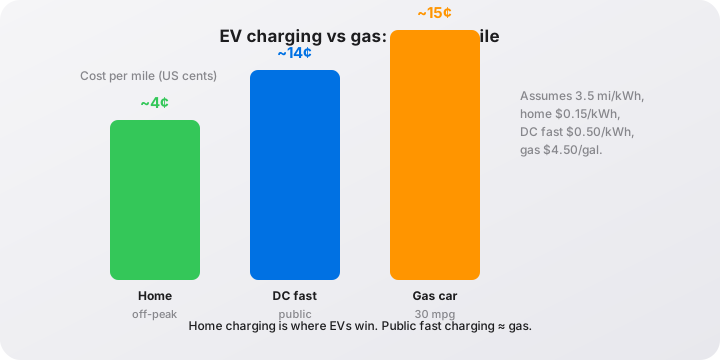
The asterisk I repeat in every one of these conversations: if you cannot charge at home, the energy advantage mostly evaporates. Public fast charging is priced to match gasoline on purpose. If you are an apartment dweller with no home charging, skip ahead — the EV probably is not cheaper for you yet. This is exactly why I tell people to sort out home charging installation as part of the purchase, not an afterthought.
Insurance: Where EVs Currently Lose
Here is the line the EV cheerleaders skip, and it has gotten worse, not better.
EVs cost more to insure than gas cars — commonly 20-40% more for a comparable vehicle, and the gap has widened in the last couple of years. The reasons are concrete: an EV’s battery pack is expensive and often means a collision that would be repairable on a gas car is a total loss on an EV; replacement parts are specialized and back-ordered; and there are fewer shops certified to work on high-voltage systems, so repairs take longer and cost more.
In dollar terms, that 20-40% can mean $400 to $900 more per year on a mid-size crossover. That single line can erase a large chunk of the fuel savings, and for some vehicles and drivers it can erase all of it.
The only reliable way to know your number is to get an actual quote on the specific VIN before you commit — never rely on a generic “EV insurance is cheaper” claim, because it often is not.
Maintenance and Repairs
Maintenance is where the EV story is genuinely good. Repairs are where it gets complicated.
Routine maintenance clearly favors the EV. No oil changes. No transmission service, no spark plugs, no timing belt, no coolant flushes on the engine side. Brake pads last dramatically longer because regenerative braking does most of the slowing. Over the first several years, an EV’s scheduled maintenance is mostly tires, cabin air filters, and the occasional brake fluid — call it a few hundred dollars a year less than a gas car, every year.
Tires are the exception. EVs are heavy — a battery pack adds hundreds of pounds — and they deliver torque instantly, both of which eat tires. Expect to replace EV tires noticeably more often than on a comparable gas car, and the tires themselves are often more expensive low-rolling-resistance or load-rated models. Budget an extra few hundred dollars a year here.
Repairs carry a tail risk. When something in an EV’s high-voltage system fails out of warranty — the onboard charger, a drive unit, or worst of all the battery pack — the bill can be enormous: battery replacements commonly run $5,000 to $20,000, and the labor must be done by certified technicians. These failures are rare — most EVs run for many years without one — but they are expensive and concentrated. The 8-year/100,000-mile battery warranty is what makes this risk acceptable for most owners. Once that warranty expires, it is a risk you carry.
The honest summary: over a long ownership, EVs win on maintenance and repairs on average, but the distribution is different — gas cars nickel-and-dime you steadily, while EVs mostly leave you alone and occasionally hit you with one big bill.
Depreciation
I covered this in depth in my guide to EV depreciation, so here is the short version for the TCO math: EVs currently depreciate faster than gas cars — roughly 40-50% over five years versus 35-40% — and because the purchase price is higher to begin with, that means a larger absolute dollar loss.
For our comparison, the EV that cost $8,000 more to buy might also lose a couple thousand dollars more in depreciation over five years. That is a real cost that offsets a meaningful slice of the fuel savings, and it is the reason the “EVs pay for themselves in two years” claim is usually fiction. Depreciation is also precisely why buying used flips the EV case from “maybe” to “probably”: you let the first owner absorb the steepest depreciation, then collect the fuel and maintenance savings yourself.
The Full Comparison Table
Here is the whole equation, side by side, for a mid-size crossover driven 12,000 miles a year, held for 5 years. These are realistic ranges based on current market conditions, and I have marked the soft numbers as estimates.
| Cost line | Gas crossover (5-yr) | EV crossover (5-yr) | Who wins |
|---|---|---|---|
| Purchase price (after $7,500 credit on EV) | ~$34,000 | ~$39,000 | Gas |
| Energy (12k mi/yr) | ~$1,400/yr ($7,000) | ~$600/yr home-charged ($3,000) | EV |
| Insurance | ~$1,700/yr ($8,500) | ~$2,200/yr ($11,000) | Gas |
| Routine maintenance | ~$900/yr ($4,500) | ~$500/yr ($2,500) | EV |
| Tires | ~$500 total (1 set) | ~$900 total (1.5 sets, estimate) | Gas |
| Out-of-pocket repairs (in warranty) | ~$1,500 (estimate) | ~$800 (estimate) | EV |
| Depreciation (5-yr, estimate) | ~$13,000 | ~$17,000 | Gas |
| Total 5-year cost | ~$69,000 | ~$74,200 | Gas (narrowly) |
| Cost per mile | ~$1.15/mi | ~$1.24/mi | Gas (narrowly) |
Hold on — that table says the gas car wins. So is the EV a bad deal? Not exactly. Look at what changes the outcome, and you will understand the entire debate.
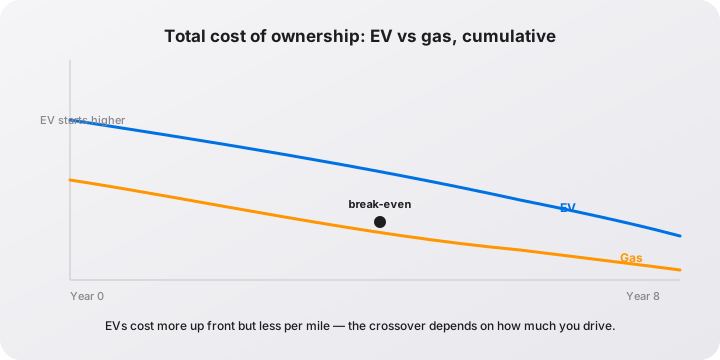
The table above assumes 5 years of ownership and a higher EV purchase price. Stretch the horizon and the picture flips. The EV’s two big advantages — energy and maintenance — are annual, compounding savings, while the gas car’s advantages — purchase price and depreciation — are one-time, front-loaded costs. Extend ownership to 8-10 years, drive more miles, or buy the EV used, and the EV pulls decisively ahead.
Let me show you the same cars held for 10 years, which is closer to how people actually keep cars:
| Scenario | Gas crossover 10-yr total | EV crossover 10-yr total | Winner |
|---|---|---|---|
| Bought new, 12k mi/yr, home-charged | ~$112,000 | ~$103,000 | EV |
| Bought new, 12k mi/yr, public-charged | ~$112,000 | ~$118,000 | Gas |
| Bought used (2-3 yrs old), home-charged | ~$82,000 | ~$74,000 | EV (clearly) |
| Bought new, 6k mi/yr (low mileage) | ~$71,000 | ~$76,000 | Gas |
These are estimates, but the pattern is the point, and it is robust: the EV wins when you drive enough, charge at home, and hold long enough. The gas car wins when you drive little, charge publicly, or flip the car every few years.
Where EVs Win, Where Gas Wins, and the Break-Even
Let me make it actionable.
Where EVs win:
- High annual mileage — the fuel savings scale with every mile.
- Home charging at reasonable (or off-peak) electricity rates.
- Long ownership (8+ years), where annual savings overpower the upfront premium.
- Buying used, where someone else already ate the depreciation.
- Access to the full tax credit plus any state/utility rebates.
Where gas cars win:
- Low annual mileage — there is not enough fuel saving to overcome the insurance and depreciation drag.
- No home charging — public fast charging prices away the energy advantage.
- Short ownership (2-3 years) — the front-loaded EV costs never get paid back.
- Buyers who cannot use the tax credit and do not lease.
The break-even reality. There is no single magic mileage, but a defensible rule of thumb: for a home-charging driver doing 12,000-15,000 miles a year, a comparable EV breaks even with a comparable gas car somewhere in the 40,000-60,000 mile / 3-5 year range, and then keeps pulling ahead. Drive 20,000 miles a year and it is closer to 2-3 years. Drive 6,000 miles a year or rely on public charging, and it may never happen.
One More Line: Protecting the Investment
If you do buy an EV, there is a cost line most guides leave out because it is small but smart: surge protection for your charging circuit. An EV is a $40,000 appliance with the most expensive electronics you own wired to a 240V circuit that is always energized. A nearby lightning strike or a utility switching event can travel straight into the car’s onboard charger.
A whole-house surge protector costs a few hundred dollars installed and protects both the charger and everything else in the panel. It is the cheapest insurance you will buy on the whole car, and it is the kind of thing that only shows its value the one night a year you really need it. While the electrician is already in the panel for your charger install, adding one is nearly a no-brainer.
The Bottom Line
The honest, complete answer to “is an EV cheaper than a gas car” is: it depends on your miles, your charging situation, and how long you keep it — and the answer flips based on those three things.
The fuel and maintenance savings are real and they compound every year. But higher insurance, faster depreciation, and a higher purchase price sit in front of them, so the EV does not win on day one — it wins over time. Home-charge an EV for 10 years and you will likely come out thousands of dollars ahead. Buy a cheap gas car, drive 6,000 miles a year, and flip it every three years, and the gas car probably wins.
Before you buy anything, do three things: get a real insurance quote on the exact VIN, confirm you can charge at home and what it will cost to wire the charger, and decide honestly how long you will keep the car. Those three answers tell you more than any “EV vs gas” headline ever will.
Frequently Asked Questions
Is an EV actually cheaper to own than a gas car?
Usually yes over a long enough ownership period, but not for the reason people assume. The fuel and maintenance savings are real and add up, but higher insurance, faster depreciation, and a higher purchase price eat into them for the first several years. The honest answer is that an EV typically wins over 6-10 years of ownership, while a gas car can still win in the first 2-3 years if you buy the cheapest possible gas car and drive few miles.
How much does it cost to charge an EV vs fill a gas tank?
At the national average residential electricity rate of roughly $0.15-0.17 per kWh, an EV that gets 3.5 miles per kWh costs about 4-5 cents per mile to drive on home charging. A gas car that gets 30 mpg at $3.50 a gallon costs about 11-12 cents per mile. So home-charged EV 'fuel' is roughly a third the cost of gasoline. The catch: public DC fast charging can cost $0.40-0.60 per kWh, which wipes out the advantage for people who cannot charge at home.
Is EV insurance more expensive than gas car insurance?
Yes, typically 20-40% more, and that gap has been widening. EVs are more expensive to repair after a collision because of the battery pack, specialized parts, and a shortage of certified shops, and some insurers are quick to declare an EV a total loss after even moderate damage. Always get an insurance quote on the specific VIN before you buy, because the premium difference can be the deciding factor.
Do EVs really need less maintenance?
Yes, on the routine side. There is no oil to change, no transmission to service, no spark plugs or timing belt, and brakes last far longer thanks to regenerative braking. But there are trade-offs: tires wear faster because EVs are heavier and torque harder, and when something in the high-voltage system does fail, the repair bill can dwarf anything a gas car throws at you. The long-term average tilts in the EV's favor, but it is savings with a tail risk.
At what mileage does an EV break even with a gas car?
There is no single universal number, but a useful rule of thumb: if you can charge at home and drive 12,000-15,000 miles a year, most EVs pull ahead of a comparable gas car somewhere around 40,000-60,000 miles, or roughly 3-5 years. Drive fewer miles or rely on public charging, and the break-even stretches out or never arrives. Drive a lot and charge at home, and it arrives fast.