Extension Cord Safety: The Gauge Chart, the Daisy-Chain Rules, and the 30-Second Inspection (2026)
Every fall, right around the first cold week, my phone starts ringing the same way. “The cord got warm. Is that normal?” Or: “Something melted, but nothing tripped.” Extension cords are the most-used, least-respected electrical equipment in the house. Everybody owns six. Nobody reads the label. And when one fails, it gets called “cheap” - when most of the time the real problem was the job it was asked to do.
NFPA data ties roughly 3,300 home fires a year to extension cords, and the damage clusters in winter - exactly when heaters, holiday lights, and space heaters start competing for the same outlets. The mechanics behind almost every one of those fires fit on a short list: the cord was too thin for the load, it was connected in a chain nobody could keep track of, or it had stopped being temporary years ago.
I have spent more than seven years maintaining critical-infrastructure power systems, where a warm connection is treated as a failure that has already started - not a curiosity to monitor. Houses run the same physics, just smaller. This guide is the whole playbook: how to read a cord like its label matters, the daisy-chain rules people keep searching for at 11 p.m., and the 30-second check that tells you when a cord is done.
The Jacket Label Is the Instruction Manual
Pick up any extension cord in your house and look along the jacket. Every few feet, a set of characters is molded or printed into the plastic: something like “SJTW 12/3” or “SPT-2 16/3”, plus an amp rating. It is the most ignored safety label in America, and it is a complete specification once you can read it.
The format, decoded:
- 16/3 - the first number is the wire gauge in AWG (American Wire Gauge). Counterintuitively, bigger numbers mean thinner wire: 16 AWG is thin, 12 AWG is beefy, 10 AWG is garden-hose-thick copper.
- The second number - 2 or 3 conductors. Three means it includes a ground wire, which any appliance with a three-prong plug needs.
- The letters - the jacket type. SPT-2 is light-duty lamp-style cord, fine for lamps and chargers. SJT is junior hard-service, tougher. SJTW adds a weather-resistant jacket. The “W” is the one that matters for anything that lives outdoors.
- The amps - the cord’s maximum. The packaging usually adds length-specific limits, because the same wire carries less current the longer it gets.
If you cannot find any marking at all, treat the cord as light duty and use it accordingly. And when a table - including mine - disagrees with the label on the cord you are holding, the label wins. It describes the actual copper and insulation in your hand.
Wire Gauge: The Number That Decides Everything
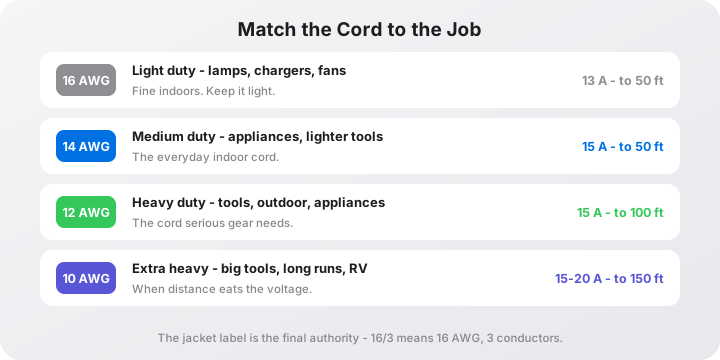
Gauge is where cords get misused most, because nothing about a store shelf explains it. A 16-gauge cord and a 12-gauge cord can look nearly identical and sit $8 apart. The difference is how much heat each one can carry away before something melts.
The rule of thumb from every manufacturer’s sheet: keep your load under the cord’s rating, and remember that distance eats capacity. A 12-gauge cord that is fine at 25 feet may be de-rated at 100. Voltage drop is the reason - the longer the run, the more of the 120 volts is spent pushing current through the copper itself, and the closer the cord gets to cooking in its own jacket.
| Jacket marking | Typical rating | Practical length | The job it fits |
|---|---|---|---|
| 16 AWG (16/3) | 13 A | to 50 ft | lamps, chargers, fans, electronics |
| 14 AWG (14/3) | 15 A | to 50 ft (about 13 A at 100 ft) | small appliances, lighter tools, shop lights |
| 12 AWG (12/3) | 15 A | to 100 ft | power tools, outdoor equipment, appliances |
| 10 AWG (10/3) | 15-20 A | to 150 ft | big tools, long runs, RV feeds |
Ratings vary slightly between makers, and the packaging often prints length-specific limits. When you need reach and draw at the same time - a circular saw at the far end of the driveway, mower, sump pump during a storm - buy a heavy-duty 12-gauge cord and stop guessing. The cost difference between the thin cord and the right cord is the cheapest insurance in this entire article.
Amps, Watts, and the 80% Rule That Keeps a Cord Cool
Almost every cord mistake starts with an amps-and-watts conversion nobody did. The math is one line: amps = watts ÷ 120. A 1,500-watt space heater is 12.5 amps. A 12-amp shop vac plus a 5-amp work light is 17 amps - more than any household cord is rated for, and more than a 15-amp breaker will tolerate for long.
A 15-amp cord is nominally good for 1,875 watts (15 × 125), and its label will say so. But nominal is not a target - it is a ceiling. Breakers live by the 80% rule, and connections should too: keep continuous draw under about 1,500 watts on a 15-amp cord, and you will rarely feel a warm plug. Run a resistive load at the ceiling for hours and the heat has nowhere to go: plugs soften, contacts oxidize, and resistance climbs - which makes more heat. It is a self-feeding loop, and it does not need to trip anything to do damage. The breaker triage guide covers why a circuit can cook quietly below its trip threshold; the cord is the same story in miniature.
Guessing is the other half of the problem. If the label on the appliance gives amps, double-check with a plug-in power meter (roughly $20-40): you plug the appliance into it and read the real draw. Five minutes with a meter beats an hour of internet math, because nameplate ratings lie in both directions.
The Daisy-Chain Rules: Nobody May Stack Connections
This is the question that sends a few thousand people a month to their search bar: can you plug a power strip into an extension cord? The answer is no - and the power strip itself already told you so, because nearly every one carries the same printed instruction: do not use with extension cords or another power strip.
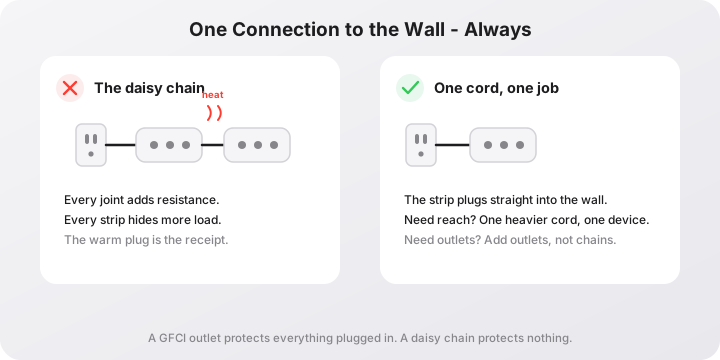
Here is the physics behind the label, and why it is not just corporate caution. Every plugged connection has contact resistance. It is small at any single joint - which is exactly why one clean connection is fine. Chain the pieces, and you stack resistances in series: the first plug in the chain now carries every amp drawn by everything downstream, through its own mated contacts plus the heat from the joints ahead of it. Nobody in that chain - not the breaker, not you - can see the true total. The breaker sees 12 amps and shrugs; it would shrug at 14.5. The joint carrying those 12 amps continuously is the part that fails, slowly, in a way your nose usually finds before your eyes do.
I have pulled apart daisy-chained setups where nothing had tripped, nothing was “broken,” and the first plug’s face was hot enough to leave a mark on a palm. That is the failure mode: not a dramatic spark, just heat accumulating at a connection no one is watching.
| Setup | Verdict | Why |
|---|---|---|
| Power strip into wall outlet | Fine | That is the design case. |
| Power strip into extension cord | No | Against the strip’s own instructions - you have extended a device whose cord length was part of its rating. |
| Power strip into another power strip | Never | Stacked joints, invisible total load, heat at the first plug. |
| Power strip into a GFCI outlet | Fine - and smart outdoors | The GFCI protects everything plugged into it. |
| Power strip into a UPS outlet | No per most makers | Devices go straight into the UPS; extra strips distort its load readout. |
| Extension cord to one heavy tool | OK, within rating | One cord, one visible load - 12 AWG for anything heavy. |
The cleanup rule is short: one connection to the wall. One strip or one cord, never a family tree. If you need more outlets, the honest fix is more outlets. If you need more reach, buy one heavier cord sized for the single device on the other end. For the deeper dive into stacked-joint overheating - and the melted strip that prompted it - see our power strip vs surge protector breakdown.
The Places a Cord Should Never Go
Even a correctly sized cord becomes a statistic when it is asked to do the wrong job. The National Electrical Code prohibits several of these uses for flexible cords by name, and every one of them is common in real homes:
| Never do this | Why it is dangerous |
|---|---|
| Run it under a rug or carpet | Heat cannot escape through the pile, feet crush the jacket, and you cannot see the damage forming. |
| Run it through a doorway or window | The same pinch point works on the cord every day; strands inside break one by one. |
| Staple, nail, or hang it on a nail | Metal pierces or crushes the insulation. One day it finds copper. |
| Hide it inside a wall, floor, or ceiling | Cords are not wiring. Concealed damage cannot be inspected, and it is a code violation. |
| Use an indoor cord outdoors | No weather rating: UV makes the jacket brittle and water finds the joints. |
| Leave it in place as permanent wiring | It stopped being temporary; the equipment changes, the load grows, and nobody re-checks it. |
Two habits belong on the same list. First: never file off, break off, or “borrow” a ground pin - the third prong is the safety path that gives fault current somewhere to go, and three-prong-to-two-prong adapters defeat it just as effectively. Second: never unplug by the cord. Pulling the cord instead of the plug means yanking on the exact connections and wire terminations you are trying to preserve.
And one honest piece of life advice that has saved more cords than any table: if a cord has been “temporarily” in place for six months, the thing you actually need is an outlet. That is an ordinary electrician job, not a renovation - and it retires the risk permanently instead of managing it.
Matching Cord to Job: A Load Cheat Sheet
Once you know the gauge and the load, matching them takes five seconds. Typical draws for common household jobs:
| Job | Typical draw | Cord to use |
|---|---|---|
| Phone chargers, lamps, a TV | under 200 W | 16 AWG is fine |
| Fans, small appliances | 200-800 W | 14 AWG |
| Circular saw, shop vac, table saw | 800-1,800 W | 12 AWG, under 50-100 ft |
| Lawn tools (outdoor) | 700-1,200 W | 12-14 AWG, outdoor-rated, on a GFCI outlet |
| Space heater | 1,500 W | 12 AWG max; wall-direct preferred; never a strip |
| Portable AC | 1,000-1,500 W | 12 AWG, as short as possible; check the manual |
| Refrigerator (temporary use) | 150-600 W running | 14-12 AWG, short run |
| Sump pump (temporary use) | 400-800 W | 12 AWG; battery backup is the real answer |
The space heater row deserves its own paragraph, because it is the single most consistent extension-cord fire starter there is. A 1,500-watt heater pulls 12.5 amps continuously for hours - 83% of a 15-amp circuit’s headline rating before you plug in anything else. Never run one on a power strip, and never on anything thinner than 12 gauge. If the outlet is genuinely out of reach, the correct sequence is: heater into wall outlet if at all possible; second best, one 12-gauge cord, as short as possible, plugged directly into the wall; never a strip, never a daisy chain. Then feel the plug after twenty minutes - that palm check is the last line of defense and it never lies.
If winter power plans involve a generator, remember a cord is for a device or two, never for a house. Feeding your panel through a cord - backfeeding - can kill a utility worker down the line and is illegal in most places; the legal path runs through a transfer switch, and the realistic storm checklist lives in our power outage preparation guide.
The 30-Second Inspection: Feel the Ends, Not the Middle
Cords fail on a schedule no calendar predicts: they fail on history. A cord that has lived under a couch leg, crossed a driveway, and spent two winters in a garage is older than its years. The good news is that the two things that matter - heat and insulation - announce themselves to your fingertips.
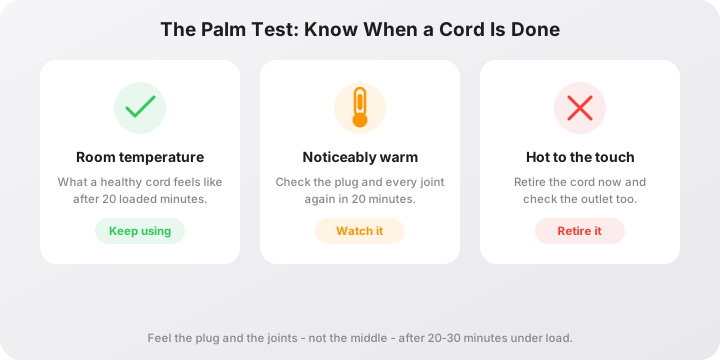
The palm test, done after the load has run 20-30 minutes: feel the plug, the cord end, and every joint. Room temperature or barely warm is normal. Noticeably warm means recheck it in twenty minutes and keep it under observation. Hot to the touch means the cord is finished - retire it now, and check the outlet it was plugged into as well, because heat marks the weak link in the chain wherever it is.
Then run down the visible checklist:
| What you find | What it means | What to do |
|---|---|---|
| Plug or joint warm after 20 minutes loaded | Resistance at a connection | Watch warm; retire hot; check the outlet too. |
| Jacket cracked, brittle, or stiff | Insulation is aging out | Retire the cord. |
| Discolored, melted, or bent plug ends | Heat has been there already | Retire the cord, inspect the outlet. |
| Missing or filed-down ground pin | The safety path is gone | Retire the cord. |
| Tape, splices, or knots | Tape is not a repair | Retire the cord. |
| Plugs fall out of the cord end | Worn contacts | Replace the cord; if the outlet is loose too, replace the outlet. |
“Retire” has a procedure: cut both ends off before recycling the cord, so nobody - not a family member, not a scrapper - fishes it out of the trash and puts it back into service. A cord with no ends is unmistakably dead.
Outdoors: The W, the GFCI, and the Joint That Sits in Water
Outdoor use doubles the failure modes, because now the cord has weather. Three rules cover it.
Use a cord rated for it. The “W” in SJTW, or the heavier SOW jacket, is the weather rating. A lamp-style SPT-2 cord left outdoors through a season will harden in the sun, crack, and let water reach the conductors - usually at the ends, exactly where the connection sits.
Put it on GFCI protection. The outlet feeding outdoor power should be GFCI-protected; outdoors is where the device earns its keep, cutting power when current finds a path through water or a person. Our GFCI vs AFCI guide covers how the device works and why it trips in the rain. If your exterior outlets are not protected, that upgrade is a small, high-value electrician visit.
Get the joint off the ground. Lakes of water form at the lowest point of any run, and the plug-to-receptacle connection is the least water-resistant part of the whole setup. Elevate the connection or shield it with a waterproof connection cover, and unplug outdoor runs when storms roll through rather than leaving them to soak.
One more outdoor rule with no exceptions: a cord that met a mower blade is dead even if the damage looks cosmetic. The copper strands inside are notched, not cut clean, and every notch is a future hot spot. Replace it - do not tape it.
Storage: How to Make a $30 Cord Last a Decade
Most cords die in storage, not in service. Wrapping a cord around your elbow - the universal habit - puts a hard kink at the same spot every time, and kinks fatigue copper. Coil it over-under instead: alternating loops, the way stage crews coil cable, so the cord relaxes on the floor without twists or kinks. Secure it with hook-and-loop straps rather than tying the cord in a knot - knots are kinks that stay in.
If you like cord reels, buy one that is rated for the cord and the load, and still uncoil for heavy draws: a coil traps heat, which is the whole reason reels carry de-rated capacities. In the garage, keep cords off the floor and away from solvents and sunlight, and give the ends a quick glance whenever you pull one out. Five seconds at pickup beats the palm test at failure.
The Bottom Line
An extension cord is a temporary tool, and it stays safe as long as you keep it on three tracks: read the jacket label so the gauge matches the job, keep the run to one connection with no chains, and feel the ends after they have been working - cool is fine, warm is a yellow flag, hot is a verdict.
Done right, a cord is one of the least interesting things in your house. That is exactly the goal. The failures that burn houses are never the cord’s idea; they are the plan it was asked to cover for. Fix the plan.
Frequently Asked Questions
Can you plug a power strip into an extension cord?
No - and the power strip says so itself: nearly every one is labeled 'do not use with extension cords.' The reason is physics, not paperwork. Every plugged connection adds contact resistance, and a chain stacks them: the first plug carries the combined load of everything downstream while the breaker sees one ordinary number. Nobody tracks 12 amps running continuously through three mated plastic-and-brass joints, and the first joint is where the heat accumulates. If you need more reach, buy one heavier cord rated for the single device you are powering. If you need more outlets, that is a job for an outlet - not a chain.
What gauge extension cord do I need?
Match the cord's printed amp rating to the job. Light duty: 16 AWG for lamps, chargers, and fans, out to about 50 feet. Everyday duty: 14 AWG for small appliances and lighter tools. Heavy duty: 12 AWG for power tools, outdoor equipment, and appliances - the safe default when you are not sure. Long runs (100 feet and up) or big tools: 10 AWG. Length matters as much as gauge: the same cord carries less at 100 feet than at 25. Convert with watts divided by 120 to get amps, keep continuous draw under about 80% of the rating, and when in doubt go one size thicker - thicker never hurts.
Can I plug a space heater into an extension cord?
Ideally, no. A 1,500 W heater draws 12.5 amps continuously, which by itself exceeds the 80% comfort line for a 15 A circuit (1,440 W). Heaters are the most common extension-cord fire starter in the country. If there is truly no way to reach the outlet: use a 12 AWG cord, as short as possible, plugged directly into the wall - never a power strip, never 16 or 14 AWG - and feel the plug with your palm after 20 minutes. More than slightly warm means stop. The better fix costs nothing: move the heater, not the power.
How long can an extension cord be?
Keep voltage drop under about 5%, which in practice means: 16 AWG stays under 25-50 feet; 14 AWG under 50 feet (100 feet only for light loads); 12 AWG up to 100 feet; 10 AWG up to 150 feet. Longer runs demand thicker wire, and you should never solve distance by chaining two cords or adding a strip - that stacks connections. This matters most for tools and motors: a long, thin cord makes a motor run hot and die young, so 'the longest cord I own' is the wrong instinct. Buy the shortest cord that reaches.
Do extension cords overheat when they are coiled?
Yes, if they are coiled on a reel or tightly looped while carrying a heavy load. A cord makes its own heat in normal use; that is fine when the surface can shed it into the air around it. A coil nests warm surfaces against each other and the heat stacks up, which is why cord reels carry a rated capacity that assumes the cord is unwound. For anything heavy - heaters, tools, pumps - uncoil the full length before use, and if the center of the coil feels warm, you have asked too much of the reel. For phone chargers the effect is tiny; unrolling is still free.