Home Battery vs. Generator: An Electrician's Honest Comparison
Every storm season, the same question lands in my inbox: should I buy a home battery or a standby generator? People usually expect a brand recommendation. What they actually need is a decision about how their house fails — and the answer changes completely depending on whether your outages are two hours or two weeks.
I maintain backup power for a living, and I have installed and serviced both. Here is the honest comparison, including the numbers the brochures leave out.

The Honest Comparison Table
This is the whole argument on one table. Prices are typical installed costs in the US as of mid-2026; I use a 13.5 kWh Tesla Powerwall 3 and a 22kW air-cooled standby generator as the reference points.
| Home battery (Powerwall-class) | Standby generator (22kW) | |
|---|---|---|
| Installed cost | $10,000 – $16,000 | $8,000 – $16,000 |
| Energy source | Stored electricity (finite) | Fuel (unlimited while supplied) |
| Runtime per outage | Hours to days, then dead | Days to weeks with fuel |
| Switchover speed | Under 1 second, seamless | 10 – 30 seconds after outage |
| Noise | Silent | 65 – 72 dB (lawn-mower loud) |
| Indoor safety | Safe, installs indoors | Never indoors — CO kills |
| Ongoing maintenance | ~None | $300 – 400/year + self-tests |
| Fuel cost | Grid recharge (~$0.15/kWh) | $0.15 – 0.70/kWh depending on fuel |
| Power output | 5 – 11.5 kW | 10 – 26 kW |
| Service life | 10 – 15 years (LiFePO4) | 1,500 – 3,000 engine hours |
| Refuel during outage | Solar or grid only | Add fuel, keep going |
Read that switchover row twice. A battery picks up the load in a fraction of a second — your router never drops, your desktop never reboots. A generator takes 10-30 seconds to start and transfer, which is fine for a fridge but means your work-in-progress is gone unless you also have a UPS on your computer and network gear.
The Deciding Question: What Does Your Outage Look Like?
Short outages, a few times a year (most urban and suburban grids): the battery wins, and it is not close. It sits on the wall doing nothing 360 days a year, then silently carries your fridge, furnace fan, lights, and internet through the two-hour blip. No fuel to store, no engine to maintain, no noise complaints from the neighbors, and it is the only option that works in a condo or an apartment.
Multi-day outages, or well pumps, sump pumps, and medical equipment (rural, storm belts, hurricane country): you need a generator. A battery is a tank that empties; a generator is a tap that flows as long as you feed it. When the outage is measured in days, there is no battery big enough at a sane price.
Frequent short outages AND occasional long ones: this is the hybrid case — and the most common one I actually recommend. More on that below.
The Money Question: Upfront vs. Lifetime Cost
The sticker prices are close. The total cost of ownership is not, because a generator is a small engine that wants attention while a battery is solid-state electronics that wants nothing.
Here is a ten-year view for a typical single-family home:
| Cost over 10 years | Home battery | Standby generator |
|---|---|---|
| Hardware + install | $12,000 | $11,000 |
| Annual maintenance | $0 | $3,000 – 4,000 |
| Engine battery replacement | $0 | $120 – 160 |
| Self-test fuel (weekly cycle) | $0 | $600 – 1,800 |
| Outage fuel (variable) | ~$0 (grid recharge) | $500 – 2,000+ |
| Approximate 10-year total | $12,000 – 13,000 | $15,000 – 19,000 |
The generator’s upfront savings evaporate inside a decade of oil changes, valve adjustments, load-bank tests, and fuel. The battery’s only meaningful ongoing cost is that you will likely want more capacity than you initially buy — and expanding a battery system is where the real money shows up, which I cover in the Tesla Powerwall alternatives comparison.
There is also a budget path that sits outside this table entirely: a $1,500-3,000 portable inverter generator plus a manual transfer switch. It is louder, manual, and cannot run central AC, but for occasional outages it delivers 90% of the practical benefit at 20% of the price.
Runtime and Energy: The Fundamental Difference
A generator’s advantage is not watts — it is that fuel is cheap to store in bulk and fast to replenish. A battery’s energy is fixed at purchase and slow to refill.
To put it in concrete terms, here is what a typical home’s critical circuits draw each day, and how far each system gets you:
| Critical load | Daily energy use |
|---|---|
| Refrigerator | ~1.5 kWh |
| Chest freezer | ~1.0 kWh |
| Furnace fan (gas heat) | ~0.5 – 1.0 kWh |
| LED lighting | ~0.5 kWh |
| Router + modem + small electronics | ~0.3 kWh |
| Typical total | ~3 – 4 kWh/day |
- A 13.5 kWh Tesla Powerwall 3: roughly 3-4 days of critical loads.
- A 5 kWh Enphase IQ 5P: roughly one day.
- A 22kW generator with a full 500-gallon propane tank: 7-10 days at partial load, and you can call for a refill and keep going indefinitely.
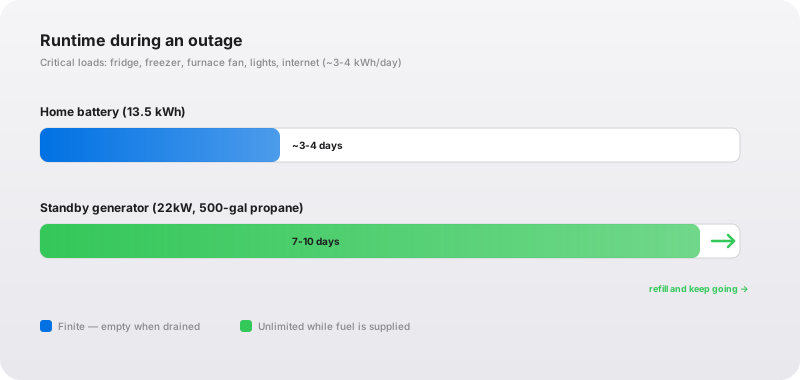
Notice the generator’s number does not come from more watts — it comes from a tank you can top off. That is the whole trade in one sentence.
Power vs. Energy: Why an AC Unit Changes the Answer
People conflate two different limits and then buy the wrong thing.
- Power (kW) is how much load the system can push at any instant — can it start your well pump or AC compressor?
- Energy (kWh) is how long it can keep pushing — how many hours before it is empty?
A battery can be strong on one and weak on the other. A 13.5 kWh Powerwall pushes 11.5 kW — enough to start a 3-4 ton AC with a soft-start kit — but running that same AC drains the whole 13.5 kWh in under four hours. A single 5 kWh Enphase IQ 5P cannot start the AC at all.
A 22kW generator handles both the power and the duration, because its energy source is the gas line, not a fixed tank. If your non-negotiable loads include a well pump, a sump pump that runs during every storm, or a central AC you refuse to live without, the generator is the safer default — and the home standby generator cost guide walks through the sizing math so you do not overbuy.
Maintenance and Day-to-Day Reality
This is where the two systems diverge the most in practice, and where I see the most buyer’s remorse.
A battery is set-and-forget. It self-manages, has no fluids, no filters, no engine, and the manufacturer warranty (10-15 years on LiFePO4 systems) is the maintenance plan. Your only interaction is the app.
A generator is a small engine that sits idle 99.8% of the time and is asked to start perfectly during the worst weather of the year. That takes a weekly self-test cycle, an annual service (oil, filters, spark plugs, load-bank test, valve adjustment on some models), and a replacement starting battery every 3-4 years. Skip the maintenance and the generator that “always worked” will often fail to start the one night you actually need it.
I have lost count of the number of times I have been called out in February to a generator that was installed three years ago and never once test-run. The engine was fine. The fuel had gone stale, or the starting battery was dead, or a rodent had nested in the enclosure. None of these failure modes exist for a battery.
Safety and Noise: The CO Rule Has No Exceptions
Two absolute rules:
- A generator runs outdoors, at least 20 feet from the house, exhaust pointing away. Never in a garage, even with the door open. Carbon monoxide is odorless, colorless, and kills people every storm season. A battery produces no exhaust and mounts on your garage wall.
- A generator is loud. 65-72 dB is lawn-mower territory, and your neighbors will notice a 22kW unit running at 3 a.m. A battery is silent — in an apartment or a tight subdivision, it is effectively the only neighbor-friendly option.
If you need backup power inside a condo, an apartment, or a townhouse with an HOA, the decision is already made for you: battery.
The Hybrid Setup I Actually Recommend
For a home in an outage-prone area, the best answer is frequently both — and it is not the extravagant purchase it sounds like.
- A home battery (or even a large portable power station) carries the house silently through the night and through short daytime blips. Switchover is instant, so nothing reboots.
- A generator runs a few hours a day to power heavy loads (well pump, water heater, laundry) and — this is the clever part — recharges the battery for the next night.
This loop cuts fuel use by roughly two-thirds versus running a generator around the clock, and you never listen to an engine at 2 a.m. Some systems integrate this natively: a FranklinWH aPower 2 controller can manage multiple generators alongside its battery bank, and the EcoFlow Delta Pro Ultra with a Smart Home Panel does the same on a smaller budget. For the portable-scale version of the same idea, I wrote a full comparison in portable power station vs generator.
How to Decide: Four Questions
Stop comparing spec sheets. Answer these in order:
- How long are your outages, really? Under a day and rare: battery. Multiple days or storm-season regularity: generator. Both: hybrid.
- What must you run? Lights, fridge, furnace, internet: either works, buy on price. Well pump, sump pump, central AC: generator, or a high-power battery with a soft-start kit.
- Where do you live? Apartment, condo, or HOA with noise rules: battery, full stop.
- How much do you want to think about it? Want to install it and forget it for a decade: battery. Willing to do annual service and weekly checks for unlimited runtime: generator.
The Bottom Line
A home battery and a standby generator cost about the same to install, and then diverge completely: the battery is silent, safe, and maintenance-free but runs out in days; the generator runs indefinitely on fuel but wants annual attention, makes noise, and demands an outdoor exhaust-safe location. Match the tool to your outage profile, not to the marketing — and if you cannot decide, the hybrid of a battery for the nights and a generator for the heavy lifting beats either one alone.
Frequently Asked Questions
Is a home battery or a generator cheaper in the long run?
It depends on your outage profile, but the battery usually wins on total cost of ownership after 10 years. A [Tesla Powerwall 3](https://www.amazon.com/s?k=Tesla+Powerwall+3&tag=homepowerfix-20) runs $10,000-16,000 installed with near-zero ongoing cost. A comparable 22kW standby generator runs $8,000-16,000 installed but then adds $300-400/year in maintenance, a $40-80 battery every 3-4 years, and $120-600/year in fuel for self-tests and outages. Over a decade the generator's ongoing costs typically erase its upfront advantage. The generator only wins financially if you have frequent long outages where the battery would need a larger, more expensive system to keep up.
Can a home battery run my air conditioner?
Sometimes — and this is where power output matters more than capacity. A [Tesla Powerwall 3](https://www.amazon.com/s?k=Tesla+Powerwall+3&tag=homepowerfix-20) delivers 11.5 kW continuous, enough for a 3-4 ton AC with a soft-start kit, but a single [Enphase IQ 5P](https://www.amazon.com/s?k=Enphase+IQ+5P&tag=homepowerfix-20) at 3.84 kW cannot. The battery's energy reserve is a separate limit: a 13.5 kWh Powerwall running a 3.5 kW central AC will be drained in under 4 hours of compressor run time. A 22kW generator runs the AC indefinitely as long as it has fuel. If large motor loads are your priority, read the [home standby generator sizing guide](/posts/home-standby-generator-cost/) before committing to a battery.
How long will a home battery keep my house running during an outage?
For the essential circuits — refrigerator (about 1.5 kWh/day), freezer (1.0), furnace fan (0.5-1.0), LED lights (0.5), and router/modem (0.3) — a typical home draws roughly 3-4 kWh per day. A 13.5 kWh [Tesla Powerwall 3](https://www.amazon.com/s?k=Tesla+Powerwall+3&tag=homepowerfix-20) therefore covers 3-4 days of those critical loads; a 5 kWh [Enphase IQ 5P](https://www.amazon.com/s?k=Enphase+IQ+5P&tag=homepowerfix-20) covers about one day. The catch: once the battery is empty, it stays empty until grid power returns or you recharge it. A generator keeps running as long as you keep feeding it fuel — a 500-gallon propane tank is 7-10 days at partial load.
Do I need a transfer switch for a battery or a generator?
Yes — for any whole-home backup that ties into your electrical panel, you need a code-compliant transfer mechanism so backup power can never back-feed the utility lines and electrocute a line worker. Standby generators use an automatic transfer switch (ATS) that is usually bundled with the unit. Whole-home batteries use a gateway/controller (Tesla Gateway, Enphase System Controller) that performs the same isolation automatically, often in under a second. A portable generator used with your panel needs either a manual transfer switch or a generator interlock kit. This is not optional — see the [generator transfer switch guide](/posts/generator-transfer-switch/) for what each option involves.
Can I use a home battery and a generator together?
Yes, and for outage-prone homes it is the best setup you can buy. The battery carries the house silently overnight and through short blips (switchover in under a second), while the generator runs a few hours a day to power heavy loads and recharge the battery. This 'generator-recharges-battery' loop cuts fuel use by roughly two-thirds versus running a generator around the clock, and you never listen to an engine at 2 a.m. Some batteries (FranklinWH in particular) integrate natively with generators through their controller; with others you coordinate them manually or through a smart panel. For the portable version of this hybrid, see [portable power station vs generator](/posts/portable-power-station-vs-generator/).