Hot Tub Electrical Requirements: 50A vs 60A, Wire Size, GFCI, and What a 2026 Hookup Really Costs
A homeowner sent me a photo last spring: a new hot tub sitting on a freshly built deck, a 50-foot coil of 6/2 Romex beside it, and one question. “Can you just hook it up this weekend?”
The tub needed four conductors. The cable had three. And the run left the house and crossed forty feet of wet ground, which is the one place plastic-sheathed cable is not permitted at all. He had saved about $180 on the wrong spool and was now looking at a second purchase, a conduit run, and a permit he had not planned on.
That sequence is normal. Most hot tub electrical problems are decided at purchase, weeks before anyone opens a panel. This guide is the conversation I wish every buyer got first: what the tub draws, what the nameplate means, why 240-volt tubs need a neutral, which cable is legal outdoors, and what the work costs in 2026.
What a Hot Tub Actually Draws
There are two completely different products sold under the same name.
A 120-volt plug-and-play spa — the inflatable and small rotomolded units — draws roughly 1,100 to 1,500 watts, or 9 to 12.5 amps. It comes with a cord and a GFCI plug, and it heats slowly, a few degrees per hour, because it cannot run the heater and the jets at full output on a 15- or 20-amp circuit. It works on a dedicated 20-amp outlet and nuisance-trips constantly on a shared garage circuit, which is what most people try first.
A 240-volt permanent tub is a different load class. The heater alone is typically 4 to 6 kilowatts. Add one or two jet pumps at 1 to 2 horsepower each, plus a circulation pump, an ozonator, and LED lighting, and the connected load lands between 30 and 55 amps depending on the model.
| Tub type | Voltage | Typical draw | Circuit | How it connects |
|---|---|---|---|---|
| Inflatable / plug-and-play | 120V | 1,100–1,500W (9–12.5A) | Dedicated 15–20A | Cord and GFCI plug |
| Small rotomolded | 120V or convertible | 12–20A | 20A dedicated | Cord, or hardwired on 240V |
| Standard 240V tub | 240V | 30–40A | 40–50A | Hardwired through disconnect |
| Large 240V tub, two pumps | 240V | 40–50A | 50–60A | Hardwired through disconnect |
The mechanical detail that matters: a hot tub is not a steady load like a water heater. The heater cycles under thermostat control, and the jet pumps run only when someone is in the tub or a filtration cycle starts. That is why a tub marked 50 amps usually sits at 5 to 15 amps most of the day and only approaches its rating when the heater, the circulation pump, and a jet pump run at once. The circuit still has to be sized for that worst case, because that is the case that trips breakers and warms terminals.
50A vs 60A: The Nameplate Decides
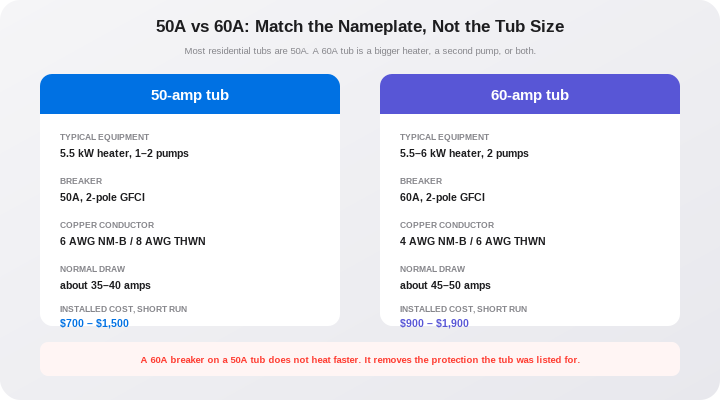
The single most useful number on a hot tub is printed on a metal plate or sticker near where the power enters the control box. It will say something like “240V 50A” or “240V 60A,” and sometimes it lists a maximum circuit breaker size. That number is the answer. Nothing about the tub’s size, price, or number of jets overrides it.
Roughly, the configurations break down like this:
| Nameplate | Typical equipment | Breaker | Copper conductor | Notes |
|---|---|---|---|---|
| 40A | 4–4.5 kW heater, one pump | 40A | 8 AWG NM-B indoors / 8 AWG THWN | Smaller tubs, some convertibles |
| 50A | 5.5 kW heater, one or two pumps | 50A | 6 AWG NM-B / 8 AWG THWN | The most common residential size |
| 60A | 5.5–6 kW heater, two pumps, blower | 60A | 4 AWG NM-B / 6 AWG THWN | Large tubs, lounge seats, multiple pumps |
Two mistakes are common enough to name.
Rounding up the breaker. A 50-amp tub on a 60-amp breaker does not heat faster. The heater is a fixed resistance; it draws what it draws. What you have done is raise the trip threshold above the rating of the tub’s internal wiring and terminal block, which is a fire risk disguised as an upgrade. The breaker protects the smallest conductor in the chain, and that conductor is inside the tub.
Rounding down the wire and hoping. A 60-amp tub fed with 6 AWG NM-B is a 55-amp conductor on a 60-amp breaker. It will work for a while. Then the terminals at the disconnect darken, the GFCI starts tripping on startup, and someone replaces a $180 breaker to fix a $60 wire mistake.
If you are buying a tub and have a choice, a 50-amp model is the sweet spot for most homes: it fits a 6 AWG run, it usually fits a 200-amp service with room to spare, and the difference in heat-up time versus a 60-amp unit is small.
Four Wires, Not Three
This is the detail that turns a one-day job into two.
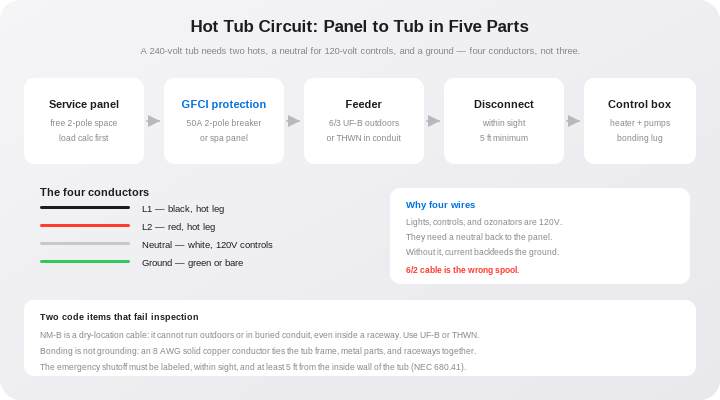
Most 240-volt hot tubs require four conductors: two hots (L1 and L2), a neutral, and a ground. The hots run the heater and the pumps. The neutral exists because the control system, the lights, the ozonator, and sometimes the audio and the remote are 120-volt circuits derived from one leg to neutral inside the control box. Take the neutral away and those parts either do not work or backfeed through the ground, which is exactly the condition a GFCI is built to detect.
So the cable is 6/3 with ground, not 6/2. The “with ground” part is not counted in the slash number: 6/3 means three insulated conductors — black, red, white — plus a bare ground. On a 50-amp tub, that is the correct cable. A handful of 240-volt tubs are true three-wire units with no 120-volt accessories, and their instructions will say so. Do not assume yours is one of them because a forum post said hot tubs do not need a neutral.
There is a second, sneakier mismatch: the lugs inside the tub’s control box. Many 50-amp tubs accept 6 AWG comfortably but not 4 AWG. If you run oversized wire “for future-proofing,” you may find it will not terminate without a reducer, and the inspector will not accept a trimmed strand bundle stuffed into a lug. Buy the wire the nameplate calls for.
Wire Size and the Wet-Location Rule
Ampacity for copper, from the NEC 310.16 table:
| Copper size | 60°C (NM-B) | 75°C (THWN in conduit) | Good for |
|---|---|---|---|
| 8 AWG | 40A | 50A | 40A tub indoors, 50A in conduit |
| 6 AWG | 55A | 65A | 50A tub; not a 60A cable run |
| 4 AWG | 70A | 85A | 60A tub |
| 3 AWG | 85A | 100A | Long 60A runs, subpanel feeders |
The column matters as much as the size. NM-B — the plastic-sheathed cable in your walls — must be sized from the 60°C column. Six-gauge copper sounds like a 60-amp conductor, and in conduit it is 65 amps, but as NM-B it is 55. That single row explains a large share of failed hot tub inspections.
Then the location rule. NM-B is a dry-location wiring method. It is not permitted outdoors, in wet locations, or in buried conduit, even inside a raceway, because the jacket is not rated for wet contact. An outdoor hot tub feeder has to be one of these:
- UF-B direct burial cable, 24 inches deep, with the proper warning tape and a permit that includes the trench
- THWN conductors in PVC conduit, 18 inches deep for direct burial, 6 inches under a slab, or shallower where rigid metal conduit protects the run
- Liquid-tight flexible conduit for the last few feet from the disconnect to the tub, where the tub vibrates and moves
A 50-foot run of 6/3 UF-B is roughly $250 to $400 in 2026. The same length of 6/3 NM-B is under $200 and cannot legally leave the house. That $100 difference is the most expensive shortcut in the project.
One more: before you dig, call 811. It is free, it is required in most states, and hitting a gas line or a service lateral with a trencher costs more than the entire electrical job.
How Far Can You Go: Voltage Drop
There is no code distance limit for a hot tub circuit, only a performance one. The NEC suggests keeping voltage drop under 3 percent on a branch circuit, and on a purely resistive heater load the arithmetic is simple.
At 240 volts and 50 amps, with 6 AWG copper at about 0.49 ohms per 1,000 feet:
- 50 feet one-way: 100 feet of conductor, 0.049 ohms, 2.5 volts dropped, about 1 percent
- 100 feet one-way: 0.098 ohms, 4.9 volts, about 2 percent
- 150 feet one-way: 0.147 ohms, 7.4 volts, about 3.1 percent
So 150 feet is the practical end of the line for 6 AWG at 50 amps. Past that, go to 4 AWG or accept a tub that heats a little slower and a cable that runs a little warmer. What you should not do is run 8 AWG three hundred feet because the wire was cheaper, then wonder why the GFCI trips every time the heater and the pump start together.
GFCI, the Disconnect, and the Five-Foot Rule
Every hot tub circuit gets GFCI protection. Not “should” — the code requires it for the receptacles and equipment supplying a spa or hot tub, and the GFCI has to protect the whole circuit, not just the receptacle. In practice that means one of two arrangements:
- A GFCI breaker in the main panel, with a non-fused disconnect at the tub
- A spa panel — a small outdoor enclosure with a GFCI breaker inside — mounted near the tub, which serves as both the GFCI and the disconnect
I prefer the spa panel, and so does almost every service tech I know. If the GFCI is inside the house, every nuisance trip means walking through the house, sometimes through a finished basement, to reset it. A spa panel puts the reset where the problem is.
The disconnect itself has rules. The code requires a clearly labeled emergency shutoff for the tub’s motors, readily accessible to bathers, not less than 5 feet from the inside wall of the tub, adjacent to it, and within sight. Five feet is a minimum, not a target: it keeps someone standing in water from reaching the switch without leaving the tub. Ten feet is fine. Mounted on the tub cabinet is not.
Test the GFCI with its own test button once a month, and once a season with a plug-in tester or a clamp meter. A GFCI that has never been tested is a plastic box with a sticker on it.
Bonding: The Wire Nobody Sees
Bonding is the part of a hot tub install that no homeowner asks about and every inspector looks for. It is not the same as grounding. Grounding gives fault current a path back to the panel so a breaker trips. Bonding ties all the metal parts together so they sit at the same voltage, which prevents a difference in potential from traveling through a person who is wet and touching two things at once.
For an outdoor spa, the metal parts of the tub, the metal raceways serving it, and any metal piping or equipment within reach are bonded together with a solid copper conductor — typically 8 AWG — run to the bonding lug on the tub’s control box or frame. Some installations also require bonding of the water itself. The bonding conductor is not a current-carrying conductor and is not protected by a breaker. It is tested with an ohmmeter, and it is the first thing an inspector checks because it is the easiest thing to leave off.
If your tub has a bonding lug and the electrician’s quote does not mention bonding, ask. The answer will tell you a lot about the rest of the quote.
Receptacles, Cords, and the Things People Try
A 125-volt receptacle near a hot tub has to be at least 6 feet from the inside wall outdoors, and 5 feet indoors, and GFCI protected. That rule exists so nobody stands in water and plugs in a phone charger with wet hands. It also means the outlet you were planning to use for the string lights is probably too close.
There is no legal way to feed a 240-volt tub from an extension cord, a dryer outlet, a generator twist-lock, or a welder receptacle. Each has a different amperage, a different conductor count, and no GFCI. The result is usually a melted plug and a tripped main breaker. If the tub is far from power, the answer is a longer circuit, not a longer cord. The same applies on the 120-volt side — extension cord failure modes are worth ten minutes first.
What It Costs in 2026
These are national ranges for 2026, assuming a licensed electrician at $95 to $175 per hour, an accessible route, and a panel with a free space. High-cost metros run 1.5 to 2 times these numbers.
| Job | Typical installed cost | What sets the number |
|---|---|---|
| 40A hookup, under 25 ft | $550 – $1,100 | 8 AWG, GFCI breaker, disconnect |
| 50A hookup, under 25 ft | $700 – $1,500 | 6/3 cable, spa panel, permit |
| 50A hookup, 50–100 ft or exterior | $1,200 – $2,600 | UF-B or conduit, trench, labor hours |
| 60A hookup, short run | $900 – $1,900 | 4 AWG copper, larger disconnect |
| Spa panel with GFCI breaker | $250 – $700 installed | $150–$400 in parts, 1–2 hours |
| Trenching, per foot | $10 – $25 | Depth, soil, surface restoration |
| Permit and inspection | $75 – $300 | Varies by city; never skip it |
| Panel full, subpanel needed | $500 – $2,500 | See subpanel costs |
| Service upgrade, 100A to 200A | $2,500 – $5,000 | See panel upgrade costs |
A typical total for a straightforward 50-amp outdoor tub — circuit, spa panel, permit, and a short trench — lands around $1,500 to $2,800. That is 10 to 20 percent of what the tub itself costs, and it is the part of the purchase that dealers routinely underestimate.
The cost drivers are the same four as any other circuit: panel space, service capacity, run length, and access. For a useful quote, send three photos before the electrician comes out: the tub nameplate, the open panel with the cover off, and the path between them. If the panel is already at its limit, start with the load calculation and circuit basics, because the hot tub does not get to jump the queue.
Why the GFCI Keeps Tripping
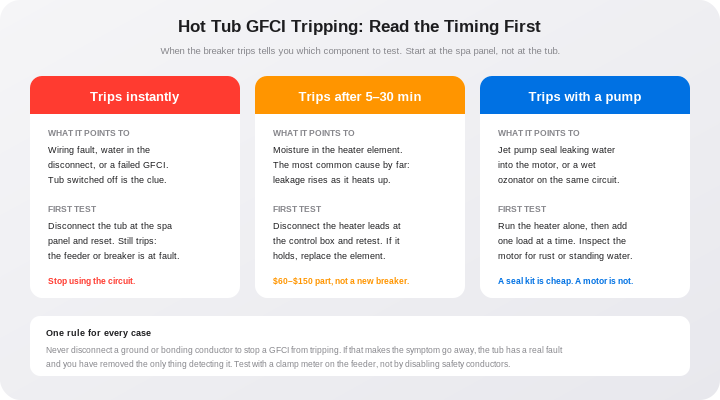
A tripping GFCI on a hot tub is a symptom with about six causes, and the timing tells you which one you have. This is the table I run through on the phone before I drive out.
| Pattern | Most likely cause | Quick test |
|---|---|---|
| Trips instantly, tub switched off | Wiring fault, water in the disconnect, failed GFCI | Disconnect the tub at the spa panel and reset; if it still trips, the problem is in the feeder or breaker |
| Trips after 5–30 minutes of heating | Moisture in the heater element | Disconnect the heater leads at the control box; if the tub runs without tripping, replace the element |
| Trips when a jet pump starts | Pump motor seal leaking, wet windings | Disconnect the pump and run only the heater; inspect the motor for water |
| Trips after rain or snow | Water intrusion in the disconnect, cord cap, or control box | Open the enclosure and look for standing water or corrosion |
| Trips only when the ozonator runs | Ozonator or UV lamp water intrusion | Unplug the ozonator and retest |
| Trips at random, no pattern | Loose neutral, damaged conductor, failing breaker | Clamp the circuit, inspect terminations, replace the GFCI breaker last |
The heater element is the answer more often than everything else combined. A resistive element is a coil inside a metal tube packed with magnesium oxide, sealed at each end. When the seal fails, water gets into the packing and the insulation resistance drops. Cold, the tub may run fine for days. As the element heats, leakage current climbs past the GFCI’s 5-milliamp threshold and the breaker opens. Replacing a $60 to $150 element is the fix; replacing the GFCI breaker is the expensive way to learn the same lesson.
One rule for this diagnosis: never disconnect a bonding conductor or a ground to stop a GFCI from tripping. If removing a safety conductor makes the symptom go away, the tub has a real fault and you have just removed the only thing detecting it.
Five Questions Before You Buy the Tub
The cheapest time to solve hot tub electrical problems is before delivery.
- What is the nameplate amperage? Photograph the plate at the dealer. If they cannot tell you, the tub is not the one to buy.
- How many conductors does it need? Four is standard. Three-wire units exist and change the cable you buy.
- How far is the tub from the panel, and what is the route? Through a wall, across a yard, under a deck, or around a corner changes the price more than the tub model does.
- Is there space in the panel, and what is the service size? A 100-amp service with electric range, electric dryer, and central air is already close to its limit before a 50-amp tub arrives.
- Who pulls the permit? If the answer is “nobody,” find another installer. The inspection is the only independent verification that the GFCI and bonding are correct.
What a Good Install Looks Like
You do not have to do the work to check it. These are the items an inspector looks at first.
- Four conductors, correctly landed. Black and red to the breaker, white to the neutral bar, green or bare to the ground bar. Neutral and ground separated at the spa panel, bonded at the service.
- GFCI protection on the whole circuit, with the test button accessible at the tub.
- A labeled disconnect within sight and at least 5 feet from the water, mounted on a post or wall, not on the tub cabinet.
- Wet-rated conductors outdoors, in conduit with listed fittings, supported and protected.
- Bonding conductor landed on the tub’s bonding lug, continuous, not cut short or left coiled in the box.
- A torque screwdriver on the terminations. Panel labels print a range, usually 25 to 45 inch-pounds. Hand-tight is not a specification, and a loose neutral on a 40-amp heater load is how cover plates get warm.
- A permit sticker and an inspection record, plus a panel schedule that says “hot tub” instead of “spare.”
When to Stop and Call Someone Else
Some houses should not get a hot tub circuit until something else is fixed.
- A 100-amp service with electric heat, an electric range, and central air. Run the load calculation before buying the tub. The answer is often a service upgrade, which changes the budget by thousands.
- Aluminum branch-circuit wiring. A 1965–1972 house with aluminum small conductors needs evaluation before any new load. Here is how to identify aluminum wiring without opening anything.
- A Federal Pacific Stab-Lok or Zinsco panel. These have documented failure histories, and a 50-amp continuous load is a bad way to find out whether yours is one of the bad ones.
- A deck that was never designed for 6,000 pounds of water. Not an electrical problem, but the call usually comes at the same time.
- Any quote with no permit, no wire size, and no mention of bonding. That is a quote for wire, not for a safe installation.
The Bottom Line
A hot tub is a 40- to 60-amp, 240-volt, four-wire load with a GFCI, a disconnect within sight, and a bonding conductor that nobody sees and every inspector checks. Get the nameplate number before you buy, run wet-rated cable if any part of the route is outdoors, and put the GFCI where you can reach it with wet feet.
Budget $700 to $1,500 for a short 50-amp run, $1,200 to $2,600 once the route is long or exterior, and $2,500 to $5,000 more if the service itself is the bottleneck. The tub is the fun purchase; the circuit is the one that determines whether you are soaking in a week or arguing with a dealer about a return.
For the two tools that make this job checkable by an owner, a non-contact voltage tester and a clamp meter will verify dead and verify load. If you are hiring the work, the torque screwdriver is the one tool that turns a good installation into a documented one.
Frequently Asked Questions
Does a hot tub need a 50-amp or 60-amp circuit?
It depends entirely on the nameplate on the tub, not on the size of the tub or the price. Most 240-volt hot tubs are marked 40, 50, or 60 amps. A 50-amp spa typically has a 5.5 kW heater and one or two jet pumps and draws around 35 to 40 amps with everything running. A 60-amp spa has a larger heater, two pumps, or both. Match the circuit to the nameplate exactly. Putting a 60-amp breaker on a tub marked 50 amps does not give you more heat, it removes the protection the tub's internal wiring was listed for.
Can I plug a hot tub into a regular wall outlet?
Only a small inflatable or plug-and-play spa that is designed for 120 volts, and even then it should be the only thing on that circuit. Those units draw roughly 1,100 to 1,500 watts, which is 9 to 12.5 amps, and they heat slowly. Any permanent 240-volt tub must be on its own dedicated circuit, usually hardwired through a disconnect. An adapter, an extension cord, or a dryer outlet is not a shortcut, it is the failure mode I get called out to clean up.
Why does my hot tub GFCI keep tripping?
The most common cause by a wide margin is moisture inside the heater element. The element is a resistive coil inside a metal tube packed with magnesium oxide, and when the seal at the terminal end fails, water migrates into the packing. The tub runs fine for five to thirty minutes, then the GFCI trips as the element heats and leakage current rises. The second most common is a leaking jet pump seal putting water in the motor. Instant tripping with the tub switched off points at wiring, a wet disconnect, or a failed breaker rather than a component.
How far can a hot tub be from the electrical panel?
There is no code maximum distance, but voltage drop sets a practical limit. At 50 amps and 240 volts, 6 AWG copper loses about 2 percent over 100 feet and about 3.1 percent over 150 feet. Past roughly 150 feet, go up one wire size, to 4 AWG, rather than accept a bigger drop. Undersized conductors on a heater load show up as slow heating, warm cable, and a GFCI that trips on startup.
Does a hot tub install need a permit and inspection?
In almost every jurisdiction, yes. A new 240-volt branch circuit, a disconnect, and bonding are all permit-and-inspection work, and many areas also require a separate spa or pool permit. A typical electrical permit runs 75 to 300 dollars. The inspection is the cheapest part of the job and the only independent check that the bonding and GFCI actually work. Skipping it can also give an insurer a reason to argue about a water-damage or fire claim later.