Two-Prong Outlets: How to Ground Them (Three Code-Legal Fixes and What Each Costs) (2026)
A two-prong outlet is not simply an old outlet. It is a statement about the wiring behind it: there is no equipment grounding conductor at that box. Everything that follows - what you can legally install, what it protects, what it costs - comes from that one fact.
Most guides answer the question by jumping straight to a GFCI. That is one of three legal answers, and it is the right one maybe half the time. The other half, people spend money on a device that protects their body but leaves their equipment unprotected, or they install a three-prong receptacle with the ground pin connected to nothing and call the job done.
I have spent more than seven years maintaining critical-infrastructure power systems, where a ground is not a formality - it is the fault path that makes every breaker and every surge device work. Houses run the same physics with less instrumentation. This is the decision sequence I use, in the order the facts arrive, plus the costs at each branch.
What the Third Prong Actually Does
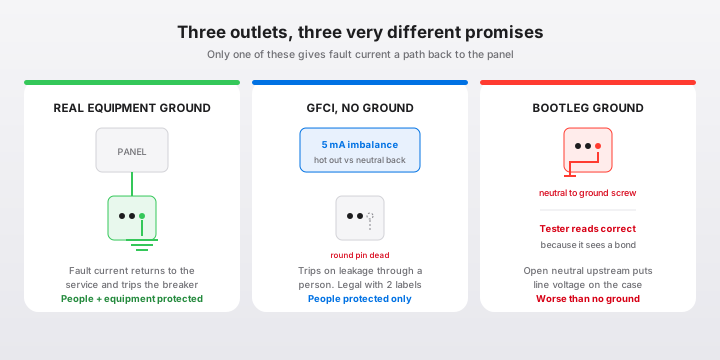
A grounding conductor has exactly one job in a branch circuit: give fault current a low-resistance path back to the source so that the overcurrent device opens fast. It is not there to absorb stray voltage, and it is not a spare neutral.
When a hot conductor inside an appliance touches the metal case, two things can happen. With a ground, the case is bonded to the panel through a low-resistance conductor, hundreds of amps flow, and the breaker trips in a fraction of a second. Without a ground, the case sits at 120 volts and waits. The appliance keeps working normally. Nothing announces the fault until a person completes the circuit to a sink, a concrete floor, or another grounded appliance.
That is why the code does not treat “no ground” as a cosmetic problem. It is a missing safety layer, and the permitted fixes are specific.
The Four Situations Behind the Same Two Holes
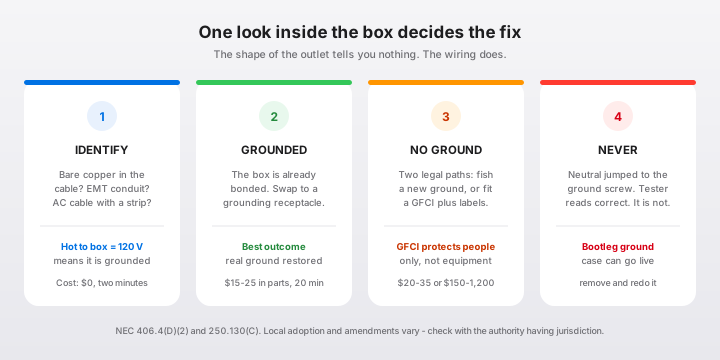
Two-prong receptacles look identical, but four different things can be behind the cover plate. Identify which one you have before buying anything.
| What you find | How you know | Correct fix | Typical parts cost |
|---|---|---|---|
| Box is grounded, receptacle is just old | Bare copper conductor folded back in the box, or continuous EMT conduit, or armored cable with a bonding strip | Swap to a grounding receptacle and bond it to the box | $15-25 |
| Box has no ground, circuit otherwise sound | Only two wires in the cable, plastic box, no ground path | GFCI protection plus the two required labels, or run a new ground | $20-35 (GFCI) |
| Someone already installed a three-prong with no ground | Three slots, tester reads open ground, ground screw empty | Remove it. Either add a ground or fit a GFCI and label it | $20-35 |
| Knob-and-tube or deteriorated cable | Separately run conductors on porcelain knobs, brittle cloth insulation, no ground anywhere | Do not extend it. Plan a circuit replacement | Electrician |
The first row is the good news, and it is more common than people expect, especially in houses wired in the 1950s and 1960s: the cable often contains a ground that was simply not connected because the receptacles of the day did not have a ground pin.
The fourth row is the one that should stop you. Knob-and-tube wiring has no ground, the conductors are often brittle, and the system depends on air gaps for cooling. Adding a modern receptacle to it is not an upgrade. If a contractor offers to “just ground the outlets” in a knob-and-tube house without discussing the wiring itself, get a second opinion.
The 60-Second Test That Decides Everything
Before you buy a receptacle, answer one question: is the box already grounded? There are two ways to find out, and the second one is the one that settles it.
Look first, with the power off. Kill the breaker, verify the circuit is dead with a non-contact tester at the receptacle slots, then remove the cover plate and pull the receptacle forward without disconnecting it. Look at the cable:
- A bare copper conductor in the cable is an equipment ground. It may be folded back and unused.
- Type AC armored cable (often called BX) has a thin aluminum bonding strip inside the armor. That strip is what makes the armor a legal ground path.
- Older BX without a bonding strip is not a reliable ground. The armor can read continuous with a meter and still fail under fault current.
- Rigid or intermediate metal conduit, and EMT with properly made fittings, is a ground path.
- Two separate conductors running through holes in the framing with porcelain insulators is knob-and-tube. There is no ground.
Then confirm electrically, with the power on - carefully. If you have a metal box, set a CAT III multimeter to AC volts and read from the short (hot) slot to the metal box or its mounting screw. A reading near 120 volts means the box is bonded to ground. Zero volts means it is not. Do this with one hand, standing on a dry floor, and stop if you are not comfortable working in a live box - this is one test where an electrician’s service call is cheap insurance.
One warning about meter continuity tests: measuring continuity between the neutral slot and the box proves very little, because the neutral is bonded to ground at the service. You will read continuity through the service bond even when the box has no local ground. Use the voltage test, or trust your eyes on the cable type.
Fix 1: Swap the Receptacle When the Box Is Already Grounded
This is a 20-minute job and the best outcome available: you get a real ground, the surge protector works, and nothing about the circuit is compromised.
- Kill the breaker and verify dead. Test at the receptacle, not at the panel label. Labels lie, including ones you wrote.
- Photograph the wiring before you touch it. One photo saves an hour of guessing which conductor went where.
- Check box fill. A GFCI is physically larger than a standard receptacle. If the box is crowded, use a box extender rather than forcing the device in and pinching insulation.
- Bond the box. If the box is metal, attach the ground conductor to the box with a listed ground screw and then to the receptacle’s green terminal, or rely on a self-grounding receptacle where the code and the device listing allow it. Pigtail with a short length of conductor matching the circuit size - 14 AWG on a 15-amp circuit, 12 AWG on a 20-amp.
- Land the conductors on the correct terminals. Brass for hot (black or red), silver for neutral (white), green for ground. Clocks and phone chargers do not care about polarity; the shell of every lamp socket on that circuit does.
- Torque the terminals. The code requires terminations to be tightened to the manufacturer’s specified torque, and it is printed on the device or in the instructions - typically in the 12 to 20 inch-pound range for receptacle terminals. A loose terminal is a hot spot; a stripped one is a callback.
- Use a tamper-resistant receptacle if this is a dwelling unit, as required by the code for most habitable rooms. Outdoor and damp locations need a weather-resistant device and an in-use cover.
- Test before you close up. Plug in a three-light tester and confirm the correct pattern, then load test with a heater or hair dryer and re-check voltage.
If all eight steps sound like more than you want to take on, that is a reasonable read. The parts cost of this job is under 30 dollars; the value is in knowing which box you are opening.
Fix 2: GFCI Protection With the Two Required Labels
When there is no ground and running one is impractical, the code permits a grounding-type receptacle to be installed if it is GFCI protected and marked. The marking is not optional and it is not decorative: the receptacle must be identified as GFCI Protected and No Equipment Ground, and so must every downstream receptacle on the load side. Most GFCI devices ship with a sheet of these labels in the box. Use them.
This is a legitimate repair, not a workaround. A GFCI protects people from exactly the failure that makes an ungrounded circuit dangerous: current leaking from hot to ground through a body. It does that by comparing outgoing and returning current, so it does not need a ground wire to function. A person touching a faulted appliance case will be protected in a way that a plain breaker never could.
What it does not do is give you a ground. That distinction matters more on this site than in most places, because of what people plug in:
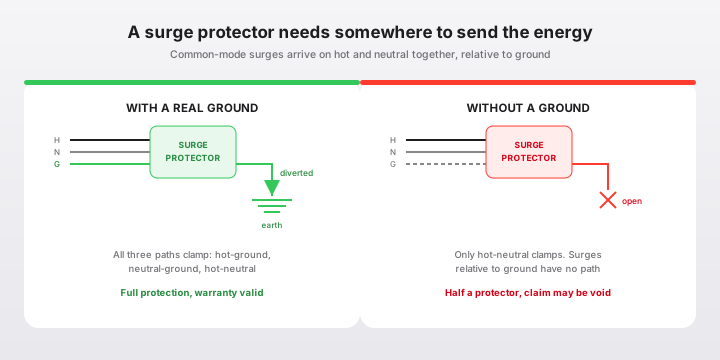
- Surge protectors. A shunt-mode protector diverts surge energy from hot to neutral and from each of those to ground. With no ground, line-to-neutral clamping still works, but common-mode surges - the ones that appear on hot and neutral together, which is how most utility-level surges arrive - have nowhere to go. The protector is not useless. It is roughly half a protector.
- UPS units. A UPS will run a load on an ungrounded circuit, and most will not complain. Its surge diversion and its chassis bonding, however, assume the ground pin is real. Some units also use the ground reference for their wiring-fault indicator, which will either stay dark or report a fault you cannot clear.
- Electronics with switching supplies. Every switched-mode supply has small filter capacitors from line to chassis. With a real ground, the tiny leakage current drains away. Without one, it sits on the chassis, which is why a laptop or a monitor on an old circuit can give a faint tingle and why audio gear hums.
The GFCI receptacle itself costs 20 to 35 dollars. Wiring it is a 30-minute job: line terminals from the panel, load terminals to the rest of the circuit, ground terminal left unconnected when there is no ground, labels applied to every protected outlet. If the GFCI is installed at the first outlet on the circuit, everything downstream is protected; if it is installed mid-circuit, only what is on its load side is. Get that order right or the labels will be lying.
One more detail that trips people up: a plug-in GFCI tester will not trip a GFCI on an ungrounded circuit, because the tester creates the imbalance by leaking current to ground - and there is no ground. The TEST button on the device is the authoritative check. I covered this failure mode in the outlet testing guide, and it is the single most common reason a perfectly good GFCI gets replaced.
Fix 3: Run a Real Equipment Ground
Running a ground is the only fix that restores the full safety layer, and the code is specific about where it may go. For an existing ungrounded circuit, an equipment bonding jumper may be connected to an accessible point on the grounding electrode system, to the grounding electrode conductor, to the equipment grounding terminal bar in the service equipment, or to the grounded conductor terminal bar within the service equipment for existing installations. In practice, an electrician is choosing between fishing a new conductor back to the panel, bonding to a nearby grounded circuit, or using an existing conduit path.
What is not allowed, and this comes up constantly:
- A jumper from the neutral terminal to the ground terminal. This is a bootleg ground. More on it below.
- A wire to the nearest water pipe. Only permitted where the pipe is part of the grounding electrode system and the connection meets the code’s bonding rules. Plastic service pipe, dielectric unions, and inaccessible connections rule it out in most houses.
- A new ground rod at the outlet. A rod that is not bonded back to the service does not provide a fault path. It may measure a few ohms to earth on a good day and still never trip a breaker, because the fault current has to return to the source, not to the dirt.
- The cover plate screw on a plastic box. It connects to the device yoke, not to ground.
Cost depends almost entirely on access. An open basement or attic with the joists exposed can be 150 to 350 dollars per circuit. Finished walls, plaster, and no attic access push it to 400 to 1,200 dollars per circuit. If the house still has two-wire cable throughout, the honest comparison is not “ground these outlets” but “replace these circuits”, and that is a 4,000 to 15,000 dollar project. The panel upgrade cost guide covers what else tends to surface when a panel is opened for that work.
The Bootleg Ground: Why It Passes the Tester and Fails the House
A bootleg ground is a short jumper between the neutral terminal and the ground terminal at the receptacle. It takes two minutes, it makes every three-light tester read correct, and it is dangerous in a way that is easy to explain and hard to forget.
The neutral conductor carries current. By bonding the ground terminal to it, you have made the grounding pin of every device on that circuit part of the current-carrying path. Two failures follow:
- An open neutral upstream - a loose splice, a burned connection in a junction box - leaves the receptacle’s ground pin energized through whatever load is plugged in downstream. The metal case of a device that was supposed to be safe is now at line voltage.
- The ground path is now a live conductor. Anyone touching a grounded surface and a real ground at the same time becomes part of the circuit. GFCIs downstream may trip randomly as neutral current finds alternate paths.
It is also a code violation: using the grounded circuit conductor for equipment grounding on the load side of the service disconnect is prohibited. Inspectors know the trick, and a home inspector with a tester that includes a ground-impedance check will find it in seconds.
The same logic applies to the three-prong adapter with the little tab. It is legal only when the tab is attached to a screw on a box that is genuinely grounded. On a plastic box, the adapter is a physical adapter and nothing more - a way to plug in a three-prong cord, not a way to ground it.
What an Ungrounded Outlet Costs You in Equipment
This is the part that rarely makes it into grounding articles, and it is the reason the topic belongs on a site about backup power.
A surge protector’s job is to clamp voltage between conductors and divert the energy. The ground conductor is the drain. In a house with an ungrounded receptacle, a protector will still clamp hot-to-neutral, which handles a portion of the surge. It cannot clamp hot-to-ground or neutral-to-ground, because those paths are open. Since a large share of surge energy arrives common-mode - hot and neutral rising together relative to ground - the protector is working with one hand behind its back. Manufacturer warranties on surge protectors typically require a properly grounded receptacle, which is worth knowing before a claim.
A UPS is in a similar position. It will carry the load and it will switch to battery. Its input surge stage and its chassis bonding assume a ground. And if the UPS has a wiring fault indicator, an ungrounded circuit may keep that light on permanently, which trains people to ignore the one diagnostic the device offers.
The practical ranking for a homeowner with limited money: fix the outlets that power the expensive and the grounded. The desktop, the network closet, the home theater, the refrigerator, the sump pump. Lamp circuits in a bedroom can wait. The whole-house surge protection guide explains why a panel-level device plus a real ground does more than any number of power strips.
What Each Path Costs in 2026
| Path | What you get | Typical U.S. cost (2026) | Code basis | Reasonable DIY? |
|---|---|---|---|---|
| Receptacle swap, box already grounded | Full equipment ground at that outlet | $15-25 parts; $75-150 installed | Receptacle grounding per installation rules | Yes, with care |
| GFCI plus labels, no ground | People protection, no equipment ground | $20-35 parts; $125-250 installed | Replacement of non-grounding receptacles with GFCI protection and marking | Yes |
| New ground conductor, open basement | Full ground | $150-350 per circuit | Equipment bonding jumper to a permitted grounding point | Sometimes |
| New ground conductor, finished walls | Full ground | $400-1,200 per circuit | Same, with fishing and patching | No |
| Whole-house rewire | Modern grounded circuits throughout | $4,000-15,000 | Current code for new work | No |
These are typical ranges, not quotes. Markets with older housing stock and union labor run higher; rural areas run lower. Any estimate should identify which row it is in, because a quote for a GFCI and a quote for a new ground are not the same job at different prices - they deliver different things.
When to Put the Screwdriver Down
Stop and call a licensed electrician if any of the following is true:
- The branch wiring is aluminum. Aluminum conductors need a specific connector or a listed pigtail; twisting them under a wire nut with copper is how fires start. The aluminum wiring guide covers identification.
- The insulation is cloth, brittle, or crumbling, or the conductors run on porcelain knobs.
- The box is too shallow for the new device, or the cable enters without a connector or clamp.
- You find scorched insulation, a melted wire nut, or a backstabbed daisy chain where the receptacle is being used as a splice.
- The circuit has a shared neutral, or more than one circuit enters the box.
- You cannot identify which breaker controls the circuit - or the panel is a type known for failing to trip.
- You rent. This is the landlord’s repair, and doing it yourself can void insurance and violate a lease.
Grounding is one of the few electrical topics where the correct answer is genuinely branch-dependent: look at the box, then decide. The mistake is not choosing the wrong fix. It is installing a three-prong receptacle and letting the shape of the outlet imply a safety layer that is not there.
If you are working through an old house room by room, the GFCI vs AFCI comparison explains which protection goes where, and the circuit breaker tripping guide covers what to do when the new device starts opening the breaker - which usually means the circuit was already overloaded before you touched it.
Frequently Asked Questions
Can I just replace a two-prong outlet with a three-prong outlet?
Only if one of two conditions is met. Either the box already has a real equipment ground - a bare copper conductor in the cable, continuous metal conduit, or listed armored cable with a bonding strip - or the new receptacle is protected by a GFCI and marked GFCI Protected and No Equipment Ground. Putting a three-prong receptacle on a two-wire circuit with the ground pin connected to nothing is the most common illegal shortcut in old houses. It does not create a ground. It only removes the visual warning that there is not one. The replacement itself is a 20-minute job; deciding which of the two legal paths you are on is the part that matters.
Does a GFCI outlet create a ground?
No. A GFCI compares current going out on the hot conductor with current coming back on the neutral. If the difference exceeds roughly 5 milliamps, it opens the circuit, on the assumption that the missing current is going through a person. That protection works perfectly well with no ground wire at all, which is exactly why the code allows it on ungrounded circuits. What a GFCI does not do is give current a low-resistance path back to the panel. The round pin on a three-prong plug stays electrically dead. Surge protectors, UPS units and anything that expects a chassis ground are still working without one.
Is a two-prong outlet actually dangerous?
The receptacle itself is not the hazard - millions of them have run lamps and radios for sixty years. The hazard is what happens when a fault develops in an appliance that has a metal case and only two wires: there is no path for fault current except through the person touching it. Double-insulated tools and modern two-prong appliances are designed around that and are fine. The second issue is protection: a surge protector plugged into an ungrounded receptacle cannot divert common-mode surges, the ones that arrive on both hot and neutral together. If your concern is a specific outlet powering a refrigerator, computer or window air conditioner, that outlet is worth fixing.
Can I ground an outlet to the water pipe?
Not as a do-it-yourself fix, and usually not at all. The code does allow a replacement receptacle to be bonded to an accessible point on the grounding electrode system, and a metal water pipe can be part of that system - but only under specific conditions, including that the pipe is electrically continuous and that the connection is made in an accessible location with an approved clamp. Plastic service pipe, dielectric unions, and the fact that many water systems are no longer a reliable electrode make this a bad bet. A jumper from the receptacle ground screw to the nearest copper pipe is not a legal or safe substitute, and a separate ground rod driven outside the window is not either: a lone rod does not clear faults because it is not bonded back to the service.
How much does it cost to ground the outlets in an old house?
Three tiers, 2026 U.S. typical ranges. Replacing receptacles where the box is already grounded: 15 to 25 dollars per outlet in parts, or about 75 to 150 dollars per outlet if an electrician does it. GFCI protection with the required labels: 20 to 35 dollars per location in parts, 125 to 250 dollars installed. Running a new equipment ground: roughly 150 to 350 dollars per circuit where the basement or attic is open, 400 to 1,200 dollars per circuit through finished walls, and 4,000 to 15,000 dollars for a whole-house rewire. Any quote should state which of the three paths it is, because they are not interchangeable.