Iberian Blackout 2025: What the Spain-Portugal Power Crisis Means for Every Homeowner
On April 28, 2025, at 12:33 PM local time, the lights went out across Spain. Not a neighborhood. Not a city. An entire country — and then some.
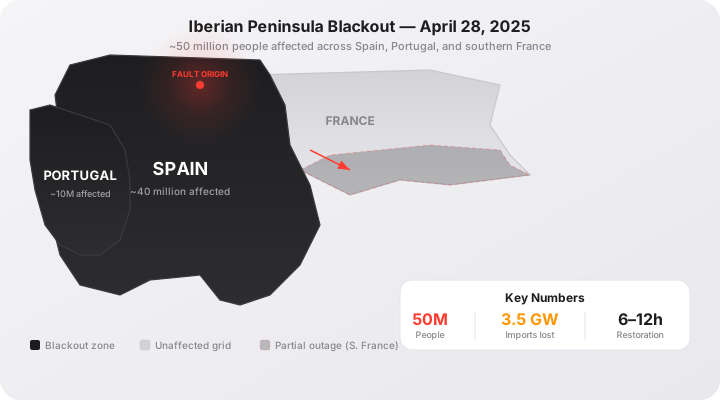
Within seconds, 50 million people across Spain, Portugal, southern France, and Andorra lost power. Trains stopped mid-journey. Madrid-Barajas and Lisbon airports switched to emergency lighting. Hospital generators coughed to life. Elevators trapped occupants between floors. Mobile networks degraded as backup batteries drained.
It was the largest blackout in European history since 2003 — and it was not caused by a storm, an attack, or a generation shortage. It was caused by the grid’s own protective systems doing exactly what they were designed to do: tripping offline to prevent equipment damage. The problem was that nobody predicted they would all trip at once.
What Actually Happened: Anatomy of a Cascading Failure
The trigger was deceptively simple. A substation in southern France — one node in the vast European interconnected grid — experienced a busbar fault at 12:33 PM. This is a routine event; substation faults happen thousands of times a year across any large grid. Normally, protective relays isolate the fault within milliseconds, the surrounding grid absorbs the transient, and nobody notices.
This time, the surrounding grid did not absorb it.
The initial voltage dip from the French substation fault caused the cross-border high-voltage DC interconnectors between France and Spain to trip offline. These interconnectors — massive undersea and overland power cables — are what allow Spain and Portugal to import electricity from the rest of Europe. Spain runs a structural power deficit during daytime hours; on April 28, it was importing roughly 3.5 GW from France when the interconnectors failed.
With the interconnectors gone, the Iberian Peninsula was electrically isolated in under two seconds. The sudden loss of imports created an immediate generation-demand imbalance: Spain and Portugal’s domestic generation could not instantly replace 3.5 GW of missing imports. System frequency — the heartbeat of any AC grid, tightly controlled at 50 Hz — began to fall.
Cascading Failure Timeline — April 28, 2025
<!-- Interconnectors - broken -->
<line x1="160" y1="30" x2="220" y2="30" stroke="#ff3b30" stroke-width="3" stroke-dasharray="8,4"/>
<text x="190" y="22" text-anchor="middle" font-family="system-ui" font-weight="600" font-size="10" fill="#ff3b30">✕ 3.5 GW</text>

<!-- Spain block -->
<rect x="220" y="0" width="240" height="60" rx="10" fill="url(#spain)" opacity=".12" stroke="#ff3b30" stroke-width="1.5"/>
<text x="340" y="36" text-anchor="middle" font-family="system-ui" font-weight="700" font-size="16" fill="#ff3b30">SPAIN</text>
<text x="340" y="52" text-anchor="middle" font-family="system-ui" font-weight="500" font-size="10" fill="#ff3b30">Domestic generation: insufficient</text>

<!-- Connection to Portugal -->
<line x1="460" y1="30" x2="500" y2="30" stroke="#d2d2d7" stroke-width="1.5" stroke-dasharray="4,3"/>

<!-- Portugal block -->
<rect x="500" y="0" width="160" height="60" rx="10" fill="url(#portugal)" opacity=".12" stroke="#ff9500" stroke-width="1.5"/>
<text x="580" y="36" text-anchor="middle" font-family="system-ui" font-weight="700" font-size="16" fill="#ff9500">PORTUGAL</text>
<text x="580" y="52" text-anchor="middle" font-family="system-ui" font-weight="500" font-size="10" fill="#ff9500">Also isolated — same fate</text>
When frequency falls below 49.8 Hz, the grid is in emergency territory. Below 49 Hz, power plants begin to trip offline to protect their turbines from mechanical damage. At 12:33:05 — roughly 5 seconds after the initial fault — Iberian system frequency hit 49 Hz. The grid’s automatic defense system, designed to prevent a total collapse, began shedding load in pre-programmed blocks.
By 12:33:10, the Iberian Peninsula was dark.
Why This Was Different From a Normal Blackout
I live and work in critical infrastructure power maintenance. I have seen substation faults. I have seen feeder trips. I have seen transformers fail. None of those events surprised me.
What happened on April 28 surprised every grid engineer I have spoken to because of the speed. Three seconds from the initial fault to interconnector trip. Five seconds to frequency collapse. Ten seconds to continental-scale blackout. The grid’s own protection schemes — each one behaving correctly in isolation — created a chain reaction that no human operator could have stopped, even if they had been watching the right screen at the right moment.
This is the uncomfortable truth about modern power grids: they are incredibly reliable 99.99% of the time, and terrifyingly fragile the remaining 0.01%. The same interconnections that make electricity cheaper and greener also create pathways for failure propagation. It is the grid equivalent of a too-big-to-fail bank — diversified enough to absorb small shocks, interconnected enough to transmit big ones.
What Happened on the Ground
The human experience of the Iberian blackout is worth understanding because it reveals what does and does not work during a real crisis.
Transportation ground to a halt. Madrid Metro evacuated passengers from tunnels. High-speed AVE trains stopped on the tracks; some passengers were stuck for over three hours. Both Madrid and Lisbon airports canceled all departing flights. Traffic lights went dark across every major city, creating gridlock that took hours to untangle even after power was restored.
Communications degraded, but did not fail entirely. Mobile towers have backup batteries, but most are sized for 2-4 hours. After four hours, coverage began to shrink noticeably. Fiber-to-the-home services went dark because ONTs (optical network terminals) in homes require local power. People with UPS units powering their routers and modems maintained internet access long after their neighbors lost it.
Hospitals ran on generators — but not without incident. Every hospital in Spain and Portugal has backup generation by law. What is less discussed is that several facilities reported fuel logistics problems. A hospital in Badajoz came within 45 minutes of exhausting its diesel supply before an emergency fuel delivery arrived. Generator maintenance — the unglamorous work of checking fuel levels, testing transfer switches monthly, and replacing aging batteries — turned out to be the difference between seamless backup and near-miss.
Homeowners with backup power became neighborhood hubs. This is a pattern I have seen in every large outage: the one house with a generator becomes the charging station, the refrigerator, and the information center for an entire street. In Lisbon and Madrid suburbs, families with portable generators or home battery systems powered neighbors’ medical devices, kept food from spoiling, and maintained communication with the outside world.
Five Lessons for Homeowners
The Iberian blackout was not an act of God. It was a failure of complex systems — and complex systems fail in predictable ways. Here is what every homeowner should take away.
1. Grid Reliability Is Not Binary — It Is Statistical
People think about the grid as either working or not working. Grid engineers think in terms of probability: the N-1 criterion says the system must survive any single failure. The Iberian blackout was an N-4 or N-5 event — multiple simultaneous failures that the system was simply not designed to withstand.
For homeowners, the practical implication is simple: the grid is reliable, but large-scale blackouts are not “if” events. They are “when” events with a probability distribution. Your preparation should match that reality.
2. Backup Power Is Not One Product — It Is a Layered Strategy
The Three-Layer Backup Power Strategy
→
→
<!-- Row 1 -->
<rect x="0" y="12" width="12" height="12" rx="3" fill="#0071e3"/>
<text x="18" y="22" font-family="system-ui" font-size="11" fill="#1d1d1f">0–2 hours: UPS keeps your router and critical electronics running through the initial chaos. You have internet while the grid is down.</text>

<rect x="0" y="36" width="12" height="12" rx="3" fill="#ff9500"/>
<text x="18" y="46" font-family="system-ui" font-size="11" fill="#1d1d1f">2–12 hours: Generator takes over via transfer switch. Refrigerator, lights, furnace, and sump pump stay on. You are not scrambling.</text>

<rect x="0" y="60" width="12" height="12" rx="3" fill="#34c759"/>
<text x="18" y="70" font-family="system-ui" font-size="11" fill="#1d1d1f">12+ hours: Home battery paired with solar runs indefinitely during daylight. No fuel runs, no noise, no refueling anxiety.</text>

<text x="0" y="95" font-family="system-ui" font-size="10" fill="#86868b" font-style="italic">Most Iberian blackout victims had Layer 0 — nothing. The ones with even Layer 1 had a meaningfully different experience.</text>
No single device solves all outage scenarios. A UPS handles the first 30-90 minutes (enough for most utility outages). A portable generator with a transfer switch handles the next 12-24 hours. A home battery with solar handles multi-day events.
The Iberian blackout, at 6-12 hours for most people, fell squarely in the generator territory. But the lesson is the layering: during the first two hours when the outage was chaotic and information was scarce, a UPS keeping your internet and phone running is more valuable than a generator still in the garage.
3. Fuel Logistics Will Fail in Extended Outages
Gas stations cannot pump without electricity. Even stations with backup generators often run out of fuel because they are not sized for a sudden surge of panicked customers. In Spain and Portugal, gas stations that did have power saw lines that stretched for blocks within the first two hours.
If you own a portable generator, store enough fuel for at least 24 hours of runtime. For a typical 5,000W generator, that is roughly 18-20 gallons of gasoline stabilized with fuel treatment. Rotate it every six months. Most people store zero gallons and plan to buy fuel during the outage. That plan fails every time.
4. Your Refrigerator Is a Clock
A full refrigerator keeps food safe for about 4 hours without power. A full freezer: 24-48 hours. In the Iberian blackout, families who opened their refrigerators “just to check” cut that window in half. Write down what is in your fridge. Do not open the door unless you have a plan.
For anyone with a whole-house surge protector and a generator setup, this is a non-issue. For everyone else, food loss is one of the most expensive consequences of a 12-hour outage — easily $300-500 for a full refrigerator.
5. The First Hour of Information Is Gold
During the Iberian blackout, official communication was fragmented. Utility companies’ websites went down. Government social media accounts were slow to update. People with battery-powered radios got real-time information hours before those relying on mobile phones (whose towers were running out of backup battery).
A $30 battery-powered AM/FM radio and a UPS for your networking equipment are the two cheapest, highest-return preparedness purchases you can make. Combined cost: under $200. Combined value during a multi-hour blackout: immeasurable.
What Grid Operators Are Changing
In the aftermath, the European Network of Transmission System Operators (ENTSO-E) launched a comprehensive investigation. The preliminary findings, released in July 2025, identified three systemic vulnerabilities:
Interconnector protection settings were too sensitive. The France-Spain HVDC links tripped on voltage dips that should have been survivable. Protection coordination across national boundaries was inadequate.
Frequency response was too slow. Spain’s domestic generation did not ramp fast enough to replace 3.5 GW of lost imports. Grid-forming inverter technology — which can respond in milliseconds rather than seconds — was not yet deployed at scale.
Restoration procedures assumed a partial blackout. Grid operators had never drilled a total Iberian blackout scenario. Restoration took longer than it should have because procedures written for regional outages did not scale.
These are not fundamentally hard problems. They are coordination and investment problems. The fixes are being implemented now: revised protection settings, faster frequency response requirements, mandatory black-start capability at more substations, and cross-border restoration drills.
But the fixes will take years. And even after they are done, the grid will still not be invincible — it will just be protected against this specific failure mode. The next one will be different.
The Bottom Line
The Iberian blackout of April 28, 2025 was a wake-up call — not because it was unprecedented, but because it was entirely predictable. Grid engineers have been warning about cascading failure risk in highly interconnected systems for decades. The 2003 Northeast blackout, the 2012 India blackout (670 million people), the 2021 Texas freeze — different triggers, same fundamental lesson.
Modern life runs on electricity. When it stops, everything stops. The question is not whether your grid will experience a major failure in your lifetime. The question is whether you will be ready when it does.
Start with a UPS for your critical devices. Add a generator and transfer switch for longer outages. Consider a home battery system for seamless whole-home backup. At every layer, you are buying not just electricity, but the ability to continue living normally while the world around you figures out what went wrong.
In the Iberian blackout, the people who had prepared were not panicking. They were charging their neighbors’ phones.
What to read next:
- Generator Transfer Switch: Types, Costs, and Installation Guide — If you are buying a generator, you need this first
- Best UPS for Router and Modem in 2026 — Keep your internet running during any outage
- Portable Power Station vs Generator: Which Backup Power Is Right for You? — Side-by-side comparison
- Whole House Surge Protector Cost: Complete Pricing Guide — Protect your electronics when the grid comes back
Frequently Asked Questions
What caused the 2025 Spain-Portugal blackout?
The April 28, 2025 Iberian blackout was triggered by a technical failure at a substation in southern France that cascaded through the interconnected European grid. A voltage dip from the initial fault caused multiple cross-border interconnectors between France and Spain to trip offline in rapid succession. With Spain's grid suddenly isolated from the rest of Europe, frequency collapsed below 49 Hz within seconds, triggering automatic load shedding that disconnected millions of customers. It was a textbook cascading failure — not a single point of failure, but a chain reaction where each protective relay tripping made the next one more likely.
How long did the 2025 Iberian blackout last?
Power restoration took between 6 and 12 hours for most urban areas, with some rural regions in Portugal and western Spain waiting up to 24 hours. The blackout began around 12:30 PM local time on April 28, 2025. Madrid and Barcelona saw power return by early evening (6-8 hours), while parts of central Portugal and Extremadura did not have full restoration until the following morning. Hospitals and critical infrastructure operated on backup generators throughout, though several reported fuel logistics challenges during the extended outage.
How many people were affected by the 2025 Iberian blackout?
Approximately 50 million people across Spain, Portugal, southern France, and Andorra were affected. Spain bore the brunt with an estimated 40 million people losing power, Portugal close to its entire population of 10 million, and several hundred thousand in the Occitanie region of southern France. It was the single largest power outage in Europe since the 2003 Italian blackout and the most severe in Iberian history.
Could a similar grid failure happen in the United States?
Yes — and it already has. The 2003 Northeast blackout affected 55 million people across the US and Canada through a nearly identical cascading failure mechanism. The US grid faces the same vulnerability: highly interconnected regional grids where a single uncontained fault can propagate. The difference is that the US has more interconnections and more generation diversity, which helps — but also means more complexity. The 2021 Texas winter blackout, while not a cascading interconnect failure, showed how a different failure mode (generation shortfall during extreme weather) can produce the same result: millions without power for days.
What backup power system should I have for a multi-day blackout?
For outages lasting 12-48 hours, a portable generator with a [transfer switch](/posts/generator-transfer-switch/) is the most cost-effective option ($1,000-2,500 total). For shorter outages under 8 hours, a [UPS for critical devices](/posts/best-ups-for-router-and-modem/) keeps internet and essential electronics running. For whole-home seamless backup with zero interruption, a home battery system like Tesla Powerwall or a LiFePO4 battery bank paired with solar ($8,000-20,000 installed) provides the most complete protection. The Iberian blackout underscores an uncomfortable truth: modern grids are reliable until they aren't — and when they fail, they fail big.