Induction Range Electrical Requirements: Breaker Size, Wire, and What the Circuit Really Costs in 2026
The call usually starts the same way. A new induction range is sitting in the box in the garage, the old gas range is still connected, and the homeowner has just read the installation sheet and discovered the words “240V, 40A dedicated circuit.”
Then comes the question I have heard a hundred times: “The stove is only 11 kilowatts. That’s like 46 amps, right? So can I just use the dryer outlet?”
No. But the reason is more interesting than the answer, and it is the reason so many of these installations go wrong before an electrician is ever called.
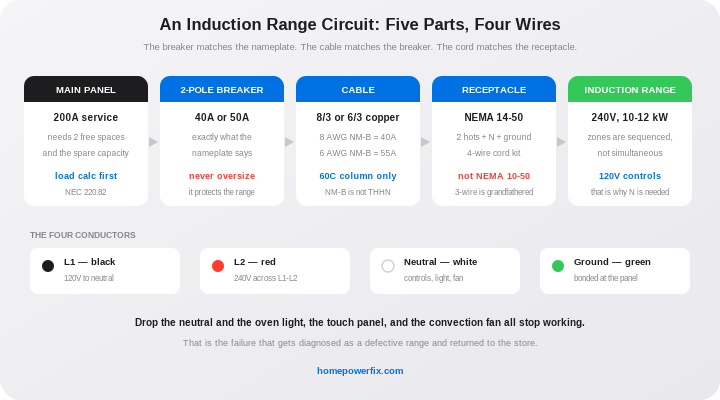
An induction range is not a complicated electrical load. It is a two-pole 240-volt circuit with four wires. The difficulty is entirely in the details: which nameplate number governs, whether the existing range circuit can be reused, why the neutral is there at all on a heating appliance, and what happens when the building supplies 208 volts instead of 240.
What an Induction Appliance Actually Draws
There are four products people lump together as “induction,” and they have almost nothing in common electrically.
A portable countertop induction unit is a 120-volt appliance, 1,800 watts, and it plugs into a normal 20-amp kitchen circuit. It is not part of this conversation beyond one warning: it will nuisance-trip a shared circuit constantly, and it does not belong on the same circuit as a microwave.
A small two-burner built-in cooktop is usually 240 volts at 20 to 30 amps, around 3.5 to 7 kW.
A full-size induction cooktop, 30 or 36 inches with four or five zones, is 240 volts at 40 to 50 amps, typically 7 to 11 kW.
An induction range, which is a cooktop plus an oven in one cabinet, is 240 volts at 40 to 50 amps and commonly 10 to 13 kW when the oven’s bake and broil elements are counted alongside the cooktop zones.
| Appliance | Voltage | Typical nameplate | Circuit | Connection |
|---|---|---|---|---|
| Portable countertop unit | 120V | 1,800W, 15A | 20A dedicated | Cord and plug |
| Two-burner built-in cooktop | 240V | 3.5–7 kW, 20–30A | 30A | Hardwired or cord |
| 30-inch induction cooktop | 240V | 7–9.5 kW, 40A | 40A | Hardwired or 14-50 |
| 30-inch induction range | 240V | 10–12 kW, 40A | 40A | 14-50 cord |
| 36-inch cooktop, five zones | 240V | 9–11 kW, 50A | 50A | Hardwired or 14-50 |
| Double-oven induction range | 240V | 12–15 kW, 50A | 50A | 14-50 cord |
Two things about that table matter more than the numbers.
First, the kW rating is not a simultaneous load in the way it looks. An induction range cannot run every zone at boost and both oven elements at once; the electronics sequence them. What the manufacturer publishes as connected load is the worst-case figure the circuit must be able to feed, which is why the circuit is sized from the nameplate and not from adding up burner labels.
Second, induction is more efficient than a coil element, but that does not lower the circuit size. An induction zone couples roughly 85 percent of its energy into the pan; a traditional coil is closer to 70 to 75 percent, with the rest heating the kitchen. That is why a 3.7 kW induction zone boils water faster than a 3 kW coil. Efficiency changes the cooking, not the breaker.
The Nameplate Decides, and kW Does Not Add Up the Way You Think
The rating plate — a metal tag or sticker on the back of the unit, or inside the oven door frame — carries three numbers that matter: voltage, total connected load in kW, and either a minimum circuit ampacity or a maximum overcurrent protection value.
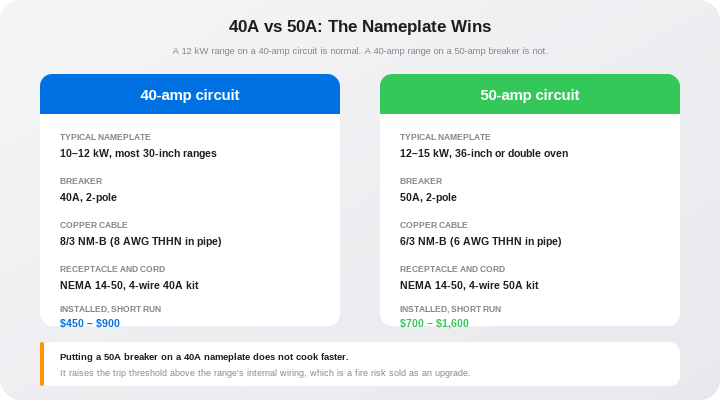
That last one is the instruction, and under NEC 110.3(b) the manufacturer’s installation instructions are part of the listing. If the sheet says 40-amp circuit, the circuit is 40 amps. If it says maximum 50-amp overcurrent protection, you may use a 50-amp breaker and not a 60.
Here is the part that surprises people. A 12 kW range does not require a 50-amp circuit, and often does not even require a 40-amp one by arithmetic. Twelve kilowatts at 240 volts is 50 amps, which would suggest a 50-amp circuit plus continuous-load headroom. The code does not work that way for household cooking appliances. NEC Table 220.55 provides demand factors for ranges, and for a single range rated 12 kW or less the demand is 8 kW. Eight kilowatts at 240 volts is 33.3 amps, comfortably inside a 40-amp circuit.
That is why 8/3 copper and a 40-amp two-pole breaker is the most common combination in American kitchens even for ranges whose element labels add up to more than 40 amps. The code assumes — correctly — that an oven element and four cooktop zones do not all sit at full draw for three hours straight.
The practical rule that comes out of this:
- Read the plate. If it says 40A, install 40A. If it says 50A, install 50A.
- Never size up the breaker to “be safe.” A larger breaker does not add heat, it removes protection. The smallest conductor in the chain is inside the appliance.
- Never size down the wire and keep the breaker. A 50-amp breaker on 8 AWG NM-B is a 40-amp conductor protected at 50 amps. It works until the terminals at the receptacle darken.
- A range with a 50-amp nameplate on a 40-amp circuit is not a judgment call. It is a fire risk and an inspection failure.
40A vs 50A: Breaker, Wire, Receptacle
The conductor sizing trips up more do-it-yourselfers than anything else in this job, because NM-B cable and THHN wire in conduit use different temperature columns.
| Circuit | Copper NM-B (60°C) | Copper THHN in conduit (75°C) | Receptacle | Cord |
|---|---|---|---|---|
| 30A | 10/3 | 10 AWG | NEMA 14-30 | 4-wire, 30A |
| 40A | 8/3 | 8 AWG | NEMA 14-50 | 4-wire, 40A |
| 50A | 6/3 | 6 AWG | NEMA 14-50 | 4-wire, 50A |
| 60A (large double oven) | 4/3 | 6 AWG | Hardwired | None |
The important asymmetry: 8 AWG copper is 40 amps in NM-B but 50 amps in THHN inside conduit. That means a 50-amp circuit in a finished wall with Romex needs 6/3, while the same circuit fished through conduit can legally be 8 AWG THHN. Contractors quote these differently and homeowners compare the numbers without knowing why. Now you know why.
Cord kits are sold separately and are not interchangeable. A 40-amp range needs a 40-amp cord kit; a 50-amp range needs a 50-amp kit. The cord must match the receptacle, and the strain relief must be tightened at the chassis, not left loose so the cord hangs on the terminals.
⚠️ The range cord is where the neutral question lives. More on that next, because it is the failure mode that produces the strangest symptoms.
The Four-Wire Rule and the 3-Wire Trap
A 240-volt heating appliance does not obviously need a neutral. Two hots and a ground would heat the elements fine. But an induction range is not a dumb resistance load. It has a control board, a touch panel, an oven light, a convection fan, and often a 120-volt convenience outlet on the back panel. Those parts need 120 volts, which means they need a neutral.
So the modern standard is four conductors: two hots, one neutral, one equipment ground. The receptacle is NEMA 14-50 for 40- and 50-amp range circuits, and the cord is a four-wire range cord with a strain-relief clamp.
The trap is the older installation. Before the 1996 NEC, electric ranges and dryers were commonly wired with three conductors — two hots and a neutral, with the appliance frame grounded through that neutral. Those circuits are grandfathered under NEC 250.140 for the existing appliance. They are not a template for new work, and a NEMA 10-50 receptacle is not an acceptable target for a new induction range.
What goes wrong when someone connects a four-wire range to an old three-wire circuit without reading the instructions:
- The oven light and control board get no return path and behave erratically, or the range throws an error code.
- Someone bonds neutral to ground at the appliance to make it work, which puts neutral current on the frame. That is exactly the condition the four-wire rule exists to prevent.
- The range works for months and then the electronics fail, and nobody connects the failure to the missing neutral.
If you are looking at a three-wire range outlet and a new induction range, the correct move is to evaluate the circuit — wire gauge, insulation condition, whether a ground path can be established — and either bring it to four-wire or leave the appliance on a circuit that matches its instructions. It is a 200 to 600 dollar conversation, not a 30 dollar cord kit.
Can You Reuse the Existing Range Circuit?
This is the most common real-world scenario: an electric coil range from the 1990s comes out, an induction range goes in, and the question is whether the existing circuit is usable. Sometimes it is a five-minute answer and sometimes it is a panel upgrade.
Run this check in order.
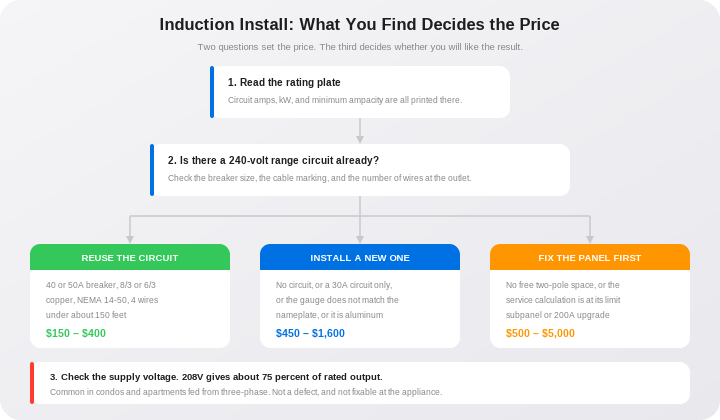
1. Find the breaker and read its size. A two-pole 40 or 50 is the normal answer. A 30-amp two-pole means the old appliance was smaller than the new one, and you are installing a new circuit. A 60-amp two-pole on 6 AWG is a warning sign that someone oversized it in the past.
2. Look at the cable. At the panel and at the receptacle, read the printed sheath marking: 8/3, 6/3, 8/2, 6/2. The “/3” means three insulated conductors plus a bare ground. A “/2” cable is two insulated conductors plus ground — no neutral — and cannot serve a range that needs 120 volts for controls, regardless of gauge.
3. Count the wires at the receptacle. Four wires at a NEMA 14-50 is the good case. Three wires at a NEMA 10-50 is the grandfathered case described above.
4. Check the run length. A 50-amp circuit on 6 AWG copper is fine at 100 feet and marginal past about 150. Voltage drop on a heating load shows up as slow heat and warm cable, and an induction unit with a control board is less tolerant of low voltage than a coil element was.
5. Look at the terminations. Pull the receptacle out and look for discolored insulation, brown spots on the device, or aluminum conductors. A 30-year-old range circuit that has been carrying 30 amps twice a day is a wear item. Receptacles are 15 to 40 dollars; the fire is not.
| What you find | Verdict | Typical cost |
|---|---|---|
| 40A breaker, 8/3 copper, 14-50 outlet, under 100 ft | Reuse | $150–$400 (cord + device) |
| 50A breaker, 6/3 copper, 14-50 outlet | Reuse | $150–$400 |
| 40A breaker, 8/3, but the new range is 50A nameplate | New circuit or verified upgrade | $450–$1,600 |
| 3-wire 10-50, no ground | Evaluate and upgrade to 4-wire | $200–$900 |
| 30A circuit, old small range | New circuit | $450–$1,600 |
| Aluminum branch conductors | Stop and evaluate first | Variable |
| No space in panel, or service at capacity | Add subpanel or upgrade service | $500–$5,000 |
If there is no free two-pole space in the panel, the options are a subpanel or, when the service calculation is already at its limit, a service upgrade. A subpanel adds spaces but not capacity — the feeder breaker is deducted from what the main panel has left. That distinction catches people who assume a subpanel solves a maxed-out 100-amp service.
Gas to Induction: Three Things Nobody Quotes
Converting from gas is the case where the electrical work is the easy part.
The circuit. A gas range uses a 120-volt circuit, often a shared 20-amp kitchen circuit. Induction needs a new 240-volt two-pole circuit of the correct size. There is no adapter, no converter, and no version of this that uses the existing gas range circuit. This is a new dedicated circuit, and the cost depends almost entirely on how far the panel is and whether the wall is open.
The gas line. The old line must be capped and leak-tested by a licensed plumber or gas fitter. In many jurisdictions that is a separate permit. Leaving a capped stub behind the new range is normal; leaving a live valve is not, and a range that gets pushed back against a live gas fitting is a real failure mode.
The vent hood. This is the line item homeowners forget. Gas ranges produce combustion byproducts and a lot of moisture; electric and induction ranges produce moisture, grease, and odors but no combustion gases. Many older hoods over gas ranges are recirculating units that filter grease and dump the air back into the kitchen. Over an induction range that is a code and comfort question, not a carbon monoxide question, but the practical outcome is the same: most people upgrading to induction also want a ducted hood, and cutting a new duct through a wall or roof runs 400 to 1,200 dollars installed. The hood itself needs a 120-volt circuit, which may or may not already exist.
| Line item | Typical 2026 cost | Notes |
|---|---|---|
| New 240V, 40A circuit, short run, panel space free | $450–$900 | The base case |
| Same circuit, long run or finished walls | $700–$1,600 | Drywall repair often extra |
| Cap and test gas line | $150–$350 | Plumber, separate permit in some areas |
| Ducted range hood install | $400–$1,200 | Depends on wall vs roof penetration |
| New 120V hood circuit | $250–$600 | Only if none exists |
| Electrical permit | $75–$300 | Varies by jurisdiction |
| Reuse existing 40/50A range circuit | $150–$400 | Cord kit plus receptacle |
A realistic all-in number for gas-to-induction in a typical house with the panel close by is 1,000 to 2,200 dollars for the electrical and gas work, plus the hood. In a house with a full panel and a kitchen on the far side of the basement, it can pass 4,000 dollars before the appliance is counted.
208 Volts: The Apartment and Condo Problem
Here is the detail that manufactures more confusing service calls than any other in this article.
Most North American homes are supplied with single-phase 120/240 volts. Many apartment buildings, condos, and some townhome complexes are supplied from a three-phase system, and the units get two legs of it — which gives 120/208 volts, not 120/240.
An induction appliance rated 240 volts will run on 208. It will not run at full output. For a resistive element, power falls with the square of the voltage: 208 divided by 240 is 0.867, and 0.867 squared is 0.75. A resistive load rated 4 kW at 240 volts delivers about 3 kW at 208.
Induction is different in mechanism but similar in outcome. The electronics typically regulate to a power target until they hit a limit, then derate. What the user experiences is a cooktop that heats fine on medium, cannot sustain boost, and takes noticeably longer to boil a large pot. On some units it throws an error code at high settings.
If you live in a building with 208-volt service, check the rating plate for a dual 208/240 rating before you buy, and expect lower performance at the top end. This is not a defect and it is not a wiring problem — and no electrician can fix it short of a service change the building will not authorize.
Seven Things That Fail Inspection
These are the items an inspector actually looks at, in the order they usually get found.
- Breaker size against the nameplate. Installed larger than the maximum on the plate is an automatic fail.
- Conductor size against the breaker. 8 AWG NM-B on a 50-amp breaker is the most common mismatch in this trade.
- Four conductors at the receptacle. Missing neutral, or a neutral landed on the ground bar.
- Cord and strain relief. A cord kit rated for the wrong amperage, or a cord hanging without a clamp.
- Receptacle type. A NEMA 10-50 installed as new work.
- Panel schedule. A range circuit labeled “spare,” or a 40-amp two-pole with no label at all. Here is how to label a panel properly.
- Working clearance and the appliance itself. A range pushed against a wall with the cord pinched, or a cooktop with no clearance to the combustible cabinet above it per the installation sheet.
None of these are exotic. Every one of them is checked on the sheet that comes in the box, which is the reason to keep that sheet in the panel folder.
When to Stop and Call Someone Else
Some kitchens should not get an induction circuit until something else is resolved.
- A 100-amp service with electric heat, an electric water heater, and central air. Run the load calculation before buying anything. The honest answer is sometimes a service upgrade, and the appliance return window is shorter than the electrician’s schedule.
- Aluminum branch-circuit wiring. A 1965 to 1972 house with aluminum small conductors needs evaluation before any new 40-amp load. Here is how to identify aluminum wiring without opening a wall.
- A Federal Pacific Stab-Lok or Zinsco panel. Both have documented failure histories, and a 40-amp cooking load cycling twice a day is a bad way to test one.
- A breaker that trips repeatedly on the old range. That is a symptom, not an inconvenience. Start with why a breaker keeps tripping before adding a bigger appliance to the same circuit.
- Any quote with no wire size, no breaker size, and no permit. That is a quote for cable, not for a circuit.
The Bottom Line
An induction range is a 240-volt, two-pole, four-wire load. Read the nameplate, match the breaker to it exactly, use 8/3 copper for 40 amps and 6/3 for 50 amps in cable, and make sure the neutral actually lands on the neutral bar.
The three things that decide whether this job is a 200-dollar afternoon or a 5,000-dollar project are all visible before anyone opens a box: the nameplate rating, the existing conductor size, and whether the panel has a free two-pole space with capacity behind it.
Budget 150 to 400 dollars to reuse a correct existing circuit, 450 to 1,600 dollars for a new one, and 2,500 to 5,000 dollars if the service itself is the bottleneck. Then check the voltage — if the building supplies 208, adjust expectations rather than calling the manufacturer.
For the two tools that let an owner verify this work themselves, a non-contact voltage tester confirms the circuit is dead before you touch a terminal, and a clamp meter confirms what the range actually draws once it is running. If you are hiring the work, ask for the breaker size and the wire gauge in writing — the two numbers that decide whether the installation is safe are also the two numbers a vague quote leaves out. For tightening the terminations at the receptacle and the breaker, a torque screwdriver turns hand-tight into documented.
Frequently Asked Questions
What size breaker does an induction range need?
Most 30-inch induction ranges are nameplate-rated for a 40-amp circuit, and most larger 36-inch cooktops and double-oven ranges want 50 amps. Small two-burner cooktops can be 30 amps. The number is printed on the rating plate, usually on the back or inside the oven door frame, and it governs everything else. A 40-amp nameplate on a 50-amp breaker does not cook faster. It removes the overcurrent protection the appliance's internal wiring was listed with, and it is the single most common thing I find wrong on a home-installed range.
Can I replace a gas range with an induction range without rewiring?
No. A gas range uses a 120-volt circuit for ignition and controls, typically 15 or 20 amps. An induction range is a 240-volt, 40- to 50-amp load. That means a new two-pole circuit of the correct wire size, a matching receptacle or a hardwired connection, and usually a permit. You also have to cap the gas line, which is plumber work in most jurisdictions, and the existing vent hood is often undersized for an electric range. Budget for three trades, not one.
Can I reuse the old electric range outlet for an induction range?
Often yes, but only after checking four things: the wire gauge, the number of conductors, the breaker size, and the condition of the receptacle. An existing 40- or 50-amp circuit with 8/3 or 6/3 copper and a NEMA 14-50 outlet is usually a direct reuse. An older three-wire NEMA 10-50 outlet with no equipment ground is grandfathered for the existing appliance only, and a new induction range on it needs an evaluation, not a new cord kit and a shrug.
Why does my induction cooktop trip the breaker or only heat on low?
Three causes cover most of it. First, a 208-volt supply in an apartment or condo building: a 240-volt element on 208 volts delivers about 75 percent of its rated wattage, so everything feels weak and the boost mode cuts out. Second, an undersized circuit or a loose termination, which shows up as a breaker that trips when two zones run together. Third, normal power sharing, where two burners on the same module cannot both run at boost at the same time. That last one is a feature, not a fault.
How much does it cost to install a circuit for an induction range in 2026?
Reusing an existing 40- or 50-amp circuit with a new cord and receptacle runs about 150 to 400 dollars. A new 40-amp circuit with a short run and space in the panel runs 450 to 900 dollars, and 700 to 1,600 dollars once the run is long or the walls are finished. If the panel has no room or the service is maxed out, add 500 to 2,500 dollars for a subpanel or 2,500 to 5,000 dollars for a 200-amp service upgrade. A permit is typically 75 to 300 dollars.