LiFePO4 Cold Weather Charging: The 32°F Rule That Quietly Kills Battery Banks
Most battery advice treats cold as a capacity problem. You get less energy in the winter, everyone shrugs, and the advice ends there. That misses the expensive part.
Here is the one sentence that decides whether your battery bank survives its first winter — and it is not the sentence most owners expect:
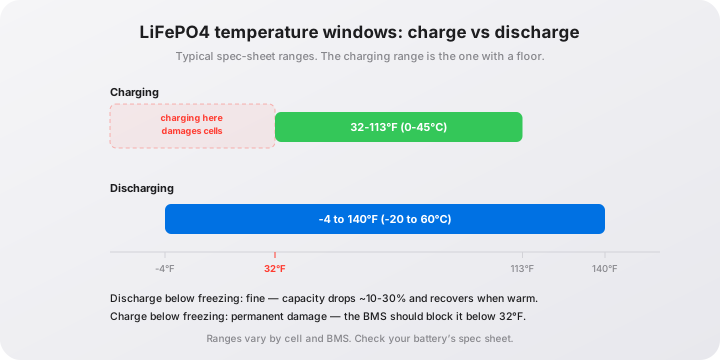
You can discharge a LiFePO4 battery below freezing. You must never charge one there.
Discharging in the cold is harmless. You get less energy out, and the capacity comes back when the pack warms up. Charging in the cold is the opposite: it damages the cells permanently, with no alarm, no error code, and no visible sign that anything happened. A cabin system that took a full winter of cold-morning charging can lose a fifth of its capacity, and nobody notices until the following summer, when the system mysteriously stops making it through the night.
This guide covers that asymmetry: why it exists, how to tell whether your battery is protected, and the four setups that let you charge safely through a cold winter — at a cabin, in an unheated garage, or off-grid.
The Rule: Discharge Yes, Charge No
The standard LiFePO4 temperature specification is easy to find once you know what to look for. It splits into two ranges that behave completely differently:
| Condition | Temperature range (typical) | What happens |
|---|---|---|
| Charging | 32°F to 113°F (0-45°C) | Below 32°F, cells are damaged by plating |
| Discharging | -4°F to 140°F (-20-60°C) | Below freezing is fine; expect less usable capacity |
| Storage | -4°F to 95°F (-20-35°C) | Store cool and dry, at a partial state of charge |
Read the asymmetry out loud once and it becomes the easiest rule in battery ownership: the floor exists for charging, not for use. A LiFePO4 bank powering a cabin through a January night at 10°F is working exactly as designed. The same bank being asked to accept charge from solar panels at 10°F the next morning is being damaged.
Ranges vary slightly by cell and BMS manufacturer — some datasheets say 0-50°C charge or -30°C discharge — so check your own spec sheet. But no reputable LiFePO4 cell allows charging below 0°C/32°F, and any seller who claims otherwise is not worth buying from.
Temperature Limits Side by Side: Not All Chemistries Agree
This is where a lot of bad habits come from. Lead-acid batteries — the technology that ran off-grid systems for fifty years — behave differently, so people who grew up around flooded batteries assume cold charging is normal. It was, for that chemistry. It is not for lithium.
| Chemistry | Safe charge range | Safe discharge range | Cold-charging behavior |
|---|---|---|---|
| LiFePO4 | 32-113°F (0-45°C) | -4 to 140°F (-20-60°C) | Cannot charge below freezing — permanent plating damage |
| NMC / li-ion | 32-113°F (0-45°C) | -4 to 140°F (-20-60°C) | Same rule; EV packs use active heating and cooling |
| Lead-acid (flooded/AGM) | Charges below freezing (with temperature-compensated charging) | Down to about -4°F (-20°C) | Tolerates cold charging; capacity drops sharply in cold |
| LTO (lithium titanate) | Down to about -22°F (-30°C) | Down to about -22°F (-30°C) | The cold-weather outlier; rare and expensive |
Two practical takeaways. First, if you are comparing chemistries for a cold-climate build, the charge range matters more than the discharge range — a battery that discharges to -22°F but cannot charge below freezing will still spend winter unable to refill itself. Second, the lead-acid comparison explains why so much inherited off-grid advice is wrong for your system: it was written for a chemistry that forgives what LiFePO4 does not.
Why Charging Below Freezing Damages the Cells
The mechanism is worth understanding, because it explains why the damage is silent and cumulative.
Charging a lithium battery is a physical insertion process: lithium ions leave the cathode, swim through the electrolyte, and slot themselves into the layered structure of the graphite anode — a process called intercalation. Think of a parking garage where cars slide into tightly stacked spaces.
Cold thickens the electrolyte and slows the ions down. Below freezing, the slowdown is severe enough that ions arriving at the anode cannot slot into the graphite fast enough, so they do something else instead: they deposit as metallic lithium on the anode surface. That is plating.
Plated lithium causes three problems, in escalating order:
- Capacity loss. Metallic lithium sitting on the surface is no longer cycling, so usable capacity drops. Some of it can slowly re-incorporate over time; much of it cannot. The loss is permanent.
- Resistance and heat. Plated lithium increases internal resistance, which makes the cell run hotter during both charge and discharge — accelerating its own aging.
- Dendrites and shorts. In severe cases, lithium deposits grow as needle-like dendrites that can pierce the separator between anode and cathode, creating an internal short circuit. This is the failure path that leads to thermal events. It is rare in well-designed packs, but it is the reason plating is treated as a safety issue and not just a wear issue.
Two variables control the severity: temperature and charge current. A trickle at 30°F is a fraction as damaging as a 50-amp bulk charge at 5°F. That is also why the damage varies so much between setups — the solar array charging a cold pack at 2 amps all December is a slow bleed, while a big inverter/charger pushing full current into a frozen bank is a fast one.
And the cruelest property of all: there is no immediate symptom. The BMS does not report it, the voltage looks normal, and the capacity loss only surfaces months later. By then, the winter is unrecoverable.
What Cold Costs You When Discharging (Nothing Permanent)
The discharge side of the ledger is much friendlier. Cold does not damage a LiFePO4 cell on discharge; it just makes it stingier.
| Pack temperature | Charge accepted? | Usable capacity vs 77°F (25°C) |
|---|---|---|
| 77°F / 25°C | Yes | 100% (rated) |
| 50°F / 10°C | Yes | ~95% |
| 32°F / 0°C | Borderline — most BMS block charge until above freezing | ~85-90% |
| 14°F / -10°C | No | ~70-80% |
| -4°F / -20°C | No | ~60-70%, near the discharge cut-off |
These figures are approximate and vary by cell, load, and BMS — treat them as planning ranges, not specs. Two practical consequences:
Winter outages draw deeper than summer ones. A bank that comfortably covers your critical loads in July may fall 20-30% short in January with the same loads — and if you are off-grid, winter also cuts your recharge rates, since the same cold that reduces capacity also reduces what solar can put back. This is exactly why off-grid systems are designed around the worst month, not the average one; see how many batteries to power a house for the sizing math.
Voltage sags under load. Higher internal resistance in the cold means terminal voltage dips further when a heavy load kicks in — a well pump or furnace blower starting up can pull the pack below an inverter’s low-voltage cut-off even when the state of charge is fine. If your inverter trips on a cold morning and works again by noon, this is often why. The off-grid system design guide covers how to size around that behavior.
What Your BMS Is (or Should Be) Doing
Battery management systems in quality LiFePO4 packs watch cell temperature with the same thermistor network they use for voltage and current, and they apply a simple rule: no charge current below roughly 32°F, resume around 41°F (5°C). Some units cut in slightly above freezing for margin; the hysteresis is deliberate, so the pack does not chatter on and off right at the threshold.
If your system does this, you will see it on a cold, bright morning: the solar charge controller reports full voltage from the array but zero amps flowing into the battery. Owners regularly email me convinced their controller has failed, because the panels are clearly making power and the battery is clearly below 50%. Almost always, the answer is that the BMS is refusing the charge and doing its job perfectly. Nothing to fix; the amps return when the pack warms.
The real danger is the other kind of battery — the budget units whose datasheets never mention a charge temperature range at all. If the spec sheet does not list low-temperature charging protection, assume it does not have it, and treat any cold-weather charging as something you must control manually. When shopping, look for an explicit charge range of 32°F (0°C) and up, or wording like low-temperature cutoff or low-temperature protection on the datasheet. LiFePO4 batteries with a documented low-temperature cutoff cost very little more than the unprotected kind, and they are the difference between a managed winter and an expensive mystery.
One more nuance: the temperature the BMS reads is the cell temperature, and cells can lag air temperature by hours in a large bank. A shed that climbed to 40°F by noon may still hold cells at 33°F. If you are charging manually, give big packs extra time to soak up warmth before trusting them.
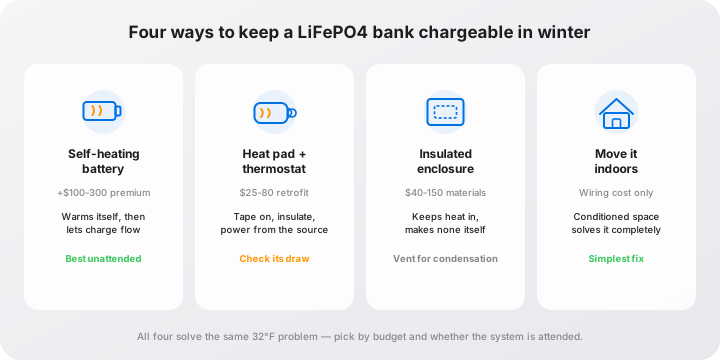
Four Ways to Charge Safely Through Winter
Everything below solves the same problem — get the cells above freezing before charge current flows. They differ in cost, in whether the system is attended, and in what powers the heat.
| Approach | How it works | Typical cost | Best for | Watch out for |
|---|---|---|---|---|
| Self-heating battery | Internal heater pads warm cells to a safe charging temperature automatically | +$100-300 premium over non-heated | Unattended off-grid and solar systems | Heater runs on charge-source power; check its wattage draw |
| Heat pad + thermostat | External 12/24V silicone pad taped to the bank, covered with insulation | $25-80 | Retrofitting an existing bank | Needs a power source; heat only when charging |
| Insulated enclosure | Slows heat loss so the bank holds whatever warmth it makes | $40-150 in materials | Sheds, garages, RV compartments | Insulation generates no heat by itself |
| Move the bank indoors | Conditioned space keeps cells far above freezing year-round | Wiring labor | Grid-charged home backup systems | Not possible at most remote off-grid sites |
Self-heating batteries are the only option that works with zero attention. A thermostat wakes heater pads when the pack drops near freezing, warms the cells to a safe charging temperature, and only then lets charge current flow — the whole sequence happens inside the battery. They cost a modest premium, and they are what I would specify for any unattended cabin or off-grid system in a cold climate. Self-heating LiFePO4 batteries are worth the extra money precisely because the failure they prevent is invisible.
Heat pads with a thermostat are the budget retrofit. A silicone pad wrapped around or taped to the side of the cells, a thermostat set to switch on near freezing, and a layer of foam board over the top will keep a small bank chargeable through most winters. Wire the pad to the charge source side where you can — grid or generator — so the heat is not being paid for out of the energy you are trying to store. Running a 30-watt pad off the battery itself is workable, but it is a real daily load: 720 watt-hours a day if it ran continuously. A thermostatically controlled battery heat pad draws only when needed, which is most of the difference.
Insulation is a multiplier, not a solution. A foam-board enclosure around the bank slows heat loss dramatically, which means pads run less and small amounts of self-heating (charging and discharging both warm cells slightly) accumulate instead of bleeding away. It matters most in the shoulder season, when a sunny afternoon can lift a well-insulated enclosure above freezing while an open rack stays cold. Just keep vents or a breather path for condensation — sealed, damp enclosures invite corrosion on terminals and BMS boards.
And the option nobody sells you: put the bank where the problem does not exist. A conditioned basement or utility room never drops below 50-60°F, which is squarely in the safe charging range all winter. Home battery backup systems like the ones compared in this roundup of Powerwall alternatives handle this for you — their manufacturers specify operating temperatures and build in heating as needed. The parallel path for batteries you assemble yourself is simply to site them indoors whenever the building has a conditioned corner to spare.
Winter Storage: Rules for a Bank You Are Not Using
A battery you are not using this winter still has one job: sit at a partial state of charge, somewhere cool, and hold it. The rules are short.
- Store at 30-50% state of charge. A mid-range charge is the least stressful resting state for the cells. Full is unnecessary; empty is risky.
- Disconnect the loads. A BMS draws a small standby current, and over months that draw can push a low pack below its over-discharge protection — and a deeply over-discharged pack may not recover at all.
- Cool and dry beats warm and damp. Freezing storage does not destroy a LiFePO4 battery (it is cold charging that does the damage), but a conditioned garage or basement will hold it closer to its rated capacity when you return it to service.
- Check every 2-3 months. Self-discharge runs about 1-3% per month. If the pack has fallen below 20%, top it back toward 50% — and only charge after it has warmed above freezing.
- Charge once before spring service. One full charge when ambient temperatures allow, then a capacity check with a battery monitor and shunt, tells you whether winter did any damage while you were not looking.
For a backup bank that stays connected all winter — the sump pump setup in this guide or a home battery serving critical loads — none of this applies directly, because a conditioned location solves the whole problem. It is the unheated outbuilding installations that need the planning.
The Bottom Line
Cold-weather battery care reduces to a short list:
- Discharge in the cold, never charge in the cold. The 32°F charge cutoff is the one rule that matters.
- Verify your BMS has low-temperature charge protection. If the datasheet does not say so explicitly, assume it does not.
- Expect less capacity, not less battery. Cold discharge is temporary; only cold charging does permanent damage.
- Heat costs less than it seems. A $50 pad and thermostat, a foam enclosure, or a corner of the basement keeps cells chargeable through the worst months.
- The damage is invisible until it is expensive. A capacity check each spring is the only way to catch a winter of bad charging before next winter arrives.
If your battery sits in an unheated shed and gets solar-charged on cold mornings, fix it before the first hard freeze — that setup is the one that pays the price, and it pays it silently.
Frequently Asked Questions
Can you charge a LiFePO4 battery below freezing?
No. LiFePO4 cells must not be charged below 32°F (0°C). Charging in freezing temperatures forces lithium to plate as metal on the anode surface instead of storing inside the graphite, and that damage is permanent. Most quality batteries include a BMS low-temperature cutoff that simply blocks charging until the pack warms up, typically allowing charge again around 41°F (5°C). The battery is not broken when this happens — it is protecting itself, and charging resumes on its own once the cells are warm enough.
What happens if you accidentally charge a lithium battery below 32°F?
The cells suffer lithium plating: metallic lithium deposits on the anode instead of inserting into it. The immediate symptoms are none, which is what makes the mistake so expensive. Over weeks and months you see reduced capacity, higher internal resistance and cell imbalance, and in severe cases internal short circuits. The colder it is and the higher the charge current, the faster it happens. One brief low-current charge just below freezing is far less damaging than repeatedly fast-charging a cold pack, but there is no truly safe amount: keep charge current at zero until the pack is above freezing.
Do all LiFePO4 batteries have low-temperature charging protection?
No, and this is the trap in the budget segment. Quality LiFePO4 batteries list it clearly in the spec sheet, usually as a charge temperature range of 32°F to 113°F (0-45°C), sometimes with an explicit low-temperature cutoff figure. Plenty of cheap no-name units omit it entirely. Check the datasheet and manual before you buy; if the charge temperature range is missing or vague, assume there is no protection, and never leave a charger connected unattended in freezing conditions.
Can I use a LiFePO4 battery in freezing weather?
Yes. Discharging is a different story from charging. LiFePO4 discharge is typically rated down to -4°F (-20°C), and many premium batteries go to -22°F (-30°C). You will get less energy out in the cold: expect roughly 10% less usable capacity at freezing, 20-30% less at 14°F (-10°C), and more voltage sag under heavy loads. None of that is permanent — capacity recovers as the pack warms. The one rule is to let a cold battery warm above freezing before you recharge it.
How do I keep a LiFePO4 battery bank warm enough to charge in winter?
Four approaches, in order of how well they work. Self-heating batteries have built-in heater pads that warm the cells to a safe charging temperature automatically — best for unattended off-grid systems. External heat pads with a thermostat are a cheap retrofit ($25-80) but must be powered; the cleanest setups run them from the grid or generator side, not from the battery itself. An insulated enclosure slows heat loss and keeps what little heat the system makes, but generates none. And the simplest fix of all: move the bank into a conditioned space, where the problem never exists.