Off-Grid Battery System Cost: Real Numbers for Cutting the Cord in 2026
Most people planning an off-grid system start in the wrong place. They shop for batteries. They compare a 48V 100Ah unit against a server-rack battery, find a number that feels affordable, and then discover in January that the system cannot start their well pump.
The battery is not the starting point. The load is. Every decision in an off-grid system — bank size, inverter size, array size, and whether you need a generator at all — falls out of one number: how many kilowatt-hours the house actually consumes per day in its worst month, not its best.
This guide follows the order a system actually gets designed: load audit, bank sizing, inverter selection, recharge sources, then cost. If you are still deciding whether you need off-grid at all, the comparison against grid-tied battery backup is the more useful starting point — most people who think they want off-grid actually want a battery that stays connected to the grid.
What Off-Grid Really Means (And What It Does Not)
The word gets used loosely, so let us be precise about three different systems that people confuse.
| System | Grid connection | Runs when grid fails | Typical use |
|---|---|---|---|
| Grid-tied, no battery | Yes | No — shuts down for safety | Solar only, lowest cost |
| Grid-tied with battery | Yes | Yes, until the battery empties | Backup power, time-of-use shifting |
| Off-grid | No | Always — there is no grid | Remote property, cabin, deliberate independence |
Off-grid means you are the utility. There is no fallback when you under-size the system, no neighbor’s transformer to borrow from, and no meter to tell you that you have been consuming more than you produce. That is why the load audit is not a formality — it is the entire design.
One more distinction worth making up front: going off-grid to save money almost never works. A grid connection, where one exists, costs a few thousand dollars and delivers unlimited energy. A comparable off-grid system costs an order of magnitude more and needs maintenance forever. People go off-grid because the grid is not there, or because they want independence — not because it is cheaper.
Step 1: The Load Audit That Decides Everything
You need three numbers: daily consumption in kWh, peak simultaneous load in watts, and the largest motor start-up surge in watts.
Start with the daily figure. Use actual appliance nameplate watts and realistic run hours — not a worst-case guess, and not the marketing figure from an appliance brochure.
| Load | Typical draw | Hours/day | Daily kWh |
|---|---|---|---|
| Refrigerator (modern, Energy Star) | 100-150W average | 24 (cycling) | 1.0-1.5 |
| Chest freezer | 60-100W average | 24 (cycling) | 0.8-1.2 |
| LED lights, whole house | 40-80W | 5 | 0.3-0.4 |
| Well pump (1/2 hp, 240V) | 800-1,100W | 1-2 | 1.0-2.2 |
| Laptop + router + modem | 60-100W | 24 | 0.5-0.8 |
| Washing machine (cold wash) | 500W | 1 | 0.5 |
| Microwave | 1,200W | 0.3 | 0.4 |
| Water heater (electric, 2 people) | 4,500W | 1-2 | 4.5-9.0 |
| Space heating (resistive) | 1,500W | 4-8 | 6.0-12.0 |
Two entries in that table dominate everything: electric water heating and resistive space heating. If you are designing an off-grid house from scratch, the single highest-leverage decision is to eliminate both — propane or solar thermal for hot water, wood or propane for heat. A house that heats water and space with electricity needs a system three to five times larger than the same house using propane, and that difference shows up directly in the battery bill.
Add 10% to the total for phantom loads and inverter losses on the DC side, then add the inverter’s idle draw as a separate daily figure (more on that below — it is the most commonly forgotten load in the entire design).
Peak load is what sizes the inverter. Add up everything that could plausibly run at once, then check your largest motor. A well pump with a locked-rotor surge of 3-5 times its running watts is the usual culprit; air conditioners and compressors are close behind.
Step 2: Sizing the Battery Bank
Here is the formula that matters, and it is worth writing down:
Usable kWh = Daily kWh × Autonomy Days Nameplate kWh = Usable kWh ÷ Depth of Discharge
Depth of discharge (DoD) is where chemistry choices become arithmetic. LiFePO4 tolerates routine 80% discharge without meaningful cycle-life penalty. Flooded lead-acid and AGM want to stay above 50%. That difference alone doubles the battery you have to buy if you choose lead-acid.
A worked example, for a small off-grid home:
- Daily consumption: 12 kWh
- Autonomy: 2 days (no sun, no generator)
- Chemistry: LiFePO4 at 80% DoD
- Nameplate needed: 12 × 2 ÷ 0.8 = 30 kWh
- At 48V: 30,000 ÷ 48 = 625Ah
That means roughly six 48V 100Ah LiFePO4 batteries in parallel, or two large server-rack batteries around 300Ah each. Both approaches are common; the parallel-100Ah route is easier to expand incrementally, while fewer, larger units mean less wiring and fewer interconnects to torque.
The 48V figure is not arbitrary. For whole-home off-grid, 48V is the practical standard because it keeps DC currents manageable — 6,000W at 48V draws 125A, versus 500A at 12V, which would require absurdly thick cable. Higher voltage also lets a single BMS and single charge controller cover more capacity.
How much battery you need for various ambitions is covered in more depth in the whole-house battery sizing walkthrough — the key overlap is that a critical-loads design and a true off-grid design start from the same load audit, but off-grid multiplies the result by autonomy days because there is no grid to fall back on.
Step 3: Sizing the Inverter (Where Systems Quietly Fail)
The inverter has to satisfy two numbers: continuous output above your peak simultaneous load, and a surge rating above your largest motor’s start-up draw. A 6kW inverter that runs your lights, fridge and router perfectly may still trip on a well pump that pulls 30A for two seconds at start-up.
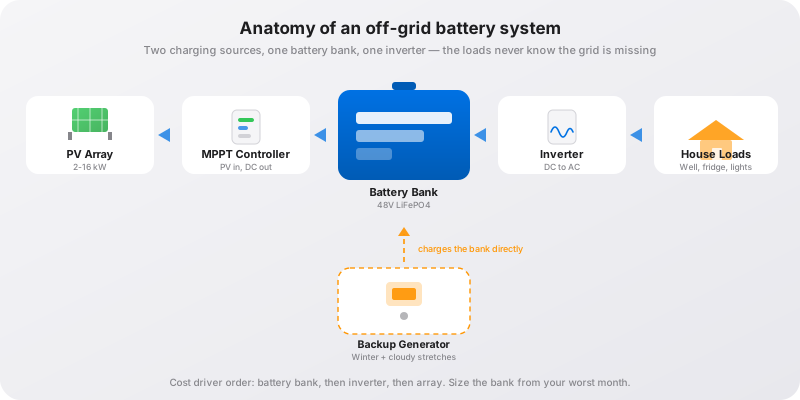
There is a second limit most buyers never see on the spec sheet: the battery’s discharge rate. A single 48V 100Ah LiFePO4 battery holds about 5 kWh, but its BMS typically limits continuous discharge to roughly 100A — around 5kW. Ask that battery to feed an 8kW inverter at full load and the BMS will shut the system down, no matter what the inverter claims.
| Inverter size | Continuous output | Typical surge | Minimum battery for full output |
|---|---|---|---|
| 3-4 kW | 3,000-4,000W | 6-8 kW peak | 1 × 48V 100Ah (5 kWh) |
| 6 kW | 6,000W | 12 kW peak | 2 × 48V 100Ah in parallel |
| 8 kW | 8,000W | 16 kW peak | 2-3 × 48V 100Ah, or 1 × 48V 300Ah |
| 12-15 kW (dual units) | 12,000-15,000W | 24-30 kW peak | 3-4 × 48V 100Ah, or 2 × 48V 300Ah |
The idle draw trap. Inverters consume power just by being on. A transformer-based 8kW unit can idle at 40-90W — that is 1.0-2.2 kWh per day, every day, whether or not anything is plugged in. On a 12 kWh/day budget, you have just spent up to 18% of your generation on nothing. High-frequency inverters typically idle lower (15-30W) but tolerate surge less gracefully. Check the idle figure before you buy; it is frequently buried in the manual rather than the datasheet.
Step 4: Recharge — Array, Generator, or Both
Off-grid systems need a charging path sized for the worst month, not the average one.
The sizing formula: Array kW = Daily kWh ÷ (Peak Sun Hours × 0.75), where 0.75 accounts for controller, wiring, and battery round-trip losses.
For 12 kWh/day at a site with 5 peak sun hours in summer: 12 ÷ (5 × 0.75) = 3.2 kW. That same site in December, with 2 peak sun hours, needs 12 ÷ (2 × 0.75) = 8 kW to break even. This is why almost every serious off-grid home has a generator: chasing December with array alone means buying an array more than twice as large for equipment that sits idle half the year.
An MPPT charge controller converts array voltage to battery voltage. Size it to the array’s output current, and — importantly — respect its maximum PV input voltage, which is what actually destroys controllers. Panels produce higher voltage in cold weather, and a string that sits comfortably at 140V in July can exceed a 150V controller’s limit in January. Always leave voltage headroom.
What It Costs: Three Real System Tiers
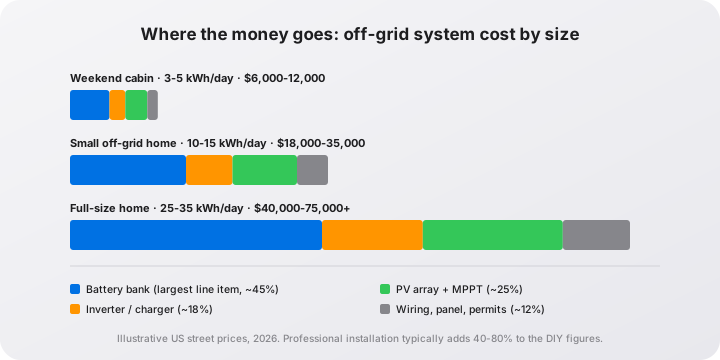
Figures below are illustrative 2026 US street prices for hardware, self-assembled. Professional installation typically adds 40-80% — and off-grid work is specialized enough that not every electrician will quote it.
| Tier | Daily use | Battery bank | Inverter | Array | Hardware total |
|---|---|---|---|---|---|
| Weekend cabin | 3-5 kWh | 10-15 kWh LiFePO4 | 3-4 kW | 2-3 kW | $6,000-12,000 |
| Small off-grid home | 10-15 kWh | 25-35 kWh LiFePO4 | 6-8 kW | 6-8 kW | $18,000-35,000 |
| Full-size home | 25-35 kWh | 40-60 kWh LiFePO4 | 12-15 kW | 12-16 kW | $40,000-75,000+ |
Component prices worth anchoring on, so you can sanity-check any quote:
- 48V 100Ah LiFePO4 battery (about 5 kWh): roughly $1,200-1,600 street price, or $240-320 per kWh
- 48V 300Ah server-rack battery (about 15 kWh): roughly $3,000-4,000
- MPPT charge controller (150V/60A class): roughly $400-650
- Off-grid inverter/charger, 6kW class: roughly $1,500-3,000
- Solar panels: roughly $0.30-0.70 per watt for modules, before racking and wiring
- Backup generator, 7-10kW portable: roughly $1,200-2,500
Notice the shape of the spend: batteries are 40-50% of the total. That is exactly why the load audit and the autonomy decision matter more than hunting for a deal on panels. Shaving one autonomy day off a small home saves more money than any other single choice available to you.
Battery Chemistry: The Off-Grid Comparison
| Flooded lead-acid | AGM | LiFePO4 | NMC | |
|---|---|---|---|---|
| Usable DoD | 50% | 50% | 80-90% | 80-90% |
| Cycles at that DoD | 500-1,200 | 500-1,000 | 3,000-6,000 | 1,000-2,500 |
| Maintenance | Watering, equalizing | None | None | None |
| Ventilation needed | Yes — hydrogen | Less | No | No |
| Charge below 0°C | Yes | Yes | No — needs heating or cutoff | No |
| Cold-weather capacity loss | Moderate | Moderate | Moderate | Higher |
| Fire risk | Low | Low | Low | Higher — thermal runaway |
| Cost per usable kWh over life | Highest | High | Lowest | Middle |
For stationary off-grid storage, LiFePO4 has become the default for good reasons: usable depth, cycle life, no watering, no hydrogen venting, and steady pricing. NMC’s higher energy density buys you nothing in a shed-mounted battery, while its thermal-runaway behavior is a genuine liability in a system you may not be able to service quickly.
The one place lead-acid still has a case is a very cold, infrequently used cabin where the battery can stay at a partial state of charge for months — or where you need the absolute lowest purchase price this month and have accepted you will replace the bank in 4-5 years.
If your goal is backup rather than true independence, the comparison shifts toward packaged wall-mounted systems — we covered that trade-off in the Powerwall alternatives breakdown, and the battery vs generator decision is worth reading before you commit either way. For a transfer-switch-based hybrid, the transfer switch selection guide covers the hardware side.
The Mistakes I See Most Often
1. Charging LiFePO4 below freezing. This is the number one killer of off-grid banks in cold climates. Charging a lithium battery below 0°C causes lithium plating on the anode; the damage is permanent, cumulative, and it shows up as capacity loss months later. Discharging in the cold is fine — charging is not. Solutions: a self-heating LiFePO4 battery, a low-temperature charge cutoff built into the BMS (most modern units have it — verify it before buying), or keeping the bank in a conditioned space. A battery in an unheated shed in Minnesota needs a heater.
2. Designing on summer sun hours. A system that balances beautifully in July runs a deficit from November through February. Design the array and autonomy for the worst month and accept that you will have surplus in summer.
3. Ignoring inverter idle draw. Forty to ninety watts of idle draw is 1-2 kWh every day. Scaled across a year that is 365-730 kWh of your own generation spent on nothing.
4. Overloading a single battery’s BMS. Parallel batteries share current. One 48V 100Ah unit behind an 8kW inverter will trip its own protection long before the inverter reaches rated output. Plan for at least 2-3 units behind anything in the 8kW class.
5. Mixing old and new batteries. Adding a fresh battery alongside three-year-old cells makes the new one carry the group and degrades it to match the old ones. If you plan to expand, buy the whole bank at once or accept the loss.
6. Skipping the permitting conversation. Off-grid installations still fall under electrical code, and some jurisdictions have specific requirements for systems without a utility interconnect. Unpermitted work complicates insurance, resale, and any future inspection.
The Bottom Line
An off-grid battery system is a load-matching problem disguised as a shopping decision. Do the audit, design on the worst month, size the bank for autonomy at the chemistry’s real depth of discharge, and make sure the inverter’s continuous rating, surge rating, and the battery’s discharge limit all line up. Add a generator as your winter insurance rather than treating it as a defeat.
If you take one number away from this article, take the spend split: the battery bank is roughly half the cost, and the two decisions that determine how much battery you need — how much you consume, and how many days you want to ride out — cost nothing to change at the design stage and thousands to fix afterward.
Recommendations based on field experience maintaining battery systems and backup power infrastructure in critical facilities. Prices are illustrative US street ranges as of September 2026 and vary substantially by brand, region, and quantity.
Frequently Asked Questions
How much does an off-grid battery system cost?
Three rough tiers based on daily consumption, using 2026 US street prices. A weekend cabin using 3-5 kWh/day runs about $6,000-12,000 in hardware if you assemble it yourself, or $10,000-20,000 installed. A small off-grid home using 10-15 kWh/day runs $18,000-35,000 in hardware, $25,000-50,000 installed. A full-size home using 25-35 kWh/day runs $40,000-75,000+ in hardware, and well over $75,000 installed with a standby generator. The battery bank is the single largest line item at roughly 40-50% of the total, which is why sizing the bank correctly matters more than shopping for deals on panels.
How many batteries do I need to go off-grid?
Work backwards from your daily consumption in the worst month, then add autonomy days. Example: 12 kWh/day with 2 days of autonomy, on LiFePO4 running to 80% depth of discharge, means you need 12 x 2 / 0.8 = 30 kWh of nameplate capacity. At 48V that is 30,000 / 48 = 625Ah, or about six 48V 100Ah batteries wired in parallel. Two things are easy to miss: inverter idle draw adds 1-2 kWh/day that never appears in your appliance audit, and systems in cold climates should be sized for the winter sun hours (2-3 per day), not the summer figure.
Can I run an off-grid system without solar panels?
Yes, but it changes the economics completely. A battery-only off-grid system is charged by a generator, which means you are buying every kilowatt-hour twice - once as fuel, once as battery wear. A typical 7kW generator burns roughly 0.6-1.0 gallons per hour at half load, so recharging a 15 kWh bank costs several dollars in fuel per day plus maintenance. It works as a design for a rarely used cabin, or as the winter backup for a solar system, but running a permanent home that way is usually more expensive than a grid connection.
Is LiFePO4 or lead-acid better for off-grid storage?
LiFePO4 wins on almost every measure that matters off-grid. Lead-acid (flooded or AGM) can only be discharged to about 50% regularly without wrecking cycle life, so you must buy roughly twice the nameplate capacity to get the same usable energy. Lead-acid lasts 500-1,200 cycles; LiFePO4 typically manages 3,000-6,000 cycles. Lead-acid also needs watering, ventilation, and equalization charging. The one advantage lead-acid still holds is the lower purchase price for the first battery - but on cost per usable kilowatt-hour over the system's life, LiFePO4 is usually cheaper. The one LiFePO4 rule you cannot break: it cannot be charged below freezing without a heated battery or low-temperature cutoff.
Why does my off-grid system run out of power in winter?
Three reasons stack up at the same time. Solar production collapses - a location with 5 peak sun hours in July may get 2 in December, less than half the array output. Loads rise, because heating and more time indoors push consumption up 30-60%. And battery capacity falls, since LiFePO4 loses usable capacity in the cold. A system designed on summer numbers will fail by January. The fix is to design on the worst month, add a backup generator for extended cloudy stretches, and keep the battery bank in a conditioned space rather than an unheated shed.