Off-Grid Inverter Sizing: How to Choose the Right Inverter in 2026
Most off-grid systems do not fail dramatically. They fail one quiet Friday night at a time: the well pump kicks on and the inverter drops into overload, the freezer alarm sounds after a long hot afternoon, or the lights cut out at 60 percent battery because the bank was asked for more current than its BMS would allow.
The inverter sits at the center of all three of those stories. It is also the component most often bought last - by price, from a marketplace listing, the same week the panels arrive. This guide puts the decisions back in order: size the inverter from your loads and your battery’s limits first, choose the right product class second, and compare spec sheets only after that.
If you are still pricing out the whole system, start with the off-grid battery system cost breakdown. This article goes one level deeper into the part that decides whether the system actually runs.
The Short Answer
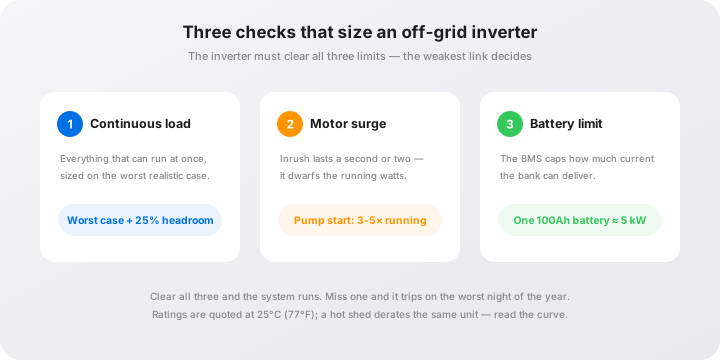
Rule of thumb for a 48V LiFePO4 system. Every number below is earned by the three checks in this article, but as a sanity check:
| System | Daily use | Inverter class | Minimum battery |
|---|---|---|---|
| Weekend cabin, small backup | 3-5 kWh | 3-4 kW | 1 x 48V 100Ah |
| Small off-grid home | 10-15 kWh | 6 kW | 2 x 48V 100Ah, or 1 x 300Ah rack |
| Full-size off-grid home | 25-35 kWh | 12-15 kW (stacked) | 3-4 x 48V 100Ah, or 2 x 300Ah |
Two notes before the detail. These are starting points for planning, not a substitute for your own load math - a house with an electric water heater or central air conditioning breaks every line in that table. And the inverter is not the only thing being sized here: each line also implies a minimum battery bank, because the battery’s discharge limit can quietly cap a system long before the inverter’s rating does.
What Size Inverter Do You Actually Need?
Size the inverter with two numbers, not one:
- Continuous watts - the worst realistic case of everything running at the same time, plus headroom.
- Surge watts - the largest motor’s start-up inrush, which lasts a second or two and dwarfs everything else on the list.
Most buyers size on running watts alone, and that is why so many off-grid inverters complain the moment a pump starts.
| Load | Typical running watts | Start-up surge | Surge multiple |
|---|---|---|---|
| Well pump (1/2-1 hp, 240V) | 500-1,100W | 1,500-5,500W | 3-5x |
| Refrigerator / freezer compressor | 100-150W | 300-500W | ~3x |
| Furnace blower | 300-800W | 900-2,400W | ~3x |
| Central air conditioning (per ton) | 1,000-1,500W | 3,000-4,500W | ~3x |
| Air compressor | 1,000-1,500W | 4,000-7,500W | 4-6x |
| Microwave | 1,000-1,500W | ~2x briefly | 2x |
| Circular saw | 1,200-1,800W | 2,400-5,400W | 2-3x |
Ranges are typical - check nameplates, and for motors look for locked-rotor amps (LRA), which is the honest worst case. A well pump is usually the single hardest load in a house to start, and it is also the load most off-grid households cannot do without. It is the same inrush problem that makes sump pump battery backup systems unforgiving to size: the motor does not care what the inverter costs, only whether the current is there for two seconds.
A worked example. Take a small off-grid home using around 12 kWh per day. The worst realistic simultaneous case:
- Base loads running: fridge 150W + freezer 100W + lights 80W + router and modem 30W = 360W
- Well pump running: +900W
- Microwave at the same time: +1,200W
- Total: about 2,460W
Add 25 percent headroom, and the continuous requirement lands around 3.1 kW - inside the 3-4 kW class. Now the surge number: the pump’s start-up draw runs 3,000-4,500W for a second or two, possibly while the fridge compressor is also kicking on. Any inverter whose surge rating has real duration behind it will cover that; a unit whose peak spec carries no duration is a coin flip.
So why does the short-answer table say 6 kW for a home this size? Two practical reasons:
- Heat. Inverter ratings are quoted at 25°C (77°F). In a shed that reaches 40°C on a summer afternoon, many units derate - sometimes by 20 percent or more - and a unit that runs hot ages faster. The derating curve is in the manual, not the listing.
- Growth. A freezer, a second pump, a workshop tool, or a guest cabin all arrive later. The step from the 4 kW class to the 6 kW class costs a few hundred dollars; replacing the unit costs a few thousand.
This is why off-grid designers talk in classes rather than single numbers - 3-4 kW for a cabin, 6 kW for a small home, 12-15 kW stacked for a full-size house - and why the arithmetic alone tends to come in one step below the final answer. If a pump surge is the only thing between you and the smaller class, a soft starter can cut the start-up surge by half or more, often for less than the price difference between inverter sizes.
Pure Sine Wave vs Modified Sine Wave
Every inverter produces alternating current, but not the same shape of it. The two options on the market are pure sine wave and modified sine wave, and the difference is not marketing - it is the waveform your appliances actually see.
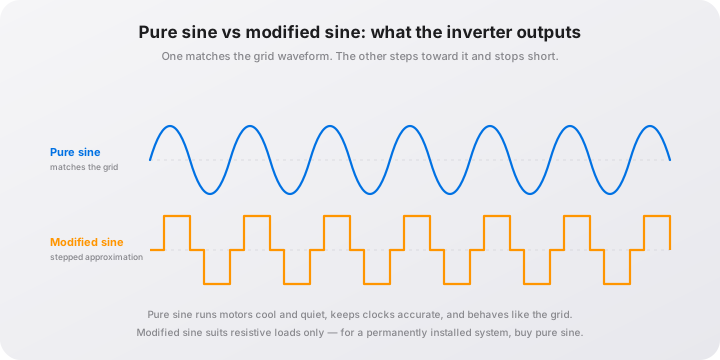
A pure sine wave tracks utility power within a few percent of distortion. Motors run cool and quiet, digital clocks keep time, and electronics behave the way they would on the grid. A modified sine wave - sometimes called a modified square wave - approximates the sine with a stepped, flat-topped waveform that works fine for simple resistive loads and progressively worse for everything else:
| Load type | Examples | On modified sine |
|---|---|---|
| Resistive heating | Space heater, kettle, incandescent lamps | Fine |
| Electronics with universal supplies | Laptops, phones, routers | Usually fine, occasionally buzzy |
| Motor-driven appliances | Fridge, freezer, well pump, furnace blower | Runs hotter, louder, less efficiently |
| Timing and control devices | Microwaves, coffee makers, clocks | Timers drift, controls misbehave |
| Sensitive and protected circuits | Laser printers, audio gear, GFCI-protected outlets, medical devices | May overheat, nuisance-trip, or refuse to run |
The problem with modified sine is that its losses are quiet ones. A motor on a stepped waveform draws more current and runs hotter; it may work for years instead of failing obviously, which makes the damage easy to miss until it shows up as a burned-out compressor. Sensitive electronics are less graceful - the classic complaints are laser printers that overheat, clocks that run minutes fast per day, and GFCI devices that trip for no findable reason.
For a permanently installed off-grid system in 2026, the argument is settled: buy a pure sine wave inverter. The price gap that justified modified sine a decade ago has narrowed to the point where, for anything feeding a house, pure sine is simply the correct spec. The one case where modified sine still makes sense is a temporary or budget setup running nothing but resistive loads - a job-site heater, a shed light - where longevity and efficiency do not matter.
Inverter vs Inverter/Charger vs Hybrid
Three classes of product get called an off-grid inverter, and picking the wrong class is the most expensive mistake in this article.
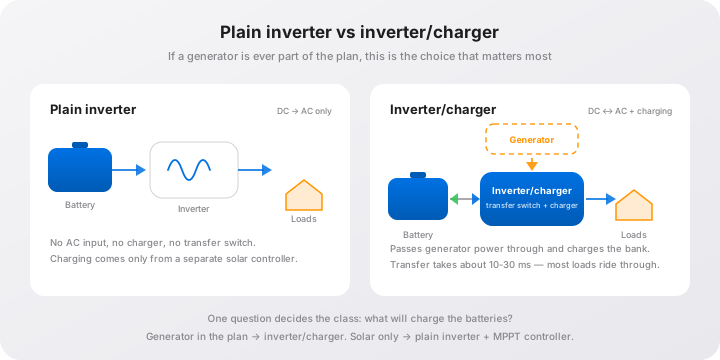
Plain inverter. Converts DC to AC and nothing else. No AC input, no battery charger, no transfer switch. It fits systems where solar is the only charging source and the charge controller handles that job - a small cabin, a shed, a portable kit. The trap: a plain inverter cannot charge from a generator, and it cannot pass generator power through to the house.
Inverter/charger. The workhorse of serious off-grid systems that include a generator. It inverts DC to AC when the batteries are supplying the house; when the generator runs, it passes that power through and simultaneously charges the bank - typical charge rates run 30-120A at 48V depending on the model. A built-in automatic transfer switch changes between the two sources in about 10-30 milliseconds, fast enough that most loads ride through. A 6 kW-class inverter/charger typically runs about $1,500-3,000 in 2026.
All-in-one hybrid. Adds solar MPPT charge controllers into the same box, and often programmable source priority - solar first, battery second, generator last. Convenient for new builds and monitoring; the caution is to check the solar input specifications against your array, because a hybrid that caps at 150V PV input cannot take the same strings as one that accepts 500V.
The decision that matters happens before shopping: will a generator ever be part of this system? If yes - and for most full-time off-grid homes the answer should be yes, even if it is only for winter - then the inverter needs a charger and a transfer switch built in. Adding generator charging later means replacing the inverter, not adding an accessory. The battery vs generator trade-off is worth reading before committing to either path.
Matching the Inverter to the Battery (the Limit Nobody Mentions)
An inverter can only deliver what the battery is willing to give, and modern lithium batteries enforce that limit electronically. A typical 48V 100Ah LiFePO4 unit holds about 5 kWh, but its battery management system (BMS) usually caps continuous discharge at around 100A - roughly 5 kW, minus inverter losses. Ask one battery to feed a 6 kW inverter at full load and the BMS will disconnect the system at around 5 kW, no matter what the spec sheet promised.
| Inverter class | DC current at 48V, full load | Minimum 48V 100Ah batteries |
|---|---|---|
| 3 kW | ~70A | 1 |
| 6 kW | ~140A | 2 |
| 8 kW | ~185A | 2-3 |
| 12 kW (stacked) | ~280A | 3-4 |
The current figures assume about 90 percent conversion efficiency and full load; in practice nobody runs at full load all day, but the limit is a limit. Brief surge bursts are a different story - BMS units tolerate short overcurrent during motor starts - but any load you expect to run for minutes at a time must fit inside the continuous discharge limit. When two batteries share a load, they share the current, which is why the answer to a big inverter is more battery, not a bigger cable.
The DC side gets decided here too: fuses and breakers are sized to the cable and the full-load current, not to marketing watts, and parallel battery strings need to stay within the count the manufacturer allows. Typical 48V 100Ah LiFePO4 batteries permit four or more units in parallel. The full walkthrough of bank sizing for a whole house lives in the battery bank sizing guide.
Specs Worth Paying For - and What to Ignore
Once sizing is settled, the spec sheet decides quality. What is actually worth money:
- Low idle draw. Inverters consume power just by being on - 40-90W for some transformer-based units, 15-30W for good high-frequency models. The gap between a 90W and a 20W idle is about 1.7 kWh per day, which on a 10-15 kWh budget is 10 to 17 percent of everything you generate. This is the most underrated spec in the category.
- Adjustable charge settings. Voltage setpoints and charge current you can tune for LiFePO4 (or whatever chemistry you run). Non-adjustable chargers overcharge or undercharge, and lithium does not forgive sloppiness.
- Generator support. Two-wire auto-start and a charger sized to the bank. If the generator cannot refill the bank in a reasonable number of run-hours, winter will be miserable.
- Split-phase or stacking. Most US homes have 240V loads - a well pump, a water heater, a dryer. A single 120V inverter cannot feed those; you need a 120/240V unit or two stackable units. Check this before you buy, not after.
- A surge rating with a duration. A real datasheet says something like twice rated output for five seconds. A marketplace listing that says 12,000W peak and nothing else is telling you nothing.
- A recognized listing. UL or ETL, with the standard named. Permanent house wiring with an unlisted inverter is a code and insurance problem.
What to ignore: peak watt claims with no duration, app features you will not use, and the temptation to buy three sizes up for a future that may never arrive. One step of headroom, as covered above, is the sweet spot - add capacity when the load actually shows up. Inverter lines stack, so growth is usually possible later within the same family.
The Mistakes I See Most Often
1. Modified sine to save eighty dollars. Then the microwave control board dies, the fridge compressor complains, and the replacement bill dwarfs the savings. Buy pure sine.
2. Sizing on running watts only. The pump starts, the lights blink, the inverter screams overload. Surge is the number that matters in any house with a motor in it.
3. One battery behind a big inverter. The BMS trips at around 5 kW and the owner blames the inverter. Count batteries against the discharge limit, not just against energy.
4. Buying a car inverter for a house. The 12V plug-in units sold for vehicles have different duty cycles and no hardwiring provisions. They are not off-grid inverters.
5. Mounting in a hot shed or an insulated attic. Electronics derate in heat and condensate in cold. Dry, shaded, ventilated, and as close to the battery as practical.
6. Forgetting 240V. A 120V-only inverter cannot run a standard US well pump or water heater. Plan split-phase from the start.
7. No charger in a generator system. The generator runs, the house works, and the batteries still die, because nothing in the chain can charge them. This is the mistake behind most sad first winters.
What Off-Grid Inverters Cost (2026)
Illustrative US street prices as of September 2026 - treat them as ranges, not quotes:
| Class | Typical size | Illustrative price |
|---|---|---|
| Modified sine, basic | 1-2 kW | $80-200 (skip for any permanent system) |
| Pure sine, budget brands | 2-4 kW | $200-450 |
| Pure sine, established brands | 3-6 kW | $500-1,200 |
| Inverter/charger, 48V | 3 kW | $700-1,500 |
| Inverter/charger, 48V | 6 kW | $1,500-3,000 |
| Inverter/charger, 48V | 12 kW (stacked) | $3,000-6,000 |
| All-in-one hybrid with MPPT | 6 kW | $1,500-3,500 |
The inverter is rarely the largest line in an off-grid build - the battery bank is, at around half the total - but it is the component that decides whether every other dollar gets used. The full cost picture across three system sizes is in the off-grid battery system cost breakdown, and if the goal is backup rather than independence, the packaged battery systems comparison is the better starting point.
The Bottom Line
Off-grid inverter selection is three questions wearing a spec sheet: how much runs at once, how hard the biggest motor starts, and how much current the battery will actually deliver. Clear all three with margin, buy the class that matches your charging plan - a plain inverter for solar-only, an inverter/charger the moment a generator enters the picture - and insist on pure sine for anything permanent. Take one step of headroom rather than three, and read the derating curve before believing any rating.
Do that, and the inverter becomes what it should be: the boring box in the corner that makes everything else work.
Recommendations based on field experience maintaining battery systems and backup power infrastructure in critical facilities. Prices are illustrative US street ranges as of September 2026 and vary substantially by brand, region, and quantity.
Frequently Asked Questions
What size inverter do I need for off-grid?
Two numbers decide it. First, add up everything that can plausibly run at the same time and add 25 percent headroom - that is your continuous requirement. Second, find the largest motor start-up surge (a well pump is usually the offender at 3-5 times its running watts) and make sure the inverter surge rating clears it. For scale: a weekend cabin typically lands in the 3-4 kW class, a small off-grid home around 6 kW, and a full-size home 12-15 kW using stacked units. Then check the battery side, because a 6 kW inverter needs at least two 48V 100Ah batteries - a single unit's BMS will not deliver the current.
What is the difference between pure sine wave and modified sine wave?
Pure sine wave output matches the shape of utility power within a few percent, so motors run cool and quiet, clocks keep time, and electronics behave normally. Modified sine wave approximates the sine with a stepped waveform that works for simple resistive loads like space heaters, but makes motors run hotter, can upset timing devices and electronics, and is behind a lot of nuisance GFCI trips. For a permanently installed system, pure sine is the correct choice - the price difference is no longer significant enough to justify anything else.
Why does my inverter shut off when the well pump starts?
Almost always a surge problem, sometimes a battery problem wearing a surge costume. Well pump start-up draw runs 3-5 times the running watts for a second or two, and inverter overload protection trips if the surge rating cannot cover it. Check the inverter surge spec against the pump's locked-rotor amps first. If the inverter is adequate, suspect the battery: a single 48V 100Ah unit's BMS typically caps continuous discharge at 100A, which is around 5 kW, and a pump start on top of other loads can hit that ceiling. Fixes include a soft starter for the pump, a second battery in parallel, or an inverter with a higher surge rating.
Can an off-grid inverter charge my batteries?
A plain inverter cannot. Charging is a separate function: with solar only, the charge controller handles it. If you want to charge from a generator, you need an inverter/charger, which contains a battery charger plus an automatic transfer switch - it passes generator power through to the house and charges the bank at the same time, typically 30-120A at 48V depending on the model. This is the most common upgrade regret in off-grid systems: buying a plain inverter and discovering that a generator cannot feed it.
How many batteries does a 6 kW inverter need?
With 48V 100Ah LiFePO4 units, plan on two at minimum. Each unit's BMS typically limits continuous discharge to around 100A, and 6 kW at 48V pulls roughly 140A at full load - one battery would disconnect the system at about 5 kW before the inverter ever reached its rating. Above 8 kW, plan for two to three units for daily full-load use, and three to four for a 12 kW-class system. Brief surge bursts are a different story - BMS units tolerate short overcurrent for motor starts - but sustained loads must stay inside the discharge limit.