Electric Sauna Heater Electrical Requirements: Breaker Size, Wire Size, and What a 2026 Hookup Really Costs
The first message came with two photos: an 8-kilowatt sauna heater still in its crate, and a 30-amp dryer receptacle on the far side of a finished wall. The homeowner had a plan. He would buy an adapter cord, plug the heater into the dryer outlet, and run the cable through the wall himself.
Every part of that plan was wrong, and none of it was his fault. Nothing on the heater’s box told him that 8 kW at 240 volts is 33.3 amps, that a dryer circuit is 30, that the cable he bought was only rated for 30, or that plastic-sheathed cable has no business inside a room that runs at 90 degrees Celsius.
Sauna electrical work is one of the few residential jobs where the expensive mistakes are all made before anyone opens a panel. This guide is the pre-purchase conversation: what the heater draws, which cable is legal where, how much of the decision the nameplate makes for you, and what the work costs in 2026.
Three Heaters Sold Under One Name
“Sauna heater” covers three products with almost nothing in common electrically.
| Type | Typical power | Voltage | Connection | What it does |
|---|---|---|---|---|
| Traditional electric (rocks) | 3–10.5 kW | 240V single-phase | Hardwired, dedicated circuit | Heats the room air to 70–90°C, water on stones makes steam |
| Infrared | 1.4–2.4 kW | 120V or 240V | Cord and plug, or hardwired | Radiant heat on the body, room stays cooler |
| Wood-burning | None | — | — | Needs a flue, clearances, and a permit, no electrical work |
The traditional electric heater is the one that creates the electrical job. It is a resistive load with a thermostat, a high-limit cutout, and often a contactor, and it runs at full power for the entire heat-up. That heat-up is what sizes the circuit.
An infrared cabin is a different animal. A 1,800-watt infrared unit is 15 amps at 120 volts, which is a dedicated 20-amp circuit most houses already have room for. It heats people, not air. If you are choosing between the two, know that the infrared decision is a comfort decision and the electric sauna decision is a construction decision.
Read the Nameplate Before You Read the Price
The rating plate is usually on the back of the heater or inside the cover over the terminal block. It gives you four numbers that matter: rated voltage, rated power in kilowatts, amperes, and either a minimum circuit ampacity or a maximum fuse or breaker size. Sometimes it gives all of them.
Amperes at 240 volts is simple arithmetic: watts divided by 240.
| Heater | Amps at 240V | Typical breaker | Copper conductor |
|---|---|---|---|
| 3.0 kW | 12.5A | 15–20A | 12 AWG |
| 4.5 kW | 18.75A | 25–30A | 10 AWG |
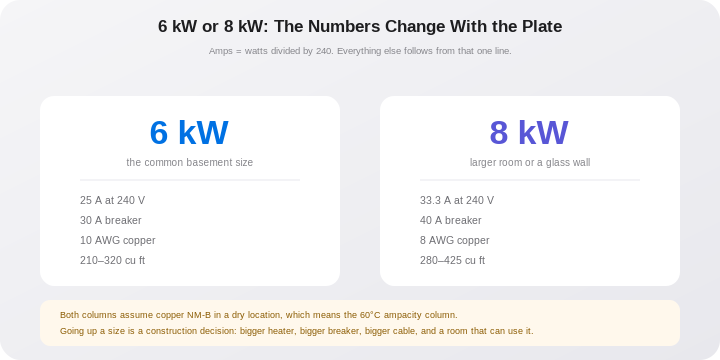
| 6.0 kW | 25A | 30A | 10 AWG |
| 8.0 kW | 33.3A | 40A | 8 AWG |
| 9.0 kW | 37.5A | 45–50A | 8 AWG THHN / 6 AWG NM-B |
| 10.5 kW | 43.75A | 60A | 6 AWG |
Three rules, and they cover most of the failures I get called out to correct.
Never exceed the maximum breaker on the plate. A 6 kW heater on a 50-amp breaker does not heat faster. The elements are fixed resistance and draw what they draw. What you have done is raise the trip threshold above the rating of the smallest conductor in the chain, which is the wiring inside the heater.
Never undersize the conductor to save a trip to the store. A 60-amp breaker on 6 AWG NM-B is a 55-amp cable pretending to be a 60-amp circuit. It works until the terminals at the heater darken and the high-limit starts nuisance-tripping.
Do not assume the biggest number wins. The heater, the breaker, and the wire are a matched set chosen by the manufacturer for a reason. Your job is to reproduce the set, not improve it.
One rule from the water-heater world does not automatically apply here. A storage water heater is a continuous load and gets sized at 125 percent. A residential sauna session is under three hours, so the heater is not a continuous load in the code sense, and 25 amps on a 30-amp breaker is normal and correct. The manufacturer’s table has already done whatever margin the design needs. Do not add your own on top, and do not subtract any.
Wire Size Depends on Which Column You Are In
The same gauge carries different current depending on insulation and installation method. NM-B, the plastic-sheathed cable sold as Romex, is limited to the 60°C column. Conductors in conduit, like THHN or THWN, use the 75°C column.
| Gauge | NM-B (60°C) | THHN/THWN in conduit (75°C) |
|---|---|---|
| 12 AWG | 20A | 25A |
| 10 AWG | 30A | 35A |
| 8 AWG | 40A | 50A |
| 6 AWG | 55A | 65A |
| 4 AWG | 70A | 85A |
This is why two quotes for the same 8 kW heater can specify different wire and both be right. The electrician running conduit can use 8 AWG THHN; the one running cable has to use 8 AWG NM-B, which is 40 amps and lands exactly on the breaker.
Length matters too. A 240-volt circuit at 25 amps over 10 AWG copper loses about 2.6 percent at 100 feet, which is acceptable. Double the distance and you are over 5 percent, and the fix is a larger conductor, not a larger breaker. Past roughly 150 feet, go up one size as a rule rather than calculating every time.
Does a Sauna Heater Need a Neutral?
Usually not, and that is the cleanest difference between a sauna and a hot tub.
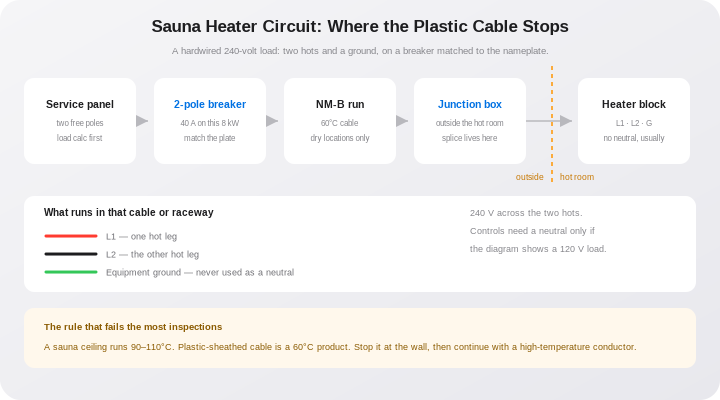
A traditional electric heater is a pure 240-volt load. The elements sit across L1 and L2. The thermostat, the high-limit, and the contactor coil are all line-voltage 240-volt parts. Nothing inside needs 120 volts. So the feed is two hots and a ground: 10/2 or 8/2 cable, or three conductors in conduit.
You need a neutral in three cases:
- The heater has a built-in light or a 120-volt receptacle.
- The heater has a factory control board that runs on 120 volts.
- You are installing a separate control panel that is powered from the heater’s terminal block rather than from its own source.
Buy the cable after you read the wiring diagram, not before. The difference between 8/2 and 8/3 is small at the counter and painful after the wall is closed. And never use the ground as a neutral to make a 120-volt control work. That puts current on the equipment grounding conductor, which is exactly the fault the ground exists to clear.
If you are comparing this to a spa, note that the answer flips. A hot tub almost always needs four wires because its pumps, ozonator, and light are 120-volt loads, which is the single most common cable mistake in hot tub hookups.
The Wire Inside the Hot Room Is Where Inspections Fail
A sauna ceiling runs 90 to 110°C. The air at bench height runs 70 to 85°C. The heater itself is hotter than either.
NM-B is a 60°C cable. Its conductors, its jacket, and its ampacity are all rated for a maximum ambient well below what a sauna does at head height, let alone at the ceiling. Running it through the wall and into the hot room is the mistake I find most often, and it is invisible until someone opens the wall.
The correct pattern is a transition at the boundary:
- Run NM-B from the panel to a junction box on the outside of the hot room, typically in the changing area or an adjacent closet.
- Splice there to a conductor rated for the ambient, either THHN in EMT or liquid-tight flex, or the high-temperature lead that ships with many heaters. Those leads are silicone or fiberglass insulated and are made for exactly this.
- Enter the heater through its knockout with a proper connector and strain relief.
Keep splices out of the hot room. Wire nuts and their plastic shells are not rated for that ambient, and a joint that gets hot and cold a thousand times is a joint that loosens.
Control wiring is its own problem. Many heaters use a low-voltage thermostat or a proprietary bus between the heater and a wall-mounted control panel. That cable has to be separate from the line-voltage conductors, and it has to be rated for the location it passes through. If the control panel is inside the hot room, check its temperature rating before you mount it at eye level.
Sizing the Heater to the Room, Not to the Price
Manufacturers publish a room volume range for each heater. The ranges below are typical of the North American charts and they are worth more than any rule of thumb.
| Heater | Room volume | Typical room |
|---|---|---|
| 3.0 kW | 2–4 m³ (70–140 ft³) | Small cabin, 4×4×7 ft |
| 4.5 kW | 4–6 m³ (140–210 ft³) | 4×5×7 ft |
| 6.0 kW | 6–9 m³ (210–320 ft³) | 4×6×7 ft, the common basement size |
| 8.0 kW | 8–12 m³ (280–425 ft³) | 5×7×7.5 ft |
| 9.0 kW | 10–14 m³ (350–500 ft³) | 6×7×8 ft |
| 10.5 kW | 12–16 m³ (425–565 ft³) | 6×8×8 ft, commercial and large residential |
Two corrections matter more than the table.
Glass and uninsulated surfaces. A full glass door or a glass wall adds roughly 20 to 30 percent to the effective load. So does an uninsulated concrete or log wall. A 6 kW heater sized for a 250-cubic-foot room will not hold temperature in the same room with a glass wall and no insulation.
Ceiling height. Volume is the right metric, but heat stratifies. An eight-foot ceiling in a small footprint puts more hot air above the bathers than the chart assumes.
The failure modes are easy to recognize. An undersized heater runs at full output, never reaches the setpoint, bakes the rocks, and shortens element life. An oversized heater cycles hard, radiates too directly at whoever sits nearest, and costs more in copper than it returns in comfort.
Disconnect, Controls, and the Timer
A permanently connected appliance needs a disconnecting means. For a sauna heater, that usually means a switch or a small disconnect enclosure near the door, or a breaker lock that lets the breaker serve as the disconnect. A lockable breaker is accepted in many jurisdictions for appliances above 300 volt-amperes; ask your inspector which option they want before you rough in.
Why it matters practically: when the heater needs service, someone is going to be leaning over a hot element with a screwdriver. Being able to kill power at the door, in sight of the heater, is the difference between a safe repair and a guess, and it is the reason the first tool out of the bag is a non-contact voltage tester rather than a screwdriver.
Controls come in three flavors. A built-in dial on the heater is cheapest and means walking into a cold room to turn it on. A wall-mounted control panel outside the door is what most people actually want. A timer is required in many commercial and multi-family installations and is optional at home, but it prevents the one failure mode that scares insurers: a heater left on for six hours in an empty house.
Clearances, Rocks, and Airflow: Where Fires Start
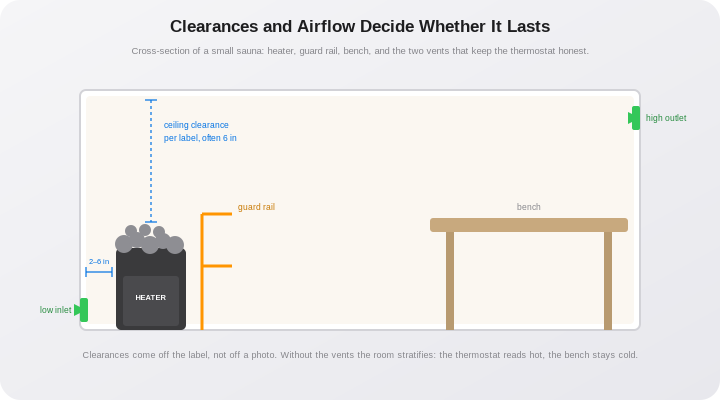
Every heater has a label with minimum clearances to combustibles. They are not suggestions. Cedar, spruce, and aspen are combustible, and they are exactly what a sauna is lined with.
| What | Typical requirement | Why |
|---|---|---|
| Heater to combustible wall | 2–6 in, per label | Radiant heat from the case and the rock pile |
| Heater to bench | Per label, often 6 in or more | Benches are directly above the hot case |
| Heater to ceiling | Per label | Hot air and radiant rise |
| Guard rail | Required when in reach | Case surfaces run above 200°F |
| Floor | Non-combustible or protected | Spilled water and falling stones |
The guard rail is the item homeowners skip and inspectors look for. A heater in the corner of a six-foot room is within arm’s reach of anyone standing up. Manufacturers sell the rail; install it. If you want to check your work after the first heat-up, an infrared thermometer pointed at the wall behind the heater will show you the real surface temperature, which is the number the clearance is protecting.
Rocks are part of the thermal design. Most residential heaters take 40 to 60 pounds of stone, sized 2 to 4 inches, rounded and unbroken. Pack them loosely enough that air can move. Rocks that are too small, or stacked tight, block the convection path through the element chamber, and the high-limit trips because the heater cannot shed heat into the room. Soft river rock that spalls will crack and drop debris onto the elements.
Ventilation is the other half. A typical plan is a low inlet near the heater and a high outlet on the opposite wall, plus a gap under the door. Without it, the room stratifies, the thermostat near the ceiling reads hot while your feet are cold, and the heater cycles off early. Manufacturers publish a vent plan for each model. Follow theirs.
208 Volts: The Apartment and Small-Building Trap
Most houses have 120/240-volt single-phase service. Many apartments, condos, and small commercial buildings have 120/208-volt three-phase service, where two legs give 208 volts rather than 240.
A resistive heater rated at 240 volts delivers its rated wattage only at 240. At 208 volts the power falls with the square of the voltage: 208 divided by 240 is 0.867, squared is 0.751. An 8 kW heater becomes a 6 kW heater. Heat-up time goes up by about a third, and in a cold climate it may never reach the setpoint.
Nothing is broken, which is what makes it confusing. The thermostat works, the elements glow, the breaker holds. The room is just lukewarm. The fix is a 208-volt-rated heater or a larger unit, not a bigger breaker.
Check the service before you buy. A voltage reading at an existing 240-volt receptacle is the fastest test: 240 means single-phase, 208 means the two legs came off a three-phase system.
What It Costs in 2026
Prices below are typical North American ranges for the electrical portion, not the sauna room itself.
| Item | 2026 range |
|---|---|
| Infrared unit, 120V plug-in | $200–600 |
| 4.5 kW heater | $250–600 |
| 6 kW heater | $350–800 |
| 8 kW heater | $600–1,200 |
| 9–10.5 kW heater | $900–1,800 |
| New 240V dedicated circuit, short run | $450–1,000 |
| Long run, finished walls, or exterior conduit | $900–2,500 |
| Disconnect switch or breaker lock | $100–300 |
| External control panel | $150–500 |
| Permit | $75–300 |
| Subpanel to free up space | $500–2,500 |
| 200A service upgrade | $2,500–5,000 |
| Prefab sauna room kit, materials | $3,000–8,000 |
A typical basement job, heater included and a short circuit run, lands between 1,500 and 2,800 dollars. The electrical portion alone is usually 700 to 1,800.
The cost multipliers are the same ones that show up in every dedicated circuit estimate: distance, finished walls, and whether the panel has two free poles. If the panel is full, you are not just buying a circuit, you are buying space for one, and the cheapest way to get it is often a subpanel rather than a service upgrade.
What a Session Actually Costs to Run
An 6 kW heater draws 6 kWh for every hour at full output. A cold room takes 45 to 60 minutes to reach temperature, so heat-up is 4.5 to 6 kWh. A 30-minute session with the thermostat cycling averages roughly half output, so another 1.2 to 1.8 kWh.
Total: about 6 to 7.5 kWh per session, or roughly 1.00 to 1.30 dollars at 17 cents a kilowatt-hour and 1.80 to 2.25 dollars in a high-cost market. Daily use lands around 30 to 45 dollars a month.
Two things move that number more than the heater’s size. Preheating an empty room for an hour costs more than the session. And leaving the heater on between sessions, which some people do in winter, turns a 7 kWh habit into a 40 kWh day.
An infrared cabin uses less power but runs longer, so the per-session cost usually lands in the same range. The heater is not where the money goes; the habit is.
When the Breaker Trips: An Eight-Row Diagnostic Table
| Symptom | Most likely cause | What to do |
|---|---|---|
| Breaker trips instantly, heater off | Wiring fault, damp element, or miswired terminal | Stop. Do not reset twice |
| Trips after 10–20 minutes of heating | Failing element, loose terminal, undersized conductor | Clamp the actual draw, then inspect terminations |
| GFCI trips on first use after weeks idle | Moisture absorbed in the element | Dry-run, then retest; replace if it repeats |
| Heats slowly, never reaches setpoint | 208V supply, undersized heater, blocked airflow | Measure voltage at the heater under load |
| High-limit trips repeatedly | Rocks packed too tight, wrong rock size, no ventilation | Repack stones, check the vent plan |
| Only some elements get hot | Open element, failed contactor, lost leg | Check each element’s resistance and both legs |
| Hot at the ceiling, cold at the bench | Stratification, poor ventilation, undersized unit | Fix airflow before buying a bigger heater |
| Burning smell on first fire | Dust and oil burning off new elements | Normal for 10–15 minutes; stop if it persists |
The one row that deserves emphasis is the GFCI trip after a long idle period. Sauna elements sit in open air and absorb moisture from the humid room. That moisture lowers the insulation resistance and leaks a few milliamps, which is enough to trip a 5 mA GFCI. Running the heater for twenty minutes drives the moisture out and the trip stops. If it comes back on the next session, the element is failing, not the breaker. The same logic, and a much longer list of causes, is covered in GFCI versus AFCI troubleshooting.
Five Questions Before You Buy
- What does the nameplate say for kilowatts, minimum circuit ampacity, and maximum breaker?
- Does the wiring diagram call for a neutral, or is it two hots and a ground?
- What is the room volume, and are the walls insulated, glass, or concrete?
- Is the service 240 or 208 volts, and are there two free poles in the panel?
- Where do the disconnect and the control panel go?
Five answers, five minutes. They decide the cable, the breaker, the heater, and about 80 percent of the price.
What a Good Install Looks Like
- A dedicated two-pole breaker matched to the nameplate, not to what was on the truck.
- A conductor sized for the load and the length, in the right temperature column.
- NM-B stopping outside the hot room, with a proper transition to a high-temperature conductor.
- A disconnect within sight of the heater, or a documented breaker lock.
- Clearances measured with a tape, not estimated.
- A guard rail around any heater within reach.
- Low inlet and high outlet vents per the manufacturer’s plan.
- A permit and an inspection sticker, plus an updated panel schedule.
The panel schedule line matters more than it sounds. In five years, when someone else owns the house and the label says “SAUNA 40A,” they will not have to guess. If your panel is already a mystery, labeling it properly is a twenty-minute job.
When to Stop and Call Someone Else
Some houses cannot take this load without more work than the heater costs.
- A 100-amp service already feeding an electric range, a dryer, a water heater, and central air.
- Aluminum branch-circuit wiring, which needs a documented solution before you add a 40-amp load. See how to identify aluminum wiring.
- A fuse panel, a Federal Pacific Stab-Lok, or a Zinsco panel.
- No free poles and no load calculation, which usually means the conversation is about a panel upgrade rather than a circuit.
- A rental property where you cannot pull a permit.
- Any scorched insulation, warm cover plate, or burning smell that is not the new-element burn-off.
None of these are reasons to abandon the project. They are reasons to price it correctly before you buy the heater.
The Bottom Line
A sauna heater is a simple load installed in a hostile place. The load is resistive and predictable: watts divided by 240, a breaker matched to the plate, a conductor matched to the breaker. The hostile place is what people underestimate, because a room at 90 degrees will destroy cable, connections, and clearances that would be perfectly fine anywhere else in the house.
Read the plate. Match the set. Keep the plastic cable out of the hot room. Give the heater air and give yourself a rail. Do those four things and the electrical part of a sauna is one of the more honest jobs in the trade: it either works exactly as specified, or it tells you immediately that something is wrong.
Frequently Asked Questions
What size breaker does an electric sauna heater need?
It depends on the nameplate, and the nameplate always wins. At 240 volts the arithmetic is watts divided by 240: a 6 kW heater draws 25 amps and typically sits on a 30-amp breaker with 10 AWG copper, an 8 kW heater draws 33.3 amps and wants a 40-amp breaker with 8 AWG, a 9 kW unit draws 37.5 amps and usually wants 45 to 50 amps, and a 10.5 kW unit draws 43.75 amps on a 60-amp breaker with 6 AWG. Follow the minimum circuit ampacity and the maximum breaker size printed in the manual. Never install a breaker larger than the maximum the heater is listed for, and never size the wire below the minimum.
Can I plug a sauna heater into a dryer outlet?
No. A dryer receptacle is a 30-amp, 120/240-volt outlet intended for a cord-and-plug appliance in a laundry room. An 8 kW sauna heater draws 33.3 amps, which is already past a 30-amp circuit, and most heaters have to be hardwired because they have no cord and no plug. You would also be running a fixed heater through an outlet with no disconnect at the heater and no strain relief, in a different room from the appliance. The right answer is a dedicated two-pole circuit of the size on the nameplate, with a disconnect within sight of the heater.
Does a sauna heater need a neutral wire?
Most do not. A Finnish-style electric sauna heater is a pure 240-volt resistive load: the elements connect across the two hot legs and there is nothing inside that runs on 120 volts, so the feed is two hots plus an equipment ground. You need a neutral only if the heater or its control system uses 120-volt control, a built-in light, or a separate control panel fed from the heater's terminal block. That distinction is the opposite of a hot tub, which almost always needs four wires because its pumps, ozone generator, and light are 120-volt. Read the wiring diagram in the manual before you buy the cable.
Does a sauna heater need GFCI protection?
Not always by code, but often by instruction. A hardwired 240-volt heater is not a receptacle, so the general dwelling-unit receptacle rules do not automatically reach it, and many sauna heaters are installed without a GFCI. Some jurisdictions require GFCI protection for equipment in damp locations, and some heater manuals call for it, so ask your inspector before you buy the breaker. A two-pole GFCI breaker costs roughly 90 to 180 dollars more than a standard one. Expect occasional nuisance trips on a heater that sits unused for weeks, because the element absorbs moisture from the air and leaks a small current until it dries out.
How much does it cost to wire a sauna heater in 2026?
A new dedicated 240-volt circuit for a heater in or next to the sauna room typically runs 450 to 1,000 dollars, and 900 to 2,500 dollars once the run is long, the walls are finished, or the cable has to go outside in conduit. Add 150 to 500 dollars for a disconnect and an external control panel, and 75 to 300 dollars for the permit. The heater itself is 250 to 600 dollars for a 4.5 kW unit, 350 to 800 for 6 kW, 600 to 1,200 for 8 kW, and 900 to 1,800 for a 9 to 10.5 kW commercial-size unit. A prefab sauna room kit is a separate 3,000 to 8,000 dollars in materials.