Sump Pump Battery Backup: Keep Your Basement Dry When the Power Goes Out
Here is the pattern I have seen too many times: the storm comes. The rain is heavy. The power lines go down. And the sump pump — the one machine in the house whose entire job is to handle exactly this situation — sits silent in the pit, its float switch submerged, doing nothing.
The water rises. The basement floods. And someone spends the next week ripping out carpet and running dehumidifiers, wondering why nobody told them about battery backups.
I am telling you now. A sump pump battery backup is not a nice-to-have. If your basement has ever taken water, or could take water, it belongs on the short list of non-negotiable home infrastructure — right next to smoke detectors and a main water shut-off valve you can actually reach.
Why a Battery Backup Is Different from a Generator Plan
A generator transfer switch powers the sump pump along with everything else — but only after you start the generator. If the outage happens at 3 AM during a downpour, or you are away from home, or the generator is buried behind a snowdrift, you have a gap. Sometimes a gap of minutes. Sometimes hours.
A battery backup system fills that gap automatically. It does not wait for you. It does not need fuel. It does not care whether you are home or three states away.
The ideal setup is both layers — battery backup for the immediate response, generator for extended outages beyond the battery’s runtime. But if you can only do one this year, do the battery backup first. It runs unattended. The generator does not.
Three Types of Sump Pump Battery Backup
Not all battery backup setups are the same. Here is what is actually on the market and what each one costs you:
| Type | How It Works | Unit Cost | Battery Cost | Total | Best For |
|---|---|---|---|---|---|
| DC backup pump kit | Separate 12V DC pump sits above the primary pump; kicks in when power fails | $150-400 | $100-250 (deep-cycle marine/RV battery) | $250-650 | Simplest, most common, no inverter needed |
| Inverter + battery bank | Deep-cycle battery runs an inverter that powers your existing AC pump | $200-500 (inverter) + $150-400 (battery bank) | Included in battery bank | $350-900 | Homes where you want to run the primary pump, not a smaller secondary pump |
| Portable power station | Large lithium power station (1,800W+) plugs into pump | $800-1,500 | Built-in | $800-1,500 | Only if you already own one for camping/jobsite use; otherwise overpriced for this one job |
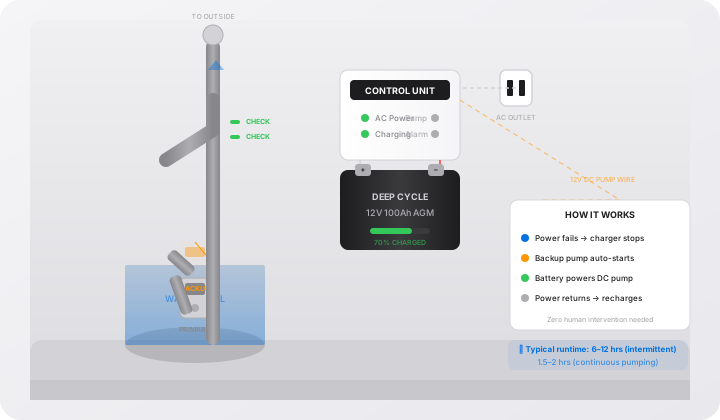
The DC backup pump kit is the most practical choice for most homes. It is self-contained, designed for exactly this purpose, and costs $250-650 depending on the pump quality and battery size. The backup pump sits slightly above the primary pump in the pit — so it only runs when the primary has failed or the water rises past the normal float switch range.
What It Actually Costs (2026 Real Numbers)
| Item | Range | Notes |
|---|---|---|
| DC backup pump kit (pump + charger/controller) | $150-400 | Basement Watchdog, Wayne, Zoeller are the established brands |
| Deep-cycle battery (Group 27, 90-105 Ah) | $100-180 | AGM preferred over flooded — no watering, no fumes |
| Deep-cycle battery (Group 31, 100-130 Ah) | $150-250 | Extra runtime for sumps that cycle frequently |
| Installation labor (if hiring) | $150-400 | 1-2 hours for a plumber or handyman; mostly PVC plumbing and battery hookup |
| Total DIY | $250-650 | Most common range |
| Total installed | $400-1,050 | With pro labor |
The battery is a consumable. Budget a replacement every 3-5 years for lead-acid, or 7-10 years for lithium — though lithium sump pump batteries are still uncommon and expensive ($300-600).
The battery is the most common failure point. People buy a backup system, install it, and then ignore the battery for five years. The first storm finds a battery with corroded terminals, low electrolyte, and 20% of its original capacity. Test it monthly. It takes two minutes: unplug the primary pump, pour a bucket of water into the pit, and watch the backup pump fire.
Sizing: How Much Battery Do You Actually Need?
The most useful number is not amp-hours — it is how many times the pump cycles during a storm. If your sump pump runs for 10 seconds every 3 minutes during heavy rain, that is about 3.3 minutes of actual pumping per hour.
Let me walk through the math for a typical 1/3 HP pump:
| Parameter | Value |
|---|---|
| Pump running current | 8A at 120V = 960W |
| Runtime per cycle | 10 seconds |
| Cycles per hour (heavy rain) | 20 |
| Pumping minutes per hour | 3.3 minutes |
| Watt-hours consumed per hour | 960W × (3.3/60) = 53 Wh |
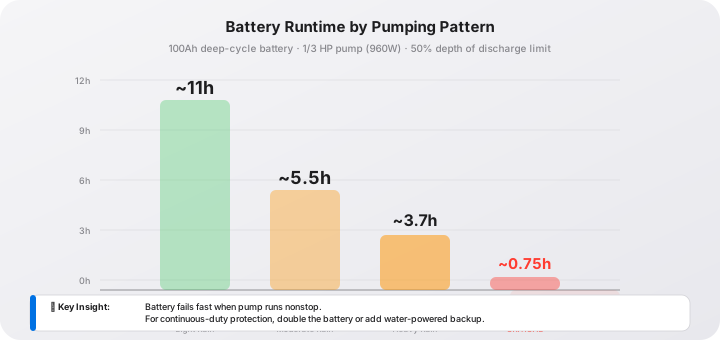
| Runtime from 100 Ah battery (50% usable) | 50 Ah × 12V = 600 Wh → 600 ÷ 53 ≈ 11 hours |
Now compare that to continuous running, which is what happens if the water table rises so fast the pump barely keeps up:
| Scenario | Runtime from 100Ah battery |
|---|---|
| 20 cycles/hour (typical rain) | ~11 hours |
| 60 cycles/hour (heavy downpour) | ~3.7 hours |
| Continuous running (pump overwhelmed) | ~0.75 hours (45 minutes) |
The takeaway: most battery backups fail during the rare severe storm where the pump runs nearly continuously. If your area gets storms that overwhelm sump pumps, size up — two Group 27 batteries in parallel double your continuous runtime to about 1.5 hours and your intermittent runtime to 20+ hours.
Installation: What Is Actually Involved
Installing a DC backup pump kit is a plumbing-and-battery project, not an electrical project. The pump runs on 12V DC from the battery; no AC wiring is involved. Here is the workflow:
- Mount the control unit on the wall near the sump pit. It needs a standard outlet for the trickle charger — the charger maintains the battery, it does not power the pump.
- Place the backup pump in the pit, positioned higher than the primary pump. The float switch for the backup should sit above the primary pump’s activation level. This way the backup only runs when water rises past the point where the primary would normally handle it.
- PVC plumbing. The backup pump connects to the existing discharge pipe with a Y-fitting and a check valve. If both pumps share a discharge line, both need check valves to prevent one from pumping back through the other.
- Connect the battery. The control unit includes ring terminals that bolt to the battery posts. Tighten them properly — loose connections create resistance, heat, and voltage drop, all of which reduce the pump’s ability to start under load.
- Secure the battery. Put it in a battery box ($15-25) if it is a flooded lead-acid type. AGM and lithium batteries do not off-gas and do not require venting, but they still benefit from a box that protects the terminals from accidental contact.
- Test. Unplug the primary pump from the wall. Pour water into the pit. Watch the backup pump cycle. Then plug the primary back in and confirm it resumes normal operation.
The whole job takes about 2 hours for a DIY install. If you are uncomfortable working in a sump pit or cutting PVC, a plumber or handyman handles it in under 2 hours for $150-400.
The charger draws maybe 10-20 watts in maintenance mode — negligible on your electric bill. It is the same power consumption as a router UPS in idle mode.
Water-Powered Backup: The Alternative That Needs No Battery
There is one backup option that sidesteps the battery problem entirely: a water-powered sump pump. It uses municipal water pressure — the same pressure that fills your faucets — to drive a venturi that sucks sump water out and discharges it. No electricity. No battery. No maintenance beyond checking that the float moves freely.
The trade-offs:
| Factor | Battery Backup | Water-Powered |
|---|---|---|
| Runtime | Limited by battery (hours to days) | Unlimited as long as city water flows |
| Cost | $250-650 DIY | $150-400 for the unit + plumbing |
| Installation complexity | Moderate (battery + PVC) | Moderate (needs dedicated water line, backflow preventer) |
| Works on well water? | Yes | No — well pump needs electricity, so it fails with the grid |
| Water usage | None | 1-2 gallons wasted per gallon pumped |
| Pumping rate | 1,500-2,500 GPH (same as primary) | 600-1,200 GPH (slower than primary) |
| Ongoing cost | Battery replacement every 3-5 years | Water bill increase during operation |
Water-powered backups shine in city-water homes with frequent short outages. If your power goes out twice a month for 20 minutes, a battery backup wastes capacity on those short runs while a water-powered unit handles them without touching the battery. But water-powered units pump slower — if your sump pit fills fast, the battery backup moves more water per minute.
The best setup is both: a battery backup as primary defense, and a water-powered unit as the last-resort failsafe that kicks in if the battery drains. This costs $400-1,000 total and covers every failure mode short of a municipal water main break during a blackout during a flood — at which point you have bigger problems.
What Kills a Sump Pump Battery Backup
I have seen battery backup systems fail in the field. Here are the common causes, ranked:
- Dead battery from neglect. The charger is plugged in but the battery terminals look like a science experiment. Corrosion creates enough resistance that the pump cannot draw starting current. Clean the terminals every 3 months with a wire brush and coat them with dielectric grease.
- Float switch stuck. The backup pump’s float gets wedged against the pit wall or tangled in the primary pump’s cord. This is a 30-second fix — physically check it moves freely during monthly tests.
- Discharge check valve failed closed or the Y-fitting clogged with debris. If the pump runs but water does not leave the pit, the problem is in the discharge plumbing, not the pump.
- Battery too cold. Lead-acid batteries lose 30-50% of their capacity at freezing temperatures. If your sump pit is in an unheated crawlspace that drops below 4°C (40°F), use an AGM battery — they handle cold better than flooded — or insulate the battery box.
- Charger failed silently. The control unit thinks it is charging, but the battery voltage tells a different story. Measure with a multimeter: a healthy charged 12V deep-cycle battery reads 12.6-12.8V at rest. Below 12.2V, it is undercharged and your runtime is compromised.
The Sump Pump + UPS Connection
People sometimes ask me whether a regular UPS — the kind that protects a desktop computer — can run a sump pump. The answer is no. A consumer UPS rated for 900W might deliver that for under a minute to a motor load with a 3x startup surge. It is the wrong tool.
What does work: a portable power station with a pure sine wave inverter rated for 1,800W continuous and 3,600W+ surge. The EcoFlow Delta series and Jackery Explorer 2000 models handle sump pump startup surges. But at $800-1,500, you are paying a premium for portability and lithium battery chemistry that you do not need bolted to a sump pit. The dedicated DC backup pump kit at $250-650 is purpose-built and cheaper.
If you already own a large portable power station for camping or a home backup power setup, by all means use it. Run an extension cord, test the surge capability, and monitor the battery level. But do not buy a $1,000 lithium power station just for sump pump duty. That money buys a backup pump kit plus a whole-house surge protector with cash left over.
The Bottom Line
A sump pump without a battery backup is a sump pump that works perfectly until it does not — and it chooses the worst possible moment to stop. The water rising in your basement while your pump sits dead in the pit is the definition of a preventable disaster.
For most homes: a DC backup pump kit with an AGM Group 27 deep-cycle battery. $300-500 total. Test it monthly. Replace the battery every 4-5 years. Sleep through the next storm.
For city-water homes that want zero battery dependency: add a water-powered backup pump. It costs another $200-400 and gives you unlimited runtime as long as the municipal water system is pressurized.
For homes with extended outage risk: combine a battery backup with a generator transfer switch. The battery handles the first hours automatically; the generator takes over for the long haul.
The cheapest sump pump battery backup costs less than the deductible on a flooded-basement insurance claim. The math is not complicated.
Recommendations based on field experience with backup power systems in critical infrastructure environments. Prices and availability current as of August 2026. [Amazon affiliate link - pending tracking ID]
Frequently Asked Questions
How long will a sump pump battery backup run?
Depends on three things: the pump's draw (typically 6-10 amps at 120V), the battery capacity, and how often the pump cycles. A 75-100 Ah deep-cycle battery running a 1/3 HP sump pump that cycles 2-3 times per hour can last 6-12 hours. Continuous running drains it much faster — typically 1-3 hours of nonstop pumping. For reference, a 1/3 HP pump running continuously with a 100 Ah battery + inverter setup will last about 1.5-2 hours. In intermittent use (the realistic scenario), runtime stretches significantly.
What's the difference between a battery backup sump pump and a water-powered backup?
A battery backup system uses a deep-cycle battery and either a DC backup pump or an inverter to run your existing pump. A water-powered backup uses municipal water pressure — no electricity needed at all — to create suction that pulls sump water out through a venturi. Water-powered units have unlimited runtime as long as city water is flowing, but they use 1-2 gallons of municipal water for every gallon of sump water removed and won't work on well water systems. Battery backups are more common and work anywhere.
Can I use a UPS or portable power station to power my sump pump?
No for a standard UPS — sump pump motors have high startup surge (3-7x running current) that trips most consumer UPS units instantly. A portable power station rated for 1,800W+ continuous with 3,600W+ surge can work, but you are looking at $800-1,500 for something like an EcoFlow Delta or Jackery 2000. This is viable if you already own one for other uses. Dedicated battery backup sump pump systems start at $150-300, making them the cheaper purpose-built option.
How do I know what size battery I need for my sump pump?
Start with your pump's nameplate amps. A typical 1/3 HP pump draws 6-10A at 120V (720-1,200W). Multiply by runtime you want: 1,000W × 4 hours = 4,000 watt-hours. Divide by battery voltage: 4,000Wh ÷ 12V = 333Ah. But you never drain a lead-acid battery below 50%, so double that: 666Ah minimum. Realistically, two Group 27 deep-cycle batteries in parallel (each ~90Ah usable, 180Ah total at 12V) gives you roughly 2,160Wh — about 2 hours of continuous pumping or 6-10 hours of intermittent use. Lithium (LiFePO4) batteries are more expensive but allow 90%+ depth of discharge, so you need less rated capacity.
Does a sump pump battery backup need maintenance?
Yes — and neglecting it is why most backup systems fail when needed. Check the battery terminals for corrosion every 3 months. Top off flooded lead-acid batteries with distilled water every 2-3 months (AGM and lithium batteries skip this). Test the system monthly by unplugging the primary pump and pouring water into the pit to trigger the backup. Replace lead-acid batteries every 3-5 years. The battery is the weakest link in every sump pump backup system — treat it like a consumable.