Why Are My Lights Flickering? An Electrician's 20-Minute Diagnostic (2026)
A flickering light is the most ignored warning in a house. People blame the bulb, then the dimmer, then the wiring, then they stop noticing altogether. I have spent more than seven years maintaining power systems where a flicker is never cosmetic - it is the first visible sign that resistance is building somewhere it does not belong, and resistance in a power path becomes heat, and heat at a connection is how houses burn.
The useful thing about flicker is that it is a pattern, not a mystery. Where it happens and what it correlates with narrows nine causes down to one or two in about twenty minutes, using a $20 tester and a $30 multimeter. This is the diagnostic I run in my own house, in the order I run it.
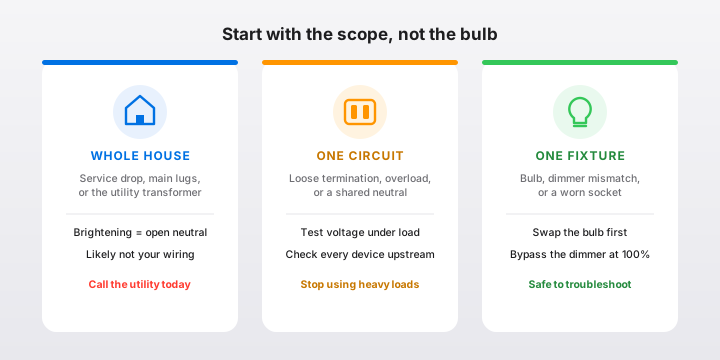
The 30-Second Answer: Scope Before Cause
Before touching anything, answer one question: how much of the house flickers? The answer splits the problem into three families that barely overlap.
| What you see | What it usually means | How urgent |
|---|---|---|
| Every light dims together when a big appliance starts | Voltage dip from motor inrush, or a high-resistance service connection | Watch it; measure if it is pronounced or worsening |
| Lights brighten and dim at the same time, bulbs fail early | Open or intermittent neutral - possibly at the service | Emergency. Call today. |
| Lights on one circuit flicker, rest of house steady | Loose connection on that circuit, overload, or a shared neutral | Schedule an electrician; stop using heavy loads |
| One fixture flickers, others on the same circuit are fine | Bulb, dimmer, socket, or fixture thermal cutout | DIY territory |
| Flicker only at low dimmer settings, or only with certain bulbs | LED and dimmer incompatibility | DIY territory |
| Flicker only in wind, rain, or heat | Service drop, tree contact, moisture in an outdoor device | Report to utility or inspect the outdoor device |
| Flicker plus buzzing, a warm cover plate, or a burnt smell | Loose termination - the fire-risk category | Stop using the circuit now |
That table is the whole article in miniature. Everything below explains how to confirm which row you are in, and what the fix actually costs.
How a Flicker Happens, in One Minute
A lamp does not care about your wiring diagram. It cares about the voltage across its terminals, and that voltage sags whenever current changes and resistance exists.
Two families produce flicker. The first is supply-side: something upstream cannot hold voltage steady when load changes. The second is connection-side: resistance in the path changes, usually because a termination is loose, corroded, or arcing. Supply-side flicker is often benign and house-wide. Connection-side flicker is the one that starts fires, because a loose joint with half an ohm of resistance carrying 10 amps dissipates about 50 watts in a space the size of a thumbnail.
Three numbers make the rest of this diagnosable:
- 120 volts nominal, 114 to 126 acceptable. ANSI C84.1 Range A service voltage. Persistent readings outside that range are a utility conversation.
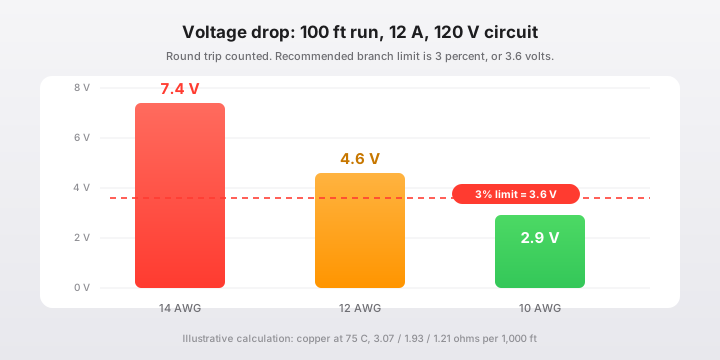
- 3% maximum voltage drop on a branch circuit, 5% total. That is the NEC informational guidance in 210.19(A). Three percent of 120 volts is 3.6 volts - the drop you should tolerate from panel to the farthest outlet, not the drop you should exceed.
- 80% continuous loading. A 15-amp circuit is 1,800 watts on paper and 1,440 watts continuously. A 20-amp circuit is 2,400 and 1,920.
Modern LED bulbs make all of this more visible. An incandescent filament rides through a 5-volt dip without a blink because it has thermal mass. An LED driver is a small power supply with a narrow input window and, in cheap bulbs, very little energy storage. The same dip that an old bulb ignored makes an LED strobe. A flickering LED is therefore not always a lighting problem - sometimes it is the most sensitive voltage monitor in your house, and it is telling the truth.
Cause 1: Loose Connections - the One That Burns Houses
This is the cause I care about most, and the one most guides bury.
A termination loosens for boring reasons: thermal cycling over decades, a backstabbed receptacle where the wire was pushed into a spring clip instead of wrapped around a screw, a wire nut that was never tight, aluminum wire that crept under a steel screw, or a device that was replaced by someone in a hurry. Loose means high resistance. High resistance means voltage drop and heat at the same point, and heat makes the connection looser. The failure feeds itself.
Signatures:
- Flicker confined to one circuit, often worse when a heavier load runs on it
- A receptacle or switch cover that feels warm, or discolored plastic
- A buzz or crackle at a device, especially when the light is on
- A plug that feels loose or falls out under its own weight
- Flicker that changes when you wiggle the plug or press the cover plate
What to do: kill the circuit at the breaker, then check terminations at the devices on that circuit - not just the one that flickers. A loose neutral at an upstream receptacle can flicker every light downstream. Look for backstabbed wires, scorched insulation, and discolored screws. If you find heat damage, replace the device and cut back the wire to clean copper. If the damage is in the panel, stop and call an electrician; panel work is not a first-project job.
Aluminum branch-circuit wiring, common in homes built roughly 1965 to 1973, deserves its own warning. Its terminations are the weak point, and flicker on an aluminum circuit is a reason to have the whole circuit evaluated rather than re-terminated piecemeal. Our guide to identifying aluminum wiring covers the tells and the approved repair methods.
Cause 2: Voltage Drop - the Circuit Is Too Long or Too Thin
A circuit can be perfectly tight and still flicker, because the wire itself is the resistance.
Copper has real resistance: about 3.07 ohms per 1,000 feet for 14-gauge, 1.93 for 12-gauge, 1.21 for 10-gauge, at normal operating temperature. Voltage drop is calculated over the round trip, so the length doubles.
Here is the arithmetic that surprises people. A 100-foot run of 14-gauge wire carrying 12 amps:
2 x 100 ft x 0.00307 ohms/ft x 12 A = 7.4 volts, or 6.1% - double the recommended branch-circuit limit. The lights on that run will dim noticeably every time a motor on it starts, and there is nothing wrong with any individual connection. The circuit was simply designed at the edge.
Long runs to a detached garage, a shed, a dock, or the far end of a big house are the usual suspects. So is a 15-amp circuit feeding a modern kitchen or a home office with a space heater. The fix is larger conductors or a new circuit closer to the load - not a bigger breaker.
Cause 3: The Shared Neutral and the Brightening Lamp
Two 120-volt circuits can legally share one neutral - a multiwire branch circuit - and in that design the neutral carries the difference between the two hots rather than the sum. It works fine until the neutral opens.
When that happens, the two circuits are no longer independent. They become one series circuit across the two 240-volt legs of your service. The loads on each side now divide 240 volts by impedance instead of each receiving 120. The lightly loaded side can see 180, 200, even close to 240 volts. Bulbs flare and pop, power strips and electronics fail, and the damage happens fast.
The signature is unmistakable: lights that get brighter before they flicker, bulbs burning out in clusters, or appliances on two different circuits misbehaving at the same time. If you see it, stop. Turn off the affected circuits at the panel if you can do it safely, and call an electrician or your utility immediately. Do not keep testing to see whether it settles.
A related pattern: flicker that appears only when a specific 240-volt appliance runs (dryer, range, well pump). That can be a marginal shared neutral, a failing breaker, or a utility issue. It needs measurement, not guessing.
Cause 4: The LED and Dimmer Mismatch
This is the most common cause of flicker in homes built or re-lit after 2015, and the least dangerous. Four separate mechanisms produce it:
- A non-dimmable LED on a dimmer. The driver was never designed to be chopped. It flickers, buzzes, or drops out at low settings. Fix: dimmable bulbs.
- Too little load for the dimmer. Many dimmers specify a minimum load around 10 to 25 watts. One 9-watt LED is below that, and the dimmer cannot regulate. Fix: add compatible bulbs, or choose a dimmer rated for low-wattage LED.
- Leading-edge dimmer on an electronic driver. Older TRIAC dimmers cut the waveform in a way that suits incandescent filaments and fights LED drivers. Trailing-edge (ELV) dimmers are the match for electronic loads. Fix: the right dimmer, and the manufacturer’s compatibility list is the only list that counts.
- A failing bulb. Electrolytic capacitors in the driver dry out with heat and age. End-of-life LEDs flicker before they die, often only when warm. Fix: swap the bulb with a known-good one and see whether the flicker follows the bulb or stays with the fixture.
The diagnostic is a swap test, not a meter: move the suspect bulb to a different fixture and put a known-good bulb in the flickering one. If the flicker moves with the bulb, buy bulbs. If it stays, the problem is the dimmer or the fixture.
Our smart home electrical planning guide goes deeper on dimmer load ratings and neutral requirements, because smart dimmers add their own constraints on top of these.
Cause 5: The Fixture Itself
Three fixture-level failures look like wiring problems and are not:
- A loose bulb in a worn socket. The contact is a spring tab; it flattens over time. Kill the circuit, gently bend the tab up, and tighten the bulb. Replace the socket if the shell is cracked or corroded.
- A recessed can hitting its thermal cutout. Insulation packed over the fixture, or a bulb above the fixture’s rating, makes the built-in thermal protector cycle: on, hot, off, cool, on. The light blinks at a slow rhythm, often minutes apart, not at 60 Hz.
- A bad connection inside the fixture or at the wire nuts above it. The splice in the box is the usual culprit. Look for melted wire nuts and scorched insulation.
Outdoor and bathroom fixtures add moisture and corrosion. A flicker that only appears after rain is telling you where water is getting in.
Cause 6: Big Motor Loads Starting
Refrigerators, air conditioners, well pumps, dryers, table saws, and vacuum cleaners all pull an inrush current several times their running current for a fraction of a second. A refrigerator that draws 200 watts while running can pull well over 1,000 watts for a few cycles at startup.
If the lights dip for a heartbeat and recover, that is normal. If the dip is deep enough to reset clocks, blink a TV, or reboot a computer, the system is telling you something: the service is marginal, the connection at the panel or meter is resistive, or the utility transformer is small for the neighborhood. A UPS on the sensitive electronics handles the symptom; an electrician with a recording meter handles the cause. Our breaker triage guide covers the overload side of this in detail.
Cause 7: The Utility Side
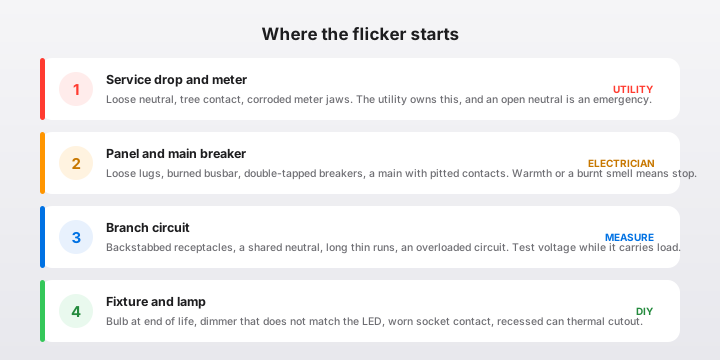
The utility owns everything up to the service point, and that equipment fails too: loose splices at the service drop, corroded meter jaws, failing transformer taps, tree limbs rubbing conductors, and neutral connections that have been quietly degrading for years.
Signs the problem is upstream of your panel:
- Flicker is house-wide and synchronized
- Neighbors describe the same flicker
- It correlates with wind, rain, or heat
- Lights brighten as well as dim
- Voltage measured at a receptacle wanders outside 114 to 126 volts over minutes
Call the utility and describe the pattern in their language: “All the lights in the house brighten and dim together, and I am concerned about a loose neutral at the service.” An open neutral is a priority call for every utility I have dealt with, because it can energize the grounding system and start fires. Do not touch the service drop, the mast, or the meter base. Those are not homeowner repairs.
Cause 8: A Failing Panel or a Known-Problem Panel
Panel-level causes are rarer but carry the highest stakes:
- Burned or pitted busbars where breakers clip on, usually from a loose breaker or a history of overloads
- Double-tapped breakers - two conductors under one terminal not rated for it
- A failing main breaker with pitted contacts
- Known-problem panels such as Federal Pacific Stab-Lok and Zinsco, which have documented histories of failing to trip and of busbar overheating. If you have one, have it evaluated by an electrician who works on them regularly; do not rely on a home inspection report alone.
Panel work is not a diagnostic step for a homeowner. If you find discoloration, a burnt smell, or a breaker that will not sit firmly, close the cover and call. Our guide to panel upgrade costs separates a genuine service upgrade from a box swap, which is useful when someone quotes you one.
The 20-Minute Diagnostic, Step by Step
Do this with the power on only for the measurement steps, and never with the panel cover off unless you are qualified to be in there.
1. Map the scope (2 minutes). Turn on every light in the house. Note which ones flicker. Whole house, one circuit, or one fixture. This single step eliminates most of the list.
2. Correlate with loads (3 minutes). Turn on the dryer, the AC, the microwave, the vacuum - one at a time. If the flicker appears only with a specific appliance, you are looking at voltage drop or a shared-neutral issue rather than a random loose connection.
3. Swap the bulb (2 minutes). Move the suspect bulb to a fixture that behaves, and put a known-good bulb in the suspect fixture. If the flicker moves with the bulb, you are done.
4. Bypass the dimmer (3 minutes). Set it to 100%. If the flicker disappears at full brightness, it is a dimmer or compatibility issue, not house wiring.
5. Test the receptacles (3 minutes). A plug-in circuit tester (about $15 to $25) reports open ground, reversed polarity, open neutral, and reversed hot and neutral in seconds. Test every outlet on the flickering circuit, not just one.
6. Measure voltage under load (5 minutes). With a digital multimeter, read voltage at a receptacle on the circuit with everything off, then again with a 1,500-watt heater or hair dryer running on the same circuit.
| Measurement | Normal | Suspicious |
|---|---|---|
| No-load voltage at receptacle | 114-126 V | Outside that range: call the utility |
| Voltage with a 12-amp load on the circuit | Drop of 1-4 V | Drop of 5 V or more: resistance upstream |
| Voltage at panel vs at the far receptacle | Within 3% | 4% or more: voltage drop or a bad joint |
| Cover plate temperature | Room temperature | Noticeably warm: loose termination |
| Voltage between neutral and ground | Under 2 V | 2 V or more: neutral path problem |
7. Check for heat and smell (2 minutes). Back of the hand near cover plates (not on them), then look for discoloration. A warm plate plus flicker equals a loose connection until proven otherwise.
8. Log it for a week if it is intermittent. Note time, weather, and what was running. Intermittent faults are found by pattern, not by luck.
What the Fixes Cost
Ranges below are typical U.S. residential figures for 2026 and vary by region and access. Treat them as planning numbers, not quotes.
| Fix | Typical cost | Notes |
|---|---|---|
| Diagnostic service call | $75-150 | Often credited toward the repair |
| Receptacle or switch replacement | $150-300 each installed | Part is $3-15; the labor is the cost |
| Dimmer replacement | $150-300 installed | More if a neutral must be pulled |
| New dedicated circuit | $400-1,200 | Depends on run length and panel capacity |
| Repair of a loose service neutral | Utility side usually no charge | Homeowner pays for mast, meter base, or interior work |
| Panel replacement | See our cost breakdown | Only after a real diagnosis |
When It Is an Emergency
Call today, not next week, if any of these are true:
- Lights brighten before they dim, or bulbs pop in clusters
- A burning smell, scorch marks, or discoloration at a device or in the panel
- A cover plate that is hot to the touch
- Flicker accompanied by a shock from an appliance or fixture
- Flicker after water intrusion
- A breaker that will not reset, or a main breaker that hums
Everything else can be scheduled. Flicker alone, with no heat, no smell, and no brightening, is a diagnostic puzzle rather than an emergency - but it is still a puzzle worth solving, because the loose connection that flickers today is the one that arcs next year.
If the flicker is confined to LED fixtures, the fix is usually bulbs and a compatible dimmer. If it is confined to one circuit, it is usually a termination. If it is house-wide, suspect the service and call the utility. Scope first, then cause - that order never fails.
The Bottom Line
Flickering lights are a message about resistance, and the message is readable. Whole-house flicker points upstream to the service or the utility. One-circuit flicker points to a connection, an overload, or a shared neutral. One-fixture flicker points to the bulb, the dimmer, or the socket. Brightening lights are the exception that overrides all of it: that is an open neutral, and it can destroy electronics and start a fire in the time it takes to finish reading this paragraph.
Measure before you replace anything. A $20 tester and a $30 multimeter will tell you more in twenty minutes than a year of swapping bulbs, and they will tell you when the right move is to stop and make a phone call.
Frequently Asked Questions
Why do my lights flicker when the AC or dryer turns on?
Because large motor loads pull a burst of current when they start - typically three to six times their running current for a fraction of a second. That current surge flows through every foot of wire and every connection between the transformer and your panel, and the resulting voltage dip shows up as a brief dim. A small, barely visible dip is normal house behavior. A pronounced dip that dims the whole house, or one that got worse over the years, points to a high-resistance connection at the panel or service, an undersized service, or a utility-side problem. The test is whether the dip is confined to one circuit or visible everywhere.
Are flickering LED lights dangerous?
Usually no. Most LED flicker is a compatibility problem between the bulb, its driver, and the dimmer, or a bulb at the end of its life - annoying, not hazardous. The exceptions are the patterns that come with heat, noise, or brightness changes: a warm cover plate, a buzzing switch, a burning smell, or lights that brighten before they dim. Those point to a loose connection or an open neutral, and an open neutral can put 240 volts across a 120-volt circuit. Treat that combination as an emergency, not a bulb problem.
Why do my lights get brighter before they flicker or burn out?
A brightening light is the signature of an open or intermittent neutral, and it is the one flicker pattern that deserves an immediate call. In a normal 120-volt circuit the neutral carries current back to the panel at close to zero volts. If that neutral opens, two 120-volt circuits can end up in series across the two 240-volt legs of your service. The lightly loaded side then sees far more than 120 volts - bulbs flare, electronics cook, and the damage can happen in seconds. Stop using the affected circuits, do not open the panel, and call an electrician or the utility right away.
Can the power company cause flickering lights?
Yes, and it is more common than most people think. Loose service-drop connections, failing transformer taps, tree branches rubbing a line, and utility-side neutral problems all produce flicker that no amount of work inside your house will fix. The tell is scope: if the whole house flickers in unison, if your neighbors see the same thing, or if it correlates with wind and storms, report it to the utility. Most utilities inspect service equipment at no charge up to the meter, and a reported open neutral gets prioritized because it is a genuine fire and shock hazard.
Do I need a new electrical panel because my lights flicker?
Usually not. A panel replacement is the right answer for a narrow set of findings: a burned or pitted busbar, a known-problem panel such as a Federal Pacific Stab-Lok or Zinsco, water damage, or no capacity left for a load you actually need. Flicker by itself is a diagnostic clue, not a verdict. The honest sequence is to test first - voltage, voltage drop under load, connection temperature, and the scope of the flicker - and only then talk about hardware. Anyone who quotes a panel swap before measuring anything is selling, not diagnosing.